renseignements supplémentaires
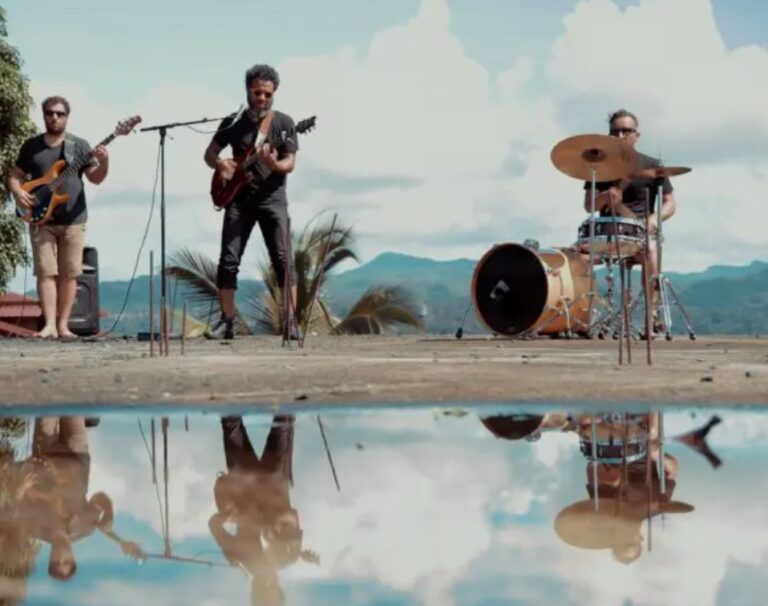
Close to Africa and Madagascar, the deeply mixed archipelago of the Comoros is rich in volcanic and cultural eruptions. Eliasse comes from there and is truly steeped in it, but he also presents himself as a citizen of the world performing with a trio founded in France. With a rock attitude and a globalized aesthetic, Eliasse expresses this tonic blend of different Comorian styles and rhythms and other musical dialects from the Indian Ocean, twarab, mgodro, chigoma… zangoma in short, also the title of his forthcoming album, which he tells us about before taking to the stage at Nuits d’Afrique, this Thursday at Balattou.
PAN M 360: Is this your first time in Montreal?
Eliasse: It’s the first time I’ve come with my own project. I came here in 2005 as a musician, accompanying a Comorian artist called Maalesh.
PAN M 360: As a layman, I can say that the music of the Comoros seems close to that of Madagascar. What do Comorian artists think?
Eliasse: Yes, our music is very similar. Of course, Madagascar has had and still has an influence on the Comoros.
PAN M 360: This region of Madagascar and the Comoros is one of the oldest known territories of inter-racial or intercultural mixing. The ancestry is African, Indian, Asian and Western. It shows in your music!
Eliasse: In any case, we’ve already built our people that way. Very mixed!
PAN M 360: And that obviously produces a music that’s very different from the music of the African continent, to which the Comoros are quite close.
Eliasse: It’s Creole in our own way because everyone came with their own little addition. Inevitably, it gets creolized as we go along. It’s quite different from what’s being created elsewhere.
PAN M 360: Where are you based exactly?
Eliasse: I’m in France, near Bordeaux. I’ve been in France for eight years, for personal and family reasons, not necessarily professional ones. I left the Comoros archipelago when I was 25.
PAN M 360: So you’re coming with a group that’s both Comorian and French?
Eliasse: Yes, the musicians are French, absolutely. The idea is to showcase this musically without doing something traditional. The idea is to show that mix too.
PAN M 360: You’re a mix of genres yourself, and so on. You’re not just defending Comorian music. You’re defending what you’ve become.
Eliasse: Thank you. That’s exactly it. I’m defending what I’ve become and what I’m living now. I think I’ll continue this crossbreeding in a natural way.
PAN M 360: And is this crossbreeding named?
Eliasse: My next album is going to be called Zangoma, the name I give to my style of music. As you may have noticed, we have a great wealth of rhythms, dozens of distinct rhythms. So, we pick and choose from them, make our little songs and people ask me, « What’s your style? » Baco, a singer from Mayotte, had this idea long before me of giving a name to all these people who make this slightly bastardized music by mixing several rhythms.
PAN M 360: What about the Comorian language? What other language is it similar to?
Eliasse: It comes from Swahili. I don’t speak Swahili, but I recognize words, expressions, phrases… I’ll understand a lot of things. That’s where our language comes from, and there’s also Malagasy. In some parts of the Comoros, people speak Kibuchi, a version of Malagasy. All this is mixed into the Comorian language, a sum of dialects. No one speaks exactly the same thing, but everyone understands each other because these dialects are not very far apart.
PAN M 360: Musically, your rhythmic patterns are more elaborate than those of many other cultures. In their construction, your songs are more complex than the average.
Eliasse: I’ll leave that to the experts. Because for me, it’s a very natural thing. I haven’t studied it. We’ll invite a musicologist to come and talk about it! (laughs)
PAN M 360: In any case, your beats are elaborate, even in your songs.
Eliasse: Because I also think that the Comorian people are complex.
PAN M 360: Haha!
Eliasse: Without getting into all the technicalities, that’s what gave me the confidence to say that maybe I could make music. When I was working with an artist from the Comoros, I thought why should he be able to travel? There was something special about him. That ties in with what you’re saying, I think there’s something special about the Comoros too.
PAN M 360: You’ve grown up with it, it’s natural for you. It’s not forced, it’s not manufactured, it’s not a vision of the mind. It’s part of you. And what does your generation bring to the table? For example, you have more rock instrumentation.
Eliasse: Of course, each generation brings its own era and influences. For example, I brought back the electric guitar. It’s not that it didn’t exist, it existed behind the sound. But I’ve brought it to the fore and I’ve taken on this rock side while keeping all these Comorian rhythms and also songs that are a little traditional.
PAN M 360: Guitars are very important in your work, anyway. There are a lot of guitars. Is that the more up-to-date element that comes from your generation? Do the generations that follow use more keyboards, computers, hip-hop-style beatmaking? Less guitar? More electronic?
Eliasse: Yes, there’s a lot of electro and synthesizers like everywhere else. I wouldn’t say it’s not good, it’s just the way it is. It’s just the way it is, and yes, there are a lot of people who compose that way.
PAN M 360: Where do you think your market is?
Eliasse: It’s a project that’s still in development. It’s been in existence for five years as a trio, guitar-bass-drums with some machines and percussion. There are three of us, all singing and playing percussion. Of course, we’re a lot more in France and also the Indian Ocean, since that’s where I come from. We’re also starting to look a bit further afield.
PAN M 360: Since we don’t know anything about the Comorian language, can we know a little about what you sing?
Eliasse: I sing about Comorian society, politics, social problems, human relations, environmental protection, violence and so on. I’m talking about this archipelago that’s very unstable politically but very peaceful, contradictorily. Yes, people witness changes in power but remain calm. And then I don’t really do love songs… At least I don’t do them in a very classic way… Feelings are a bit hidden there.
PAN M 360: So, intimacy isn’t a priority in your lyrics?
Eliasse: No, it’s not. Mind you, I can write a very, very intimate song, but I write it figuratively, without putting myself on stage. I’m already on stage!
AT NUITS D’AFRIQUE, ELIASSE WILL PERFORM THIS THURSDAY, 8:30 PM, AT BALATTOU; INFOS AND TICKETS HERE