The lied as a herald of the human spirit. At the beginning of the 19th century, Schubert astonished the musical world with his short operas of three or a few minutes, his lieder. The emotional breath, sometimes also spiritual and above all romantic (in the sense of a subjective and individual expressiveness of the artist, tending towards an absolute greater than themselves) of these masterpieces would partly define the beating heart of the coming century, later redefined as the century of Romanticism.
At the center of this very beautiful album, then, is a program of lieder, yes by Schubert (of course), but also by composers who benefited from the path left by the master while remaining rather anonymous nowadays: Oberthür, Kalliwoda, Sieber, Lachner.
To set the tone, we are immediately hooked with Auf dem Strom (On the River), D. 943, by Schubert, and its unfulfilled desire, compensated by the barely sketched attainment of an absolute.
Die Heimat by Charles Oberthür (1819-1895), more Schubertian than Schubert himself, in its character of a popular ballad. Then, Johann Wenzel Kalliwoda (1801-1866), so impressive in Die Entführung: in nine minutes, the almost desperate song of a lover whose beloved is compared to an unattainable star. It is a magnificent page by a composer who deserves much better than his general anonymity (he wrote seven symphonies, concertos, and numerous lieder, in a catalogue of around 450 opus numbers). It exudes an expressive power that would not be out of place next to Schubert’s Erlkönig, for instance.
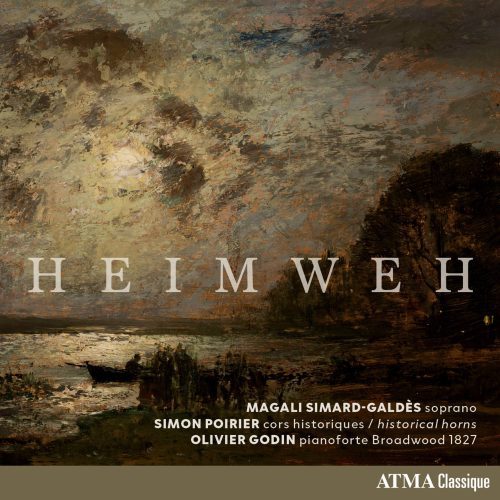
Kalliwoda, always very strong, in the outpourings of another solitary lover, who looks at the celestial vault with envy (the still inaccessible stars) in Nachtlied eines Einsamen (Night Song of a Solitary). We conclude the exploration of Kalliwoda with Heimweh, a tribute to the sweetness of death, camouflaged in an optimistic light carried by the affirmative insistence of the pianoforte, which supports the almost juvenile refrain of the melody.
A captivating drama unfolds during the four minutes of Waldhornruf (The Call of the Hunting Horn) by Vinzenz Lachner (1811-1893), partly made famous for snubbing Wagner, who made him pay for it (the petty, mean little acts of revenge were not things to be scorned by the master of Bayreuth). It tells of a love dream that ends in a double murder! All this in the dynamic of a good-natured peasant dance. Delicious.
Lein und Lust by Ferdinand Sieber (1822-1895) expresses what Stefan Zweig would call The Confusion of Feelings, this mixture of pleasure and emotional pain. Today, more prosaically, one would maybe speak of masochism, or emotional schizophrenia… Nevertheless, in light attire, Sieber creates here another example of a piece fully indebted to the Schubertian style, and does so with great panache.
Two other Schubert pieces on the program: first Herbst (Autumn), with its insistent piano motifs, which betray a pervasive pessimism. « The clouds race by so dark and grey, the stars disappear from the blue sky. »
Die Sterne (stars), steeped in melancholy, is a pure product of Schubert’s last year, burdened by depression and the (probable) intuition of his impending death. Here, once again, the stars as a metaphor, this time of a light that is certainly hopeful, but too weak to truly illuminate life as a whole.
The finale is well chosen: Viola (Violet), D 786, an incomparable masterpiece of over 13 minutes in which flowers, such as snowdrops, roses, tulips, and hyacinths, discuss the secrets of the human soul. Simple yet richly developed beauty of the melody, depth of feelings, and keen acuity of psychological analysis. The main qualities of the album as a whole are brought together.
Magali Simard-Galdès has the embodied timbre of a pleasantly mature voice, used as a natural extension of emotions. In just a few years, the soprano has become one of our most beautiful lyrical interpreter, coupled with an effective communicator.
The ancient horn (several models, including a natural one without valves, as demonstrated in the booklet) makes its strong presence felt thanks to the impeccable playing and especially the sound of Simon Poirier. The instrument embodied, at the time, a kind of cross between nobility and rusticity, a marriage that can of course be closely associated with the music of Schubert and his disciples represented here.
The pianoforte used is a very beautiful Broadwood from 1827, belonging to the Festival Classica. Olivier Godin, a thoughtful, insightful, and ideally in-tune accompanist, plays it beautifully and guides an intimate and relevant dialogue with Simard-Galdès.
Heimweh is an album of delicate shadows and discreet luminosity, which brings to life a captivating, often moving repertoire.