Additional Information
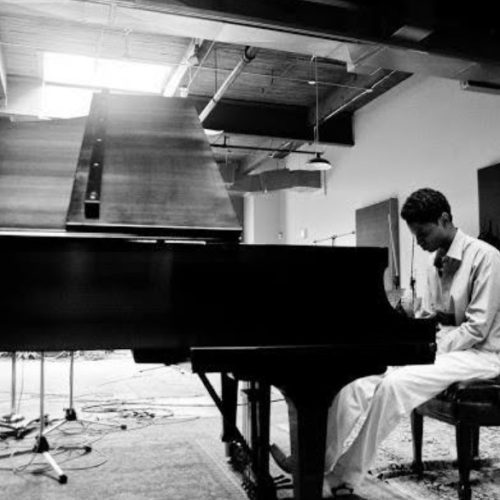
On April 10 at 6:30 p.m., at the Salle Bourgie, pianist Meagan Milatz joins Olivier Thouin, Jean-Sébastien Roy, Charles Pilon and Sophie van der Sloot of OSM for a chamber music concert that includes the String Quartet in F major op. 77 No. 2 by Haydn and Two Pieces for Quartet and the Quintet in G minor op. 57 by Shostakovich. We caught up with Meagan Milatz to find out more about her and the program of the upcoming concert.
PANM360: You are very active in chamber music, can you describe the relationship you have with this discipline and how it impacts your solo and orchestral activity?
Meagan Milatz: I do quite a lot of chamber music and what I love about it is the possibility of learning from others and growing musically. It is the same approach I try to bring to my activity with orchestras: for example, I recently played Mozart’s Piano Concerto No. 24, which to me is like a large-scale chamber music work, and in interpreting it I put into practice those listening skills that are so useful in making chamber music.
PANM360: How do you feel about playing with the musicians of OSM, one of the most important orchestras on the national scene?
Meagan Milatz: This is an incredible collaborative opportunity, which started a few years ago after COVID with Franck’s Quintet. It was an opportunity to make music after a difficult period for everyone and playing with musicians of the highest level made it all really special. My first contact with OSM, however, took place many years ago, in 2009, when I took part in the OSM competition. I also had the opportunity to listen to Lang Lang playing with the orchestra and the exceptional level of the orchestra really impressed me.
PANM360: Can you tell us something about the program you will perform on April 10 at the Salle Bourgie?
Meagan Milatz: I believe the program highlights a very interesting contrast between Haydn, usually very ironic, and Shostakovich, often dark and intellectual. As for Shostakovich’s Quintet, the piece I will be personally involved in, I can say that it is a piece that was written for the Beethoven Quartet, an ensemble of great prestige that premiered almost all of Shostakovich’s quartets. The piece, which Shostakovich wrote to be able to collaborate and tour with the ensemble, was successful at the time and in it you can hear a man who never totally lets himself go to emotion, neither joy nor suffering, in a contrast between authentic self-expression and the satisfaction of a limiting regime.
PANM360: Can you tell us something about your upcoming commitments?
Meagan Milatz: My schedule will see me active in various engagements. First, a chamber music tour with James Campbell and Cameron Crozman that will take me to Montreal, Ontario and Saskatchewan with music for clarinet, cello and piano by Beethoven, Brahms and contemporary composers. Afterwards, another chamber music engagement for the Festival Classica with Schubert’s piano trios on a fortepiano. On this occasion I will play a mid-nineteenth century Erard and I will be accompanied by Chloe Kim and Cameron Crozman.
PANM360: What would you like to devote yourself to at this stage of your career?
Meagan Milatz: I would certainly like to devote more time to fortepiano, having been lucky enough to study with an expert like Tom Beghin. In Belgium I will record Schumann on an 1835 fortepiano and I would like to work more in Europe from this point of view. What I love about fortepiano, being also a pianist, is the possibility of seeing the evolution of the instrument and the repertoire over the years, which is a great privilege. In addition, I would also like to devote myself more to contemporary music, recording the piano concerto of David McIntyre, a composer from Saskatchewan, my province of origin, whom the public appreciates very much and who deserves more diffusion.
PANM360: ou have obtained the prestigious support of the Mécénat Musica Prix Goyer award, how do you think this has helped you to emerge in a complex field such as classical music?Meagan Milatz: One of the traditional ways to emerge has always been through piano competitions, which I have not taken part in for several years. Winning this award, in an unexpected way, was a surprise and a pleasure and this also gave me the opportunity to collaborate with incredible people. I realize more and more how fundamental connections and relationships are for classical musicians and this is a piece of advice I would like to give to young people: do not neglect relationships because they are a pivotal part of our profession and can also become important friendships for life!
credit photo: Steve Gerrard