Additional Information
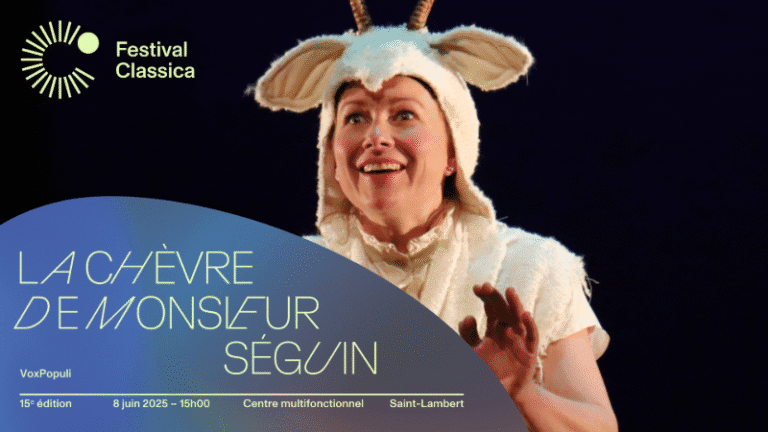
This Sunday, at the Centre multifonctionnel de Saint-Lambert, the play La chèvre de Monsieur Séguin (Mr. Seguin’s goat) will be presented, halfway between opera and theater. Patrick Mathieu, who wrote the libretto and music, offers his vision of an opera for young audiences. With lucidity and a touch of irony, he shows us that the eyes of a child do not make judgments, other than the constructions acquired by the society around them.
PAN M 360: Why did you decide to adapt Mr. Seguin’s Goat as an opera-theater for children?
Patrick Mathieu: It depends where the emphasis lies in your question… Why this story? Why an opera? Or why for children? Why an opera? The obvious answer is that I’m a musician. The only reason I sign the texts for most of our productions is that writing an opera libretto requires musical skills that very few writers possess.
Why an opera for children? The first thing to point out is that it’s adults, not children, who have prejudices against opera, most of which are completely unfounded. Basically, an opera is a Disney film: a story and tunes, or the opposite. A Disney film is an opera where the story takes precedence over the music. Now, I can well understand that someone who’s never been exposed to “classical” music and/or theater can be quite bewildered when they attend their first grand opera, especially if they understand nothing of what’s being told. That’s a shame. For them. They’ve been deprived of something fantastic, and that in itself seems more than enough reason not to do the same to your own children.
Now, is it essential to love opera? What’s essential is eating, having a roof over your head and being healthy… not opera, a TV series or a field hockey game. What is vital, however, is that children discover the pleasure of a culture that is not just entertainment, that they learn to think differently, for themselves. A culture-free, self-referential society brings Trump to power. Well, there are also hyper-educated and cultured societies that supported Hitler, but that’s another debate.
PAN M 360: The ending of the original story is rather tragic. How did you manage to adapt this dark ending for a young audience?
Patrick Mathieu: Daudet’s tale is very short, and there’s a certain amount of adaptation and invention, including characters and far-fetched episodes, that’s necessary, otherwise the show would have lasted 5 minutes! However, everything in the original text is present in our version, including the ending. Now, is this ending tragic? What’s always interested me about this fable is that it’s amoral. It describes life, not an American movie. The wolf eats the goat because that’s what wolves do. If he doesn’t eat the goat, he starves. For me, the central point of the tale isn’t the goat’s death, it’s the fact that she resists the wolf all night, knowing that she won’t escape. It’s the heroism of the human condition: doing the best we can, knowing that it never ends well. So yes, the story is deeply tragic, but it’s a philosophical tragedy.
That said, it’s only the end of the show that’s dramatic, and the whole “art” consists in leading the audience from comedy to drama. Children love drama as much as the next person, on the obvious condition that its representation respects their sensibilities. It’s the old artistic principle: it’s not so much what’s said that matters as how it’s said. What’s certain is that after hundreds of performances, if we’d done a realistic ending, there’d be a serious shortage of sopranos and the prisons would be full of obese baritones.
PAN M 360: You’ve just returned from Brazil and Mexico, where you presented this piece. How did these foreign audiences influence your perception of the work?
Patrick Mathieu: We’ve been back a long time!
I don’t know to what extent a foreign audience – indeed, any audience – can influence my perception of a work, whether it’s mine or not. As a director selling tickets and shows, perhaps, but certainly not as a musician.
Is the show perceived differently by foreign audiences? As far as the form of the show is concerned, no. What changes in the particular case of La chèvre is the way in which the children express their feelings about the tragedy. It obviously depends on each child, but in general, it seems to me that it’s much more a question of social class than country. There’s more difference between a child from Outremont and one from Montreal North than between a Mexican or Brazilian child from the same social class and one from Quebec. The only notable cultural difference is the visceral, physical reaction to music of the people who dance. This is true in Latin America, and would be equally true in Africa. Francophones and Anglophones are the only cultures where audiences are incapable of clapping their hands to the beat of a pop song!
PAN M 360: The work is aimed at young people aged 4 to 12. How do you manage to engage these different age groups?
Patrick Mathieu: The process doesn’t seem any different to me than when I compose “for adults”. I write what I want to hear, which doesn’t yet exist. The only difference with operas for young audiences is that I write what I would have liked to hear as a child. Obviously, I didn’t know this when I was a child. Like everyone else, I imagined I’d end up at the Forum, not in music! Maybe I would have realized it sooner.
I think the charm of the show, which perhaps also explains its success, is that the adults have done a serious job of remembering what it’s like to be a child.
The only way to engage a children’s audience is to give them a good show. If they like it, you’ll know it just as much as if they don’t!