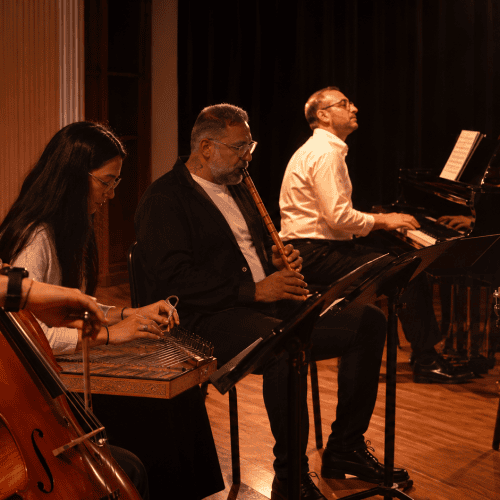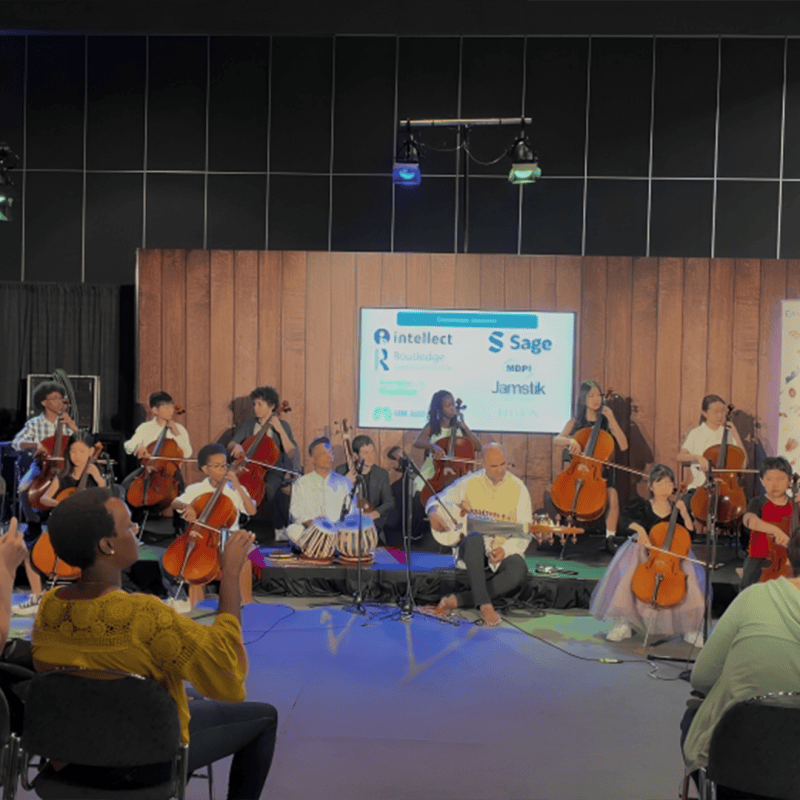
Une mélodie n’appartient jamais tout à fait à celui qui la joue, elle se transmet, se transforme, et parfois traverse d’un instrument à l’autre sans perdre son âme. Dans cet atelier-concert, le sarodiste Aditya Verma retrace l’histoire du sarod et son propre apprentissage des ragas auprès de Pandit Ravi Shankar, avant de raconter comment il a transmis cet héritage à Josh Fink, qui l’a adapté et enseigné aux jeunes violoncellistes de l’Ensemble de violoncelles de Montréal (EVM).
Accompagné du tabliste Subir Dev, Aditya Verma initie le public aux principes du raga et du tala, puis l’invite à apprendre lui-même certaines mélodies et certains rythmes, avant que les violoncellistes avancés de l’EVM n’interprètent à leur tour les ragas aux côtés du sarod et du tabla.
Cet atelier-concert met en lumière la transmission orale, le dialogue entre les traditions classiques indienne et occidentale, et la rencontre entre artistes professionnels et jeunes musiciens montréalais issus d’horizons multiples.
A melody never belongs entirely to the one who plays it; it is transmitted, transformed, and sometimes crosses from one instrument to another without losing its soul. In this participatory concert-workshop, sarod player Aditya Verma traces the history of the sarod and his own study of ragas under Pandit Ravi Shankar, before recounting how he passed this heritage on to Josh Fink, who adapted and taught it to the young cellists of the Ensemble de violoncelles de Montréal (EVM).
Accompanied by tabla player Subir Dev, Aditya Verma introduces the audience to the principles of raga and tala, then invites them to learn certain melodies and rhythms themselves, before the EVM’s advanced cellists in turn perform the ragas alongside the sarod and tabla.
This concert-workshop highlights oral transmission, the dialogue between Indian and Western classical traditions, and the encounter between professional artists and young Montreal musicians from diverse backgrounds.
CET ÉVÉNEMENT EST GRATUIT!
Ce contenu provient du Festival du Monde Arabe de Montréal et est adapté par PAN M 360