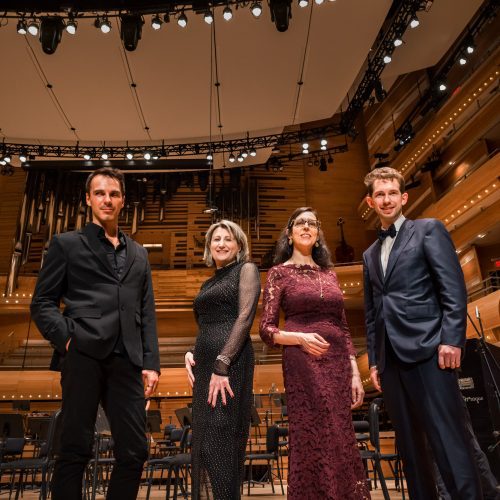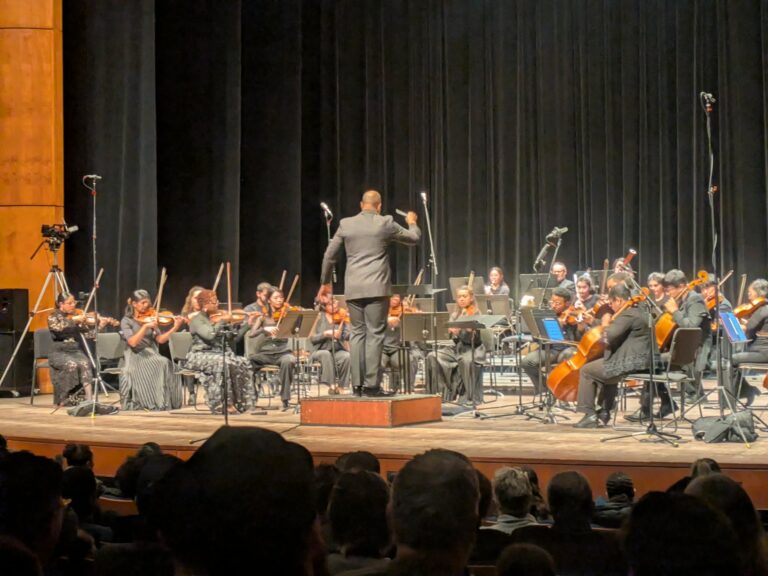
A concert by the EDI-wise Obiora Ensemble is enough to make anyone happy. One, the orchestra is good, two, the atmosphere is cheerful and family-friendly (there are young people everywhere!) and three, you often make some great musical discoveries there, alongside some good pillars of the repertoire.
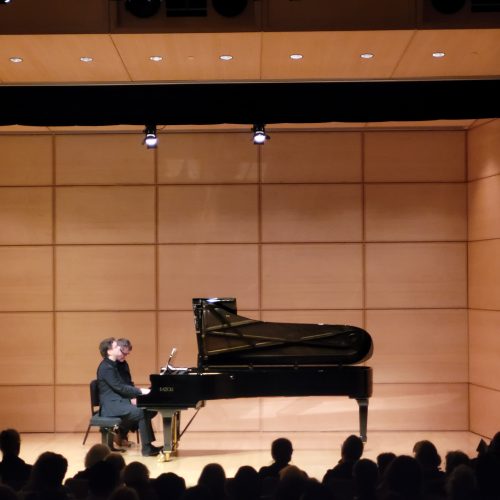
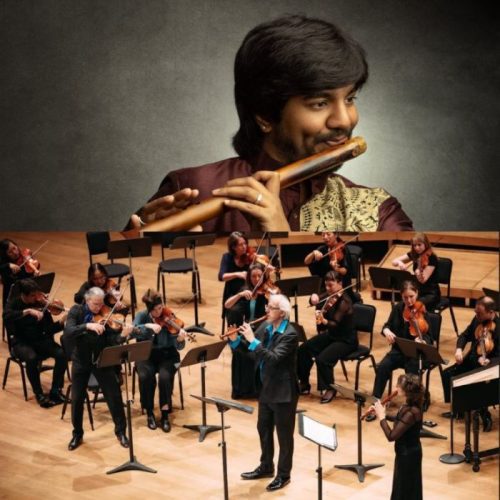
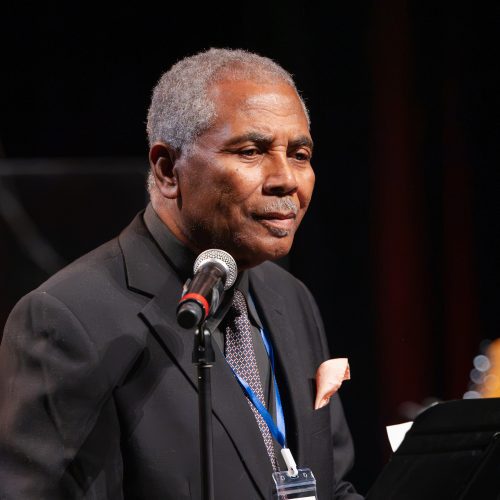
Last night at the Pierre-Mercure hall in Montreal, we got all of that. In addition, it was also Daniel Bartholomew-Poyser’s first concert as Principal Guest Conductor. The man has charisma. He speaks good French and of course English, in a spontaneous exchange between the two languages, “Montreal style.” He has a sense of humour and sympathetically betrays his passion for the classics. One can say that, in terms of image and marketing, Obiora seems to have made a good choice.
On the musical side, we also discover an artist who greatly enjoys constructing his ensemble according to very strong criteria of clarity and precision. The man is a detail refiner.
The cradle of the classical symphony, for once
A given at the start of the concert, when we were given Haydn’s rarely heard first symphony. As Bartholomew-Poyser said amusingly, no 104, or 103, or 88, or any other without a no. 1! The conductor immediately established his vision of hyper-articulated music, driven by chiselled rhythms. A nice introduction, notwithstanding the fact that it is still Haydn not yet totally at the peak of his art of concision: the second movement is too long.
In order to give the wind section the opportunity to shine, the conductor chose to follow up with the delicate and neo-classicist Three Short Pieces for wind quintet, by Jacques Ibert. A resolutely French universe, made of elegance and instrumental purity, very well interpreted by the first chairs of flute, oboe, clarinet, bassoon and horn of the ensemble.
A world premiere of a tornado
Then the sky was amber, a concerto for viola with the character of a symphonic poem followed, in its world premiere. The new creation by Iranian-Canadian (Toronto) Saman Shahi evokes, in a language oscillating between contemporary atonality and cinematic chromaticism, the building of a storm, first in the distance, then approaching and enveloping everything, before subsiding and leaving behind a devastated landscape capped by the evanescent beauty of an amber sky (hence the title of the work). Soloist Sharon Wei navigated the gusts of Shahi’s highly expressive music with a combination of virtuosity and sonic power. By turns resisting the storm as best it could and commenting thoughtfully on a landscape left bloodless, Wei’s viola resonated with power.
The attractive modernity of Caroline Shaw
I really love the music of the composer who followed in the program: Caroline Shaw. The American knows very skilfully how to blend the techniques of the modern avant-garde with accessible neo-tonal writing. Her ideas are often simple but constructed with great efficiency. The piece chosen by Bartholomew-Poyser, Entr’acte, is a tribute in the form of a deconstruction of classical language (a nod to Haydn), both harmonic and rhythmic. As in a pulse organised by inhalations and exhalations, a simple and elegant melody is regularly tortured, disarticulated, before returning to its original state. It is fine music, pleasant to discover and stimulating. We eagerly await the next “destructive” iteration to see what tactics the composer will use to illustrate her point.
Pulcinella
Stravinsky’s Pulcinella ended the evening. A way for the conductor to use the full technical possibilities of the ensemble. A very correct version, if not for some sourness in the first violins, the oboe not demonstrating the desired narrative poise in the Serenata (2nd movement), and a slightly too high number of tears in the horns later in the work.
Beyond this nitpicking, we appreciated the exceptional precision of the construction of the portraits and the scenery by the conductor. As he showed us from the beginning of the concert, Bartholomew-Poyser weaves almost arachnid webs with his orchestra. Such diligent work will certainly yield very beautiful results in the medium term. We will appreciate, perhaps, the addition of a holistic binder from him, an overall timbral velvet that will prevent him from falling into excessive sonic granularity. But that will come in due time.
In the meantime, the new principal guest conductor has demonstrated very fine qualities of musical direction, but also of communication and artistic choices. I will be very pleased to see and hear what he will do in the next three years of his new contract.