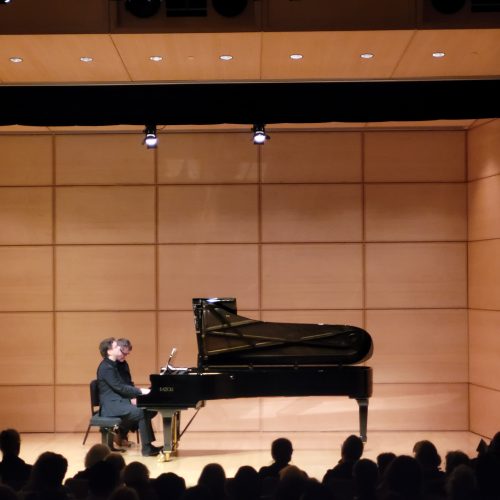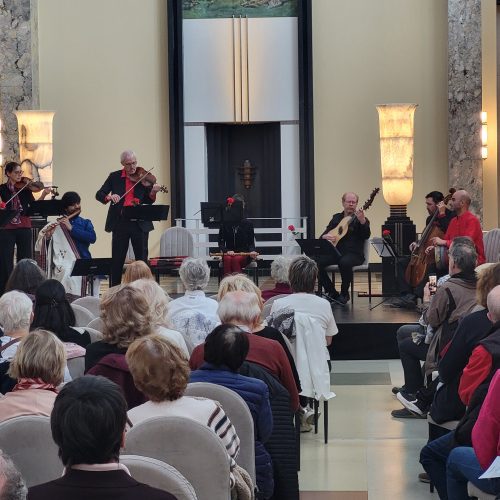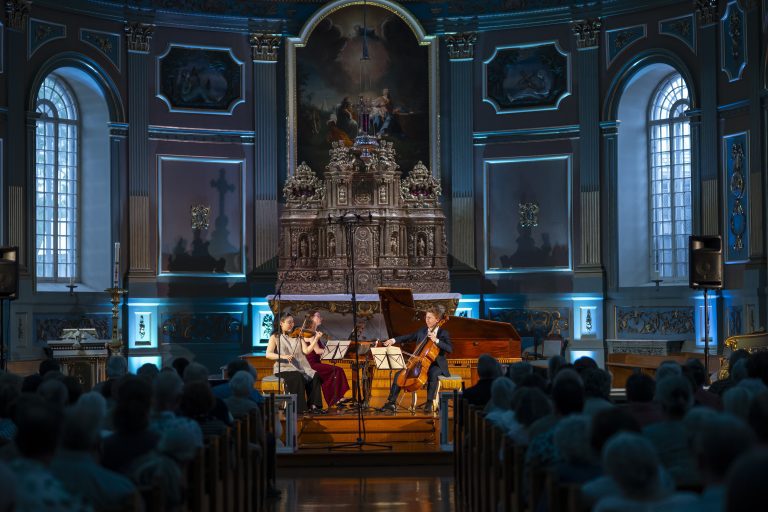
It was hot and humid last Wednesday night at the Sainte-Famille Church in Boucherville. Mind you, I’ve seen worse, but still… The concert held there promised us beautiful moments of music, with top young performers: cellist Cameron Crozman, violinist Chloe Kim, and pianist Meagan Milatz. Crozman and Milatz, I have already told you about them. He and she are excellent. Chloe Kim, I had never heard of her before.
On the program, the two wonderful Piano Trios by Schubert. For the occasion, they were presented to us on period instruments: a 1826 pianoforte (contemporary with Schubert, therefore) and a period violin. Only Crozman’s cello remained modern, but with gut strings instead of metal. A more muted sound, then.
You need to understand something about these instruments (and gut strings): they are very delicate little creatures. Much more than their modern descendants. These things go out of tune for nothing, in addition to having less projection power. And when it’s hot and humid, guess what, it’s worse.
Result: the concert ended up resembling a constant struggle for the performers to give depth to their phrases and, above all, to maintain their tonal accuracy. This is less true for the pianoforte, whose mechanics are more resilient, but for the violin and cello, it’s a different story. Not knowing Chloe Kim, I cannot testify to her usual skills in terms of intonation. She is reputed to be excellent, and has played with Rachel Podger, Monica Huggett, Masaaki Suzuki, William Christie and Les Arts Florissants, and others of that calibre. These people cannot be mistaken in their assessment of playing partners.
What I can say, only, is that the intonation problems with the violin last night were recurrent. What part of the fault is with the violin and the performer? I refuse to comment. If I compare it to the cello, the latter appeared much less guilty. In truth, almost never. I must say, knowing Cameron, I know he is a musician of exceptional quality. Did he find it easier to compensate for the atmospheric conditions? His strings were gut, but his instrument remains modern, more resilient.
I took a lot of time for this introductory explanation, but I think the context was important, as I guess the musicians present gave their best.
Thus, setting aside the issue of intonation, the three artists demonstrated a very solid ensemble performance, with narrative constructions vibrant with naturalness and conviction. Crozman offered us superb sunny lines in the expositions of the first movements of both trios. He also sang with an enormous emotional force the famous melody of the Andante from Trio No. 2 in E-flat, revisited with delicate and very expressive attention in the final Allegro moderato.
Chloé Kim demonstrated convincing technical skills, expressing herself with great clarity, even though I missed the enveloping brilliance of a modern instrument (I think, for example, of Isabelle Faust, in a magnificent live recording).
That said, it was Megan Milatz who particularly delighted me. Those who have already heard her elsewhere in Montreal (like at a HausMusique concert on the 9th floor of the Eaton Centre, for example) know how remarkably precise her playing is, while maintaining a plastic ease that allows her to make any surgically organised line dance. The young lady was in great form yesterday and gave us precious passages on a particular instrument, an English pianoforte by Broadwood.
Let’s open a parenthesis here about this instrument. At the beginning of the 19th century, there were different makers of fortepianos (ancestors of the modern piano). Each had its own manufacturing style. We mainly distinguish between two models: English and Austro-German. The English (including Broadwood) had a more robust architecture and construction details (strings, types of pads on the hammers, etc.) that still today give these sound machines a rounder, less bright timbre compared to their Germanic cousins.
The use of a Broadwood model was an “interesting” experience, according to Cameron Crozman’s own words in the concert introduction. Especially because it is not the type of instrument that Schubert would have used.
The experience was indeed interesting, and I can hardly imagine any artist who could have done as well as Meagan Milatz in bringing colours and expressiveness to this music, which usually resonates in a more radiant way with an Austro-German period instrument or a completely modern one. The instrument itself, a property of local patron Jacques Marchand, is clearly very good.
That said, I’m not convinced that I want to hear this music again with this kind of sound model. The “mist” surrounding the pianistic discourse (Meagan Milatz’s own expression) ultimately creates a void. One expects a more affirmative presence of the instrument in the complex and elaborate narrative constructed by Schubert. It is not there. The instrument fades away too easily.
Conclusion: I left thinking that I really wanted to hear these artists play the same program either in a better controlled and temperate environment, on modern instruments, or both.