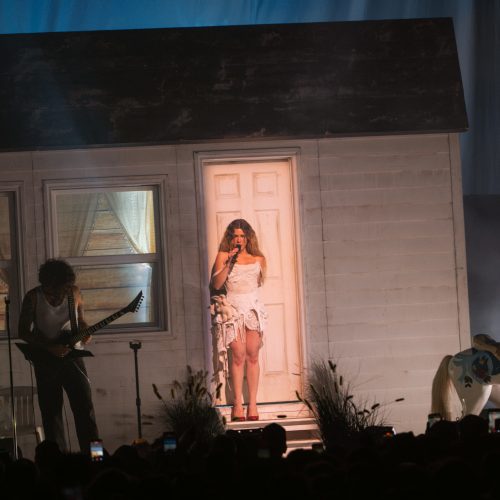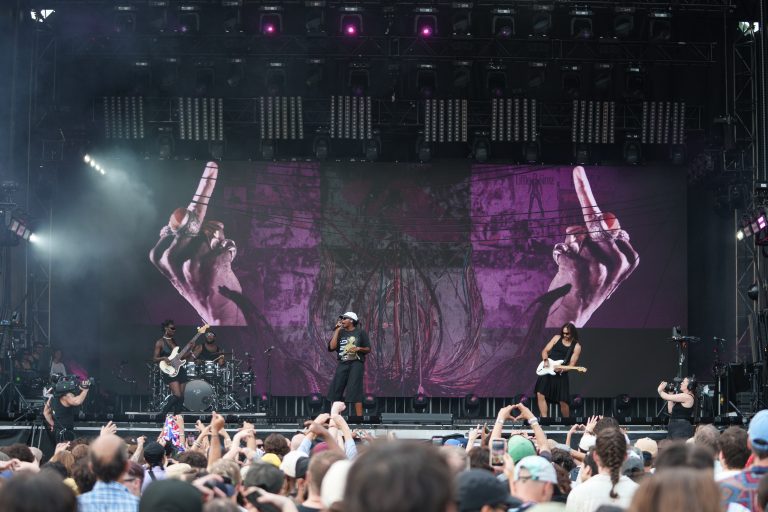
Little Simz had everything it took to wow the crowd on the rockiest day of this year’s Osheaga, surrounded by bands like Angine de Poitrine, Viagra Boys, Franz Ferdinand, and Turnstile. Accompanied by her touring musicians on bass, guitar, and drums, she delivered one of the festival’s most memorable performances. She kicked things off with the explosive energy of “Thief,” the opening track from her album Lotus. Wearing a T-shirt featuring Aang, the main character from the animated series Avatar: The Last Airbender, she exuded—from the moment she took the stage—that cool, laid-back, and unique attitude that would define her entire performance.
From the very first lyrical flourishes, her magnetism comes across as completely natural. The song’s dynamic, garage-influenced percussion, abrasive guitar lines, and heavy bass create an almost punk-like tension, amplified by a massive black-and-white lotus flower crackling with electricity behind the band. With “Flood” and “Young,” she continues in this rawer direction before diving back into the introspective world of Sometimes I Might Be Introvert with “I Love You, I Hate You.”

The highlight comes with “Venom.” Alone on stage, Little Simz exudes a regal presence: her precise flow and intensity make it feel as though every word carries physical weight. Then, without losing momentum, she transforms the stage into a nightclub by stepping behind the turntables to revisit the electronic soundscapes of her EPs Drop 7 and Sugar Girl. On “Mood Swings,” “Game On,” and “SOS,” she explores a new facet of her sonic identity—blending percussive beats, tribal house, and Brazilian influences—inviting the crowd to dance.
Back with her band, she delivers one highlight after another: “Lion,” a celebratory track in which she proudly asserts her accomplishments, accompanied by visuals in warm colors displaying the phrase “We don’t care for what they say, that’s my superpower” in the background, while the silhouette of a man striking a powerful pose appears on screen. She then continues with “Point and Kill,” driven by a sinuous bassline and brass sections reminiscent of Fela Kuti’s Afrobeats — a unifying moment where the crowd sings along with her. Finally, “Woman” brings a more soulful and elegant touch, before “Gorilla” concludes her performance with triumphant confidence, as Little Simz’s silhouette appears backlit in a monochrome aesthetic.
This performance served as a reminder of the breadth of Little Simz’s sonic palette; she is always ready to push her own boundaries by exploring new musical territories. With a blend of power, vulnerability, and infectious joy, she confirms that she has the stature of the great figures of contemporary hip-hop.
Photos by Benoit Rousseau