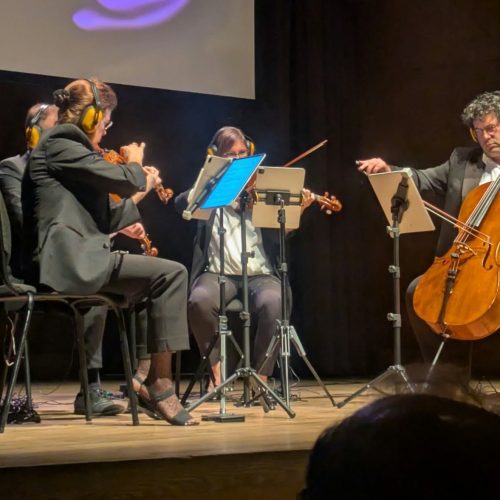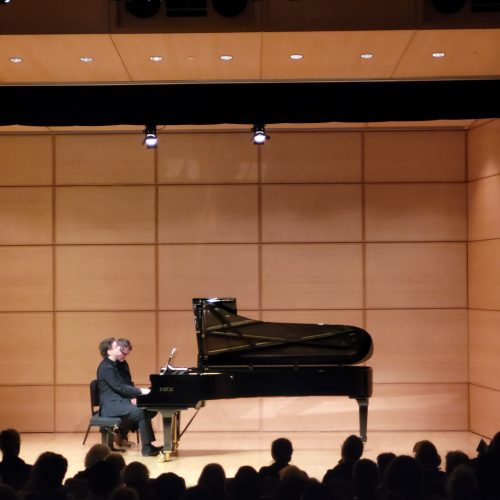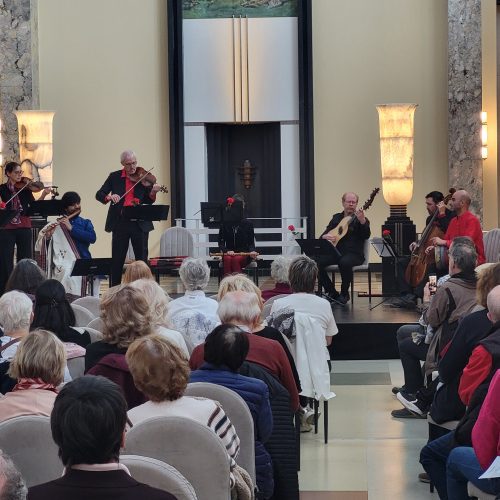
It was a damn good show. No, it wasn’t at the exit of the Bell Centre or the Metropolis that my esteemed PanM colleagues (Alain Brunet and Michel Rondeau) and I expressed this spontaneous reflection together. It was after a concert by the Molinari Quartet at the Bourgie Hall. An intelligently crafted program, composed of contemporary works of very high calibre, as enjoyable to listen to as they are demanding. A requirement that rewards music lovers who dive into the adventure tenfold.
The concept was driven by the spirit of a meeting between Quebec and the Netherlands. First through music, with two Quebec composers (John Rea and Denis Gougeon) and two Dutch composers (Wilbert Bulsink and Guus Janssen), who equally shared the creation and interpretation of an existing piece. The meeting also took place through the pictorial universe of the two respective giants, Guido Molinari in Quebec and Piet Mondrian in the Netherlands. Finally, to complete the loop of this holistic perspective, video projections inspired by paintings of the two masters (among others) accompanied the performance of the four members of the Montreal Quartet.
The program began with Objets perdus (Lost objects) by John Rea (born in 1944), a piece from 1991 that I hadn’t heard in a long time. Listening to it again under the expert fingers of the Molinari, I realised how well this music has aged. Its bustling pulses, occasionally overflown by broad and lyrical lines, its tonal anchoring (expanded), its frank expressiveness, all of this sounds like good so-called “post-modern” music today, the kind that claims to return to classical forms and principles and step out of the ideological framework of strict avant-garde. Thus, Objets perdus was (and still is) a more relevant score than many experimental and rigidly abstract pieces written at the same time. The visual accompaniment, created by the videographer Udo Prinsen, did not demonstrate relevant connections to Rea’s musical language. At least as far as I’m concerned. Fortunately, the following ones would be more inspired (I’ll come back to that).
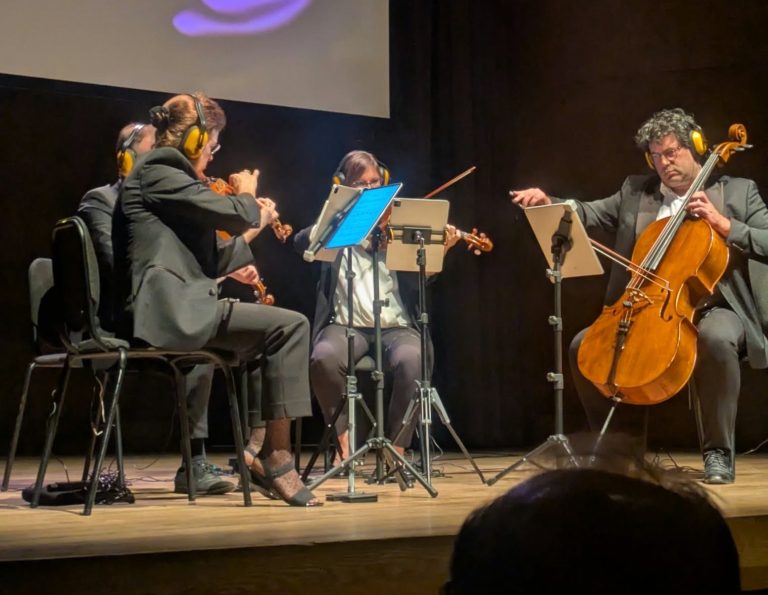
The next piece was a premiere by Wilbert Bulsink (born in 1983), a composer apparently quite well-known in his country and elsewhere in Europe, but unknown here. His String Quartet No. 2 is inspired by four paintings by Guido Molinari: Serial, a title from the Continuum series, Collage, and a painting from his automatist period when he painted in the dark, without visual reference (the title is not specified). Bulsink’s music is structurally informed by Molinari’s pictoriality. In the case of Serial, the sharply delineated coloured vertical bands are musically illustrated by strongly contrasted motifs/textures/sound expressions, juxtaposed without any transition. These knife-cut opposites initially coexist without blending, but towards the end, a sort of holistic relationship becomes perceptible, as if, after observing each vertical colour monad, the observer could finally grasp the complete work with their eyes. Continuum is a painting inhabited by a profusion of small chromatic squares, in a square canvas tilted by a quarter, so that the frame appears on its tip rather than its flat base. The impression is rather that of an intertwining of shades. In music, Bulsink constructs a more integrated score, with less violent contrasts, which intertwine more naturally. Collage refers to the technique of snippets of materials brought together by Molinari in compositions held together with, literally, masking tape. Bulsink takes snippets from the first two movements and assembles them in a more coherent manner than one would expect. Finally, …dans le noir (in the dark) is inspired by Molinari’s experiences with automatic painting, done in the dark, thus without visual reference. In order to create a musical equivalent, Bulsink asked the performers of the Molinari Quartet to wear noise-cancelling headphones, the kind used on construction sites. Thus, the musicians cannot hear their neighbours, and even less what they are playing themselves. Add to that a score based on sections that can be played randomly by the performer, and you have a piece that will be almost impossible to hear twice in the same way. Bulsink’s writing fortunately avoids cacophonous mush by ensuring that each musician’s gestures and interventions were made with softness, subtlety, and sometimes spider-like delicacy. Behind the music, Prinsen’s projections were this time logically symbiotic with the notes. Prinsen did not just show the corresponding paintings (which would have been, I must say, quite banal), but he transformed their nature by infusing them with rhythmic and dynamic movement that supported the musical narrative.
Next was a 1981 work by Guus Janssen (born in 1951), String Quartet No. 2 “Streepjes,” which means stripes in English. Janssen’s trick in this finely crafted quartet is to have asked each string player to detune one of the strings of their instrument and adjust it to allow the use of a natural tuning, or what is called just intonation. The result is a formally atonal piece, but one that seems to float gently on airy harmonies, pleasantly ventilated, and not constrained by rough dissonances. The use of bouncing pulses, but never heavily emphasised, completes the rather pleasant (even if still demanding) character of this Quartet, mastered with grace and precision by the Molinari. The projections of very fine luminous lines in pastel colours, by Prinsen, skilfully complemented the musical discourse here as well.
To conclude, it was the Quebec composer Denis Gougeon who returned the favour to Wilbert Bulsink by drawing inspiration from a Dutch painter, the most famous of them all, and one of the most popular in the world, Piet Mondrian. Gougeon, happily, did not seek to create a mimetic reflection of an abstract visual structure. He rather let a certain emotion speak. In fact, that’s what he does best. The first of the three movements is inspired by Evening, Red Tree, one of Mondrian’s early paintings, before his abstract period. A red tree on a deep blue background thus stimulates the Quebecois in an organic piece, which is born in a velvety darkness, trembling with serpentine glissandos, as many roots extending into the secret of the earth. The whole progresses slowly towards the light, allowing branches to unfold that seem to reach out towards the sky. Magnificent, with a very beautiful visual construction by Prinsen, which gradually reveals the tree.
Composition with large red, yellow, black, grey, and blue planes, the second movement finally enters the geometric world of Mondrian, the one we know so well. Here, the music becomes denser, fuller, and meatier, albeit resplendent. It is also imbued with a vibrant energy that aptly complements Prinsen’s visual creation, which draws us into the painting, revealing itself in a swirling three-dimensionality. Imagine you have an image with multiple dots, or squares/rectangles, and you discover that in truth, they are the tops of skyscrapers in a big city. Imagine then everything astonishing you will see as you descend to street level.
Finally, Gougeon concludes his journey with an exciting bang: Broadway Boogie Woogie. This painting, perhaps the most famous of all Mondrian’s works, is an invitation to swing music, an invitation that the Quebecer did not refuse. He uses as his basic material a piece for piano by Albert Ammons, Stomp (1939), whose jazzy syncopations perfectly evoke, of course, the invigorating New York of the musical theatre district in the 1930s and 1940s. Gougeon quotes his material from the outset, but transforms it brilliantly, making it take unexpected and eccentric detours, like in a yellow cab driven by a madman who wants to show off. Ammons’ swaying melody returns at the end, as if to firmly reinforce the message, but it gradually fades away. An exciting and appropriate finale.
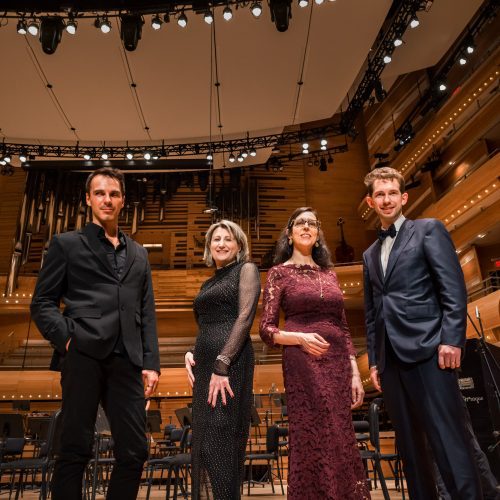
Hats off to the four members of the Molinari Quartet, as well as to the composers present and the videographer Udo Prinsen. It was a damn good show.