Additional Information
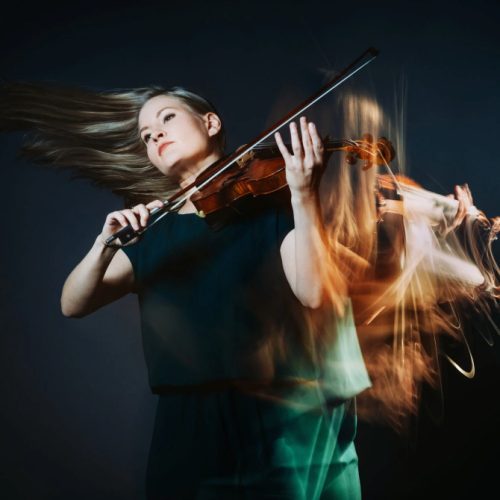
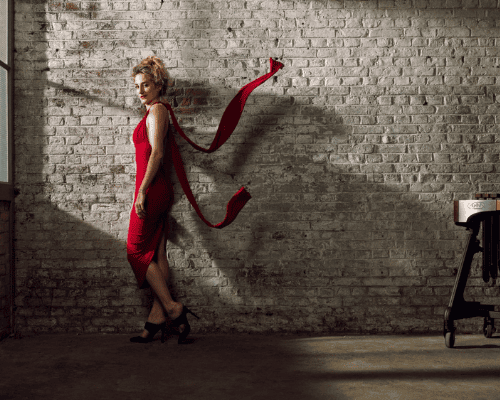
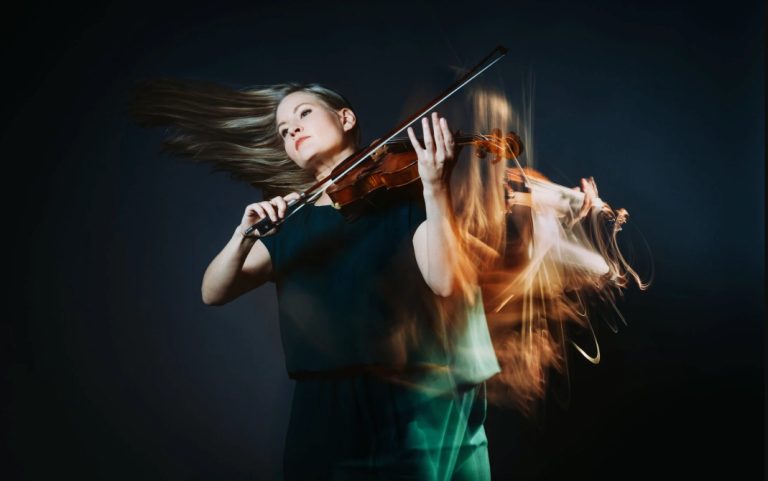
Le Vivier is hosting an Austrian violinist who is making an increasingly significant mark on the contemporary and avant-garde music scene at the moment. Judith Fliedl loves to explore the remote areas of violin technique, its sound and timbre capabilities, as well as all the possibilities of exchanges with electronic lutherie and even ultrasound! I spoke with the young artist about the concert she will give on Friday, October 30, at the Sainte-Hilda space, a brand new performance venue in the Rosemont district, which allows for very intimate encounters with the artists (I went there, and I really like it).
PanM360 : Hello Judith. Can you shortly tell me about your musical upbringing and what was your first decisive encounter with avant-garde music that set you on this career path mostly dedicated to contemporary music?
Judith Fliedl : I started when I was six years old and already at seven, I knew I was going to do this for the rest of my life. The violin was going to be my companion. I was very clear about that, very soon. Then I studied at Mozarteum in Salzburg, I studied in London, I studied in Vienna chamber music and then at the end of my studies, also did contemporary music with the Klangforum Vienna, one of the most important ensembles for contemporary music. I was immediately drawn by the approach in contemporary music, I mean being able to work with composers as well as co-create with them. And so it was clear then that this was going to be my musical path and journey. My whole musical life is about researching and finding out new ways of music making. I think for this, contemporary music is just the best way to go.
I can remember when I played my very first music competition, I think I was nine or 10 years old. Each person had to play one contemporary piece. And I chose a piece which I cannot remember the name of, but I knew that this was my world. I felt just so comfortable and at home with creating sounds which were not ‘’normal’’.
PanM360 : You played the classical repertoire. You still do sometimes. Are there composers of the past still special for you?
Judith Fliedl : Yes, actually, at the end of my North America tour, I will play a concert with only Mozart, and I think a piece by Korngold. It will be the launch event of the Mozarteum Canada, Society in Toronto (November 3).
I think it’s so great that I can play both past and contemporary music. I think both worlds can be very helpful for each other and inform each other immensely.
When I now practice a lot of contemporary music and I come back to playing some Bach or Mozart or whatever, Brahms, I can feel that I have much more depth now being able to see the music. So they’re maybe not even so far away. It’s just the institutional worlds around the musical approaches that are maybe different.
To answer your question : it may sound cheesy, but the Bach Chaconne, is always close to my heart. I always come back to it. I think it’s just a masterpiece and you can never stop learning from it. So when I have a free day and don’t need to practice, I would go for this piece.
When I have a free day and don’t need to practice, I would still go for Bach Chaconne.
PanM360 : Ok, let’s talk about the concert at Sainte-Hilda. Very nice place, you will love it. But the program, what is it? I see you will be playing a piece called Ultra Violin 1+ 2 by Benjamin Alphart. It’ s about ultrasounds?
Judith Fliedl : It’s a piece I commissioned. I co-created it, actually, with a composer I know from Graz. And he’s working a lot with field recordings, but also, you know, investigating electronic possibilities. He told me that he would be very much interested in finding out about the sounds which the human ear cannot perceive. And that, of course, is just so exciting.
PanM360 : Music we can’t hear. Like music for dogs and cats?
Judith Fliedl : Yes, of course, but making them audible, lol. So there are special microphones which make them audible. And then I play in a duo with the sounds which would be not audible in a normal case. It just brings the listener and also me, the player, into a completely new world.
It’s like you can find out about the depth of my violin.
PanM360 : This is the kind of sound world that you relish, no? But, there are a lot of types of contemporary music. It is so vast. There’s a lot of schools or so-called schools and styles. Is this kind your preferred one, I mean the abstract and complex one, or do you also investigate things like post-minimalism, repetitive, neo-tonal, whatever?
Judith Fliedl : I play everything as long as it’s good. I would not say I’m drawn to a school. I do love the challenge of complex music a lot, that is true.
PanM360 : Also on the program, a piece by Canadian, based in Montreal, Chris Paul Harman, from 1995. ‘’Old’’ contemporary music….
Judith Fliedl : Yes. It’s such a beautiful piece. It’s so complex. It’s such a challenge to play also. As well for the listeners, I have to say.
PanM360 : Why?
Judith Fliedl : It’s very intense and it’s extremely virtuosic to play. So it is technically difficult, but also a challenge to listen to, because you get a lot of information in a very short time. It’s not soft. But I really like this kind of music, in which you can express yourself and go for it and show what’s possible with the violin. I have to say, I also like music which is not too complex. As long as it has some qualities, I would never say, I just play this kind of music or this other kind.
I think that’s also what I like about the contemporary music scene or approach is that you can find your own path. You don’t need to be, you know, in a box. It means a lot to me, but mainly I’m open and work with a lot of different composers from very different backgrounds. And that’s what I also want to show in these concerts, that there are so many possibilities in sound production and music making on the violin today. Because all of the pieces are super different. You could not compare them to each other.
PanM360 : And what about Malin Bång’s …när korpen vitnar (2003)?
Judith Fliedl : It’s one of the first contemporary pieces I played when I still did play mostly classical music. It opened the world of contemporary music to me. When I did my PhD and investigated the perception of music in the audience, I did a lot of experiments, playing very close, playing in the dark… I also did a lot of interviews about how the listeners can perceive music and then I chose this piece because I had the feeling I could be very free with my body playing it. I think many violinists who play this piece can say the same. It’s a very natural piece. It’s a bodily piece, I would say, that’s why I like to play it.
PanM360 : And it leads to the final peice by Kaajia Saariaho…
Judith Fliedl : Yes, and it is kind of a full circle thing to play it, in my case, because it was composed to be played next to the Bach Chaconne. I’m not going to play the Bach Chaconne, but knowing that this is one of my favorite pieces, it’s actually very natural and clear that I choose to play this piece whenever it’s possible. The venue also has to be prepared for it, because it has to be performed live with electronics which means that you also have to have a very good sound artist to do this. I think Le Vivier is the right partner to make sure it will sound great. I am looking forward to play it in Montreal.
PanM360 : What is your impression of Kaija Saariaho? She’s so iconic, but what does she and her music represent for you? How do you relate to that music?
Judith Fliedl : Oh, that’s a very good question. For me, it’s very, I would say, three-dimensional music, and there’s always a story behind it. Like a painting. As soon as her music starts, you are in a world which is full of stories and so much creativity, and you can just get lost in the very best way in your own imagination. She makes it possible that the listener and the player can dream together.
PanM360 : Is there a composer you would like to commission a piece from? That you haven’t yet?
Judith Fliedl : There are many. Now, with finishing this PhD project, I’m actually thinking of doing an album. For this, I would like to commission. So, there are many composers which I find enormously interesting. It’s hard to choose, but I think of Rebecca Saunders, for example, or Sarah Nemtsov, which is amazing. There’s a very interesting English composer called Alex Paxton.
PanM360 : If you had to choose one composer from the past to compose something especially for you, who would it be?
Judith Fliedl : I would ask Mozart to write a piece for violin and live electronics. Imagine what he would do. I’m also a massive Schnittke fan.
PanM360 : Thank you!