Additional Information
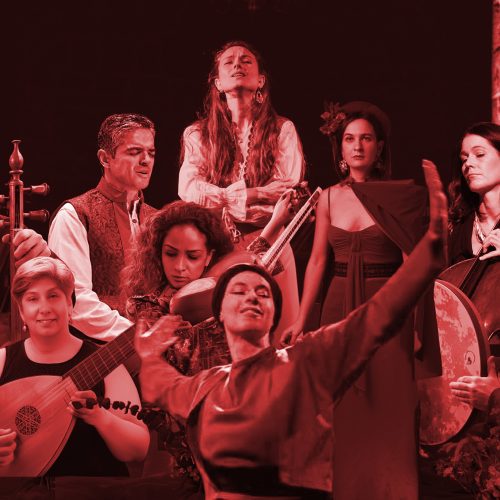
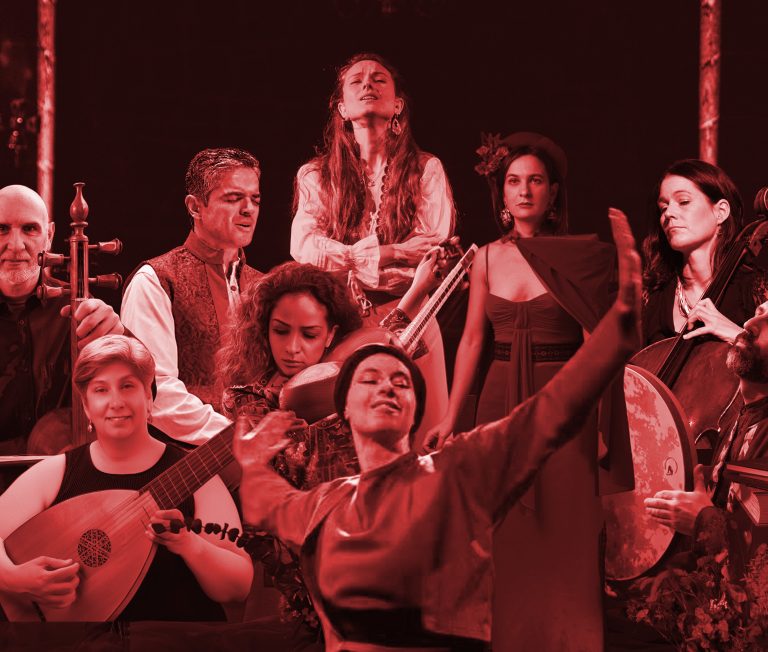
On November 15, 2026, at the Pierre-Mercure hall in Montreal, the Festival du Monde Arabe (Arab World Festival) will conclude its current edition by presenting a double program, initiated by the show The Garden of Roses, by Quebecois Juulie Rousseau and Saeed Kamjoo, in the first part, followed by The Book of Queens (Le Livre des Reines), a transcultural female project by the French Camille Bordet (Kalam, by her stage name). The project created in 2025 for the Opéra de Dijon proposes a meeting/dialogue/fusion between the ancient Persian and Western worlds. The lyrical artist, originally, who speaks Armenian and Farsi, offers through this extraordinary show an experience of cross influences that celebrates the strong and atypical women who populated ancient Europe and Persia, without history sufficiently remembering their names. I discussed this show with Camille.
PANM360: Hello. You are a trained opera singer, to begin with. What exactly is your background?
Camille Bordet: Music has always been a part of my life. I have always sung a lot, but I must say that even before music, it was the stage that interested me. It was the place where I felt good since I was very young. I have memories from when I was four or five years old where I wanted to put on plays, I wanted to tell stories. My parents had the idea of enrolling my brother and me in schools where we could explore something other than just the main subjects. So we went to the Maîtrise de Dijon, a school where we sang in the afternoon. We had classes in the morning and at least two hours of singing every day.
We also had concerts. It shaped my character in many ways. Because, first of all, it gave me a musical culture and a musical ear, a polyphonic ear as well. That was the first milestone, I would say, in my relationship with music. My parents are also very much music lovers, but they are not musicians.
Moreover, I was quite a curious child. I was interested in many things. I loved music, I also loved drawing, debating, classes…
That said, since I had no role models of people who made music and earned a living from it, and they kept telling me that I had to get a brilliant education, earn a living, and not depend on anyone, well, the arts came after, you know. I was immersed in that discourse. I never really questioned whether it was possible to be a professional musician.
As a result, I pursued non-musical studies. The curiosity I had also took me in many different directions. But I always had music in the background. And at the same time, I had a somewhat passionate and, on the other hand, quite painful relationship with singing. For example, I couldn’t stand going to concerts because they made me cry. It triggered super strong emotions in me. I was always jealous of the people on stage. I had something a bit strong inside me and I couldn’t analyse it at that time.
And then, I went to Paris. I first studied political science and then art. Because I quickly realised that it would be complicated for me to have an office job. I needed a lot of freedom in my job, etc. And so, I combined my master’s degree from Sciences Po (Political Sciences) Paris with studies in decorative arts at the National School of Decorative Arts in Paris. And then, when I finished my studies at Sciences Po, I had a bit more free time.
I re-enrolled in the Conservatory because, you know, I told myself I had to stop overthinking things. That’s what I love to do. I love the stage, I love the voice. It completely fascinates me. Finally, at 25, I dropped everything once again and decided to focus on music and make it my profession. It was a tough journey because, in fact, I was starting at a much older age than most people who decide to pursue this profession. I was missing a lot of fundamentals. Even though I had great ease in certain areas, particularly in everything related to stage presence.
On the other hand, I was very behind in terms of technical skills and theoretical knowledge. In the world of opera, which is a very elitist and very structured world, very standardised, with hyper-precise expectations, it was a big challenge for me. I really worked like crazy in the first few years. At the same time, I always had this passion for many other things. I started to take an interest in languages, I always had a very strong connection to writing, I travelled a lot, I met people from all over, etc. And I quickly felt constrained in the world of classical music.
Because the world of classical music is largely a world of interpretation and not a world of creation. Since we embody roles, we interpret works that have been written by others.
So, we are always trying to understand what the composer intended and to stay as close as possible to that intention. And I always wanted to go elsewhere.
Then, in 2020, I took a big trip to Armenia. I learned Armenian. When I was there, I spoke fluently. Then, I completely forgot because when I learned Persian, it replaced it. It’s very frustrating because I don’t speak a word of Armenian anymore, even though it was the language I spoke in my daily life at one point.
PANM360: What led you to speak this language? It’s not trivial.
Camille Bordet: That’s another story. When I was in Basel, I was learning German because I studied singing in Basel for the most part for two years. It was a German-speaking school. I was looking to learn German and then I signed up on a language exchange site and met a boy who was bilingual in German but he was Armenian. We started exchanging like that. And then, actually, I very quickly became much more interested in Armenian than in German.
I started learning the alphabet. It was in the autumn of 2020. And I became very attached to this country. I didn’t really know why I wanted to learn this language so much. I had no reason to learn it apart from an irrational and quite irrepressible need, I must say. And then, there are people who told me to come to Armenia. I took a one-way ticket. I spoke a grand total of ten words of Armenian at that time. And I arrived at the end of January 2021.
I arrived in Yerevan. I didn’t have a dime. I made a lot of contacts there. I started talking to a lot of people. It was the beginning of a story that lasted two and a half years between France and Armenia.
PANM360: And this led you to another musical path…
Camille Bordet: Yes, in Armenia, I met musicians and that’s where I discovered the whole world of improvisation. Since it was music I didn’t know at all, I approached it completely from instinct. I had no frame of reference. I went in many directions, I searched for many things without the intention of committing to a particular school, and it gave me, I don’t know, a breath of freedom that was incredible and that I really loved. That was my first approach to improvisation.
Afterwards, since I had some basic knowledge of Persian since my adolescence, I always told myself that when I would master Armenian properly, I would return to Persian. That’s what I did. In 2022, I started learning Persian again and happened to meet Iranian musicians on a project with Jordi Savall.
We got along really well. Since I was looking to learn Persian, naturally, I got closer to them and we started improvising together. They liked my work and, little by little, it became the heart of my work.
PANM360: You say you learned Persian when you were a teenager? Tell me more…
Camille Bordet: When I was 13, we made a lot of round trips in France with my family because my grandparents lived on the other side of the country. During those long car trips, I used to argue a lot with my brother. My father had decided to put a small TV in the car so we could watch movies and leave them alone, you know.
But of course, they were the ones who chose the films. One day, my father had chosen a documentary about Afghanistan, more specifically a documentary about Commander Massoud called A Valley Against an Empire, which is an extraordinary documentary made by the journalist from Le Monde, Christophe de Ponfilly. My life changed the day I watched that documentary. First, I completely fell in love with this culture. I fell in love with this country. I found everything to be extraordinary. And I also fell in love with this language because at one point in the documentary, we hear Massoud speaking and reciting poems to his soldiers.
And what struck me about this language, it’s crazy, is that when he recites poems, I feel like I’m hearing music. I love it. I told my parents that I wanted to become a journalist and that I wanted to go to Afghanistan and learn Persian. They said we would talk about it again after the holidays. And what’s crazy is that I wrote a letter to Christophe de Ponfilly, the journalist and director, and when I came back from my trip, I realised he had committed suicide six weeks earlier.
PANM360: Ouch.
Camille Bordet: It was completely crazy, but I thought to myself that I would still learn Persian. I had a teacher when I was little who was married to an Iranian and lived in my village. I knocked on her door and asked her if she wanted to teach me Persian. She was very touched and she said yes. We started like that. I learned with her for two years.
But you know, I learned like a 13-year-old teenager. There was a lot of passion, but it wasn’t very organised. Let’s say it gave me a first glimpse into this culture and this language.
PANM360: Wow. You were quite a unique teenager! But tell me, after learning lyrical singing and singing in Italian, French, etc. What do you think of Persian as a singing language? Is it more difficult?
Camille Bordet: I don’t have the feeling that there are languages that are easier to sing than others. I feel that every singer has a special relationship with the languages they sing. I love singing in Persian. That said, I don’t sing at all like an Iranian, nor with an Iranian vocal technique. But I find it to be a very melodic, very musical language. I have that kind of relationship with Arabic as well.
PANM360: Let’s talk about the Book of Queens. What is the Book of Queens, to begin with?
Camille Bordet: So, The Book of Queens came from a commission from the Dijon Opera, which gave me free rein for a festival called The Nights of the Orient. Because they knew I was working with Iranian musicians and they had really enjoyed the various performances in which I had sung. For a long time, I had wanted to work on female lyrics because, as an opera singer, I always sang male lyrics. Well, I have nothing against composers. There is an enormous amount of beautiful music that has been written by male composers. But I thought it would also interest me to be able to sing and embody words that were written by women. And there are plenty. The problem is that there are also many that have been silenced, and many that we have lost because they were considered less interesting than works by men.
And also, when I decided to put together The Book of Queens, I wanted there to be a male singer in the project, because I thought it was great for a male singer to sing words from a woman, for once.
PANM360: What background had the musicians?
Camille Bordet: In fact, half of the cast was more from European music and the other half more from Iranian music. There were people who came from Spain, Switzerland, Belgium, France, and we had a singer who came directly from Iran.
The Book of Queens is a dialogue between female works from around the tenth century to the present day. It’s a dialogue between times and geography.
There are European composers, like Hildegard von Bingen and Barbara Strozzi. There are also compositions by team members, myself for example, and also compositions by Maryam Tazhdeh, who is the Tar player and is based in Montreal.
PANM360: But apart from Maryam, is it an entirely Montreal team that will be on stage for the show here?
Camille Bordet: Almost. There is the singer who comes from Toronto. So there is a first team in Europe with the initial project. And then, the Arab World Festival offered us to redo this show in Montreal. And I have the desire to redo it with different teams because it is a show that is built collectively. That is to say, since there are compositions by the team members, obviously, when I replace a team member, I also replace the part they contributed to. Actually, I’m interested in the fact that The Book of Queens is an evolving show.
PANM360: How did the creation of the project go?
Camille Bordet: It’s a project that was very difficult to implement for many different reasons. But I am very pleasantly surprised by the Montreal team. I find that everyone has really understood the project. Everyone wants to contribute. Everyone is super positive.
PANM360: Alright. Specifically, is there a common thread that connects the entire show?
Camille Bordet: Specifically, at the core, these are compositions by women. Most of them are compositions that talk about love, both human love, sensual love, but also spiritual and mystical love. And then, we also have a warrior part, particularly through the character of Gordafarid, who is a mythical warrior.
It is a character from the Book of Kings, a great Persian epic. She is a female character who was written by a man, Ferdowsi, a great author. It’s the only exception of this kind in the show. But I decided to include her because it is very rare to have such a strong female character in an epic from the 10th-11th century. She is a woman who fights, who disguises herself as a man to go to the battlefield, who challenges the greatest hero of her time to combat, etc.
But for the rest, these are women who talk about love and who converse with each other. I took existing compositions or existing poems on which I composed music, then I slightly disintegrate these compositions to integrate other elements within them. For example, we have songs by Barbara Strozzi (1619-1677) that directly interact with Iranian improvisations.
Hildegard is also interpreted in a completely unorthodox manner.
I am not at all interested in a historically informed version of the works I propose; on the contrary, I use them as a canvas or a script to co-create with the musicians.
PANM360: What is the importance for you of this dialogue between the millennia-old Persian culture and the West?
Camille Bordet: For me, dialogue is important even before knowing between which cultures it takes place. That is to say, I think my obsession in work, and particularly in intercultural work, is to restore a dialogue that I find almost impossible today. It materialises concretely, since I bring together people who have nothing in common, who do not speak the same language, who do not share the same musical culture, who do not have the same habits, and who do not have the same personalities. Inevitably, there will be disagreements, opposing visions, but we have to come to an understanding because we have a show at the end. We have no choice. I am not at all selling an idealised version of intercultural dialogue, in which everything would go well, in the best of worlds, where people would be able to understand each other like that, spontaneously. Not at all. My project is made up of disagreements, it is made up of contradictions, it is made up of a lot of exchanges, a lot of conversations, in order to, precisely, reach a common result that is made up of compromises, that is made up of listening to the other, and that is made up of humility.
And why is it fundamental for me?
Because I think it’s the major problem in the world we live in today. It’s that people no longer listen to each other. And above all, they are in a kind of communitarianism, whether it’s related to their country, their religion, their culture, their language, their whatever, their gender, their religious or gender affiliation, and I find that terrifying. What interests me is the opposite. On the contrary, what can the other bring me? And how, by confronting my identity with that of the other, can I emerge strengthened and not weakened? I believe that otherness helps in defining oneself and that just because we accept the other within our world, it doesn’t mean our world becomes weaker. It’s really my obsession.
You were talking about the East and the West. For me, it materialises between France and Iran, but actually, it could be between many other things. It’s in any interpersonal relationship as long as there is otherness.
PANM360: To what extent does your lyrical training inform what you do, and how you do it, in The Book of Queens?
Camille Bordet: First of all, I am an opera singer, and you can hear it in the way I sing. Whether I like it or not, it really is part of my identity. I have a vocal colour that is a lyrical colour, although it has been influenced by many other genres. I do not try to get rid of it, whatever the musical style I interpret. And then, I think it influenced me first because classical music is a group effort. Even when you are a soloist, you work with an orchestra, you work with technicians, you work with other singers on stage. We are obliged to have a team spirit. It really struck me. I think it also left a mark on me in terms of the level of rigour it requires. Because opera is also a school of rigour. I acquired a discipline there that I think will stay with me for my entire life, and that I apply to all my projects. Actually, I love opera, I love classical music, I love its sounds. It also greatly influences my way of writing.
PANM360: One or two pieces from the repertoire that particularly touch you?
Camille Bordet: There isn’t just one or two works. There are plenty. I am particularly sensitive to ancient music. The entire repertoire of Baroque and Renaissance music completely overwhelms me. But I am also a fanatic of Puccini.
PANM360: Thank you very much!
November 15, 2026 8:00 PM
Pierre-Mercure Hall, Montreal
Voices
Camille Bordet, Habib Hosseini
Musicians
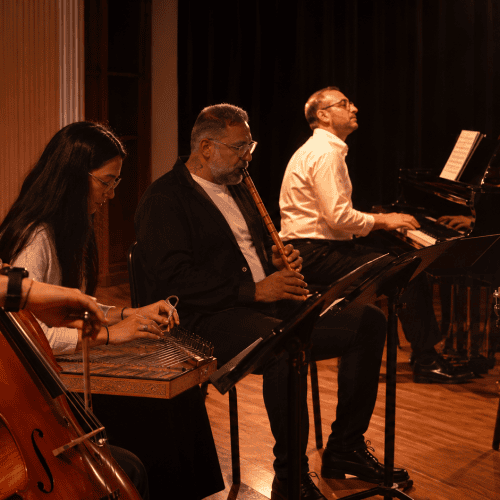
Saeed Kamjoo (kamancheh), Madeleine Owen (lute, theorbo), Maryam Tazhdeh (tar), Sheila Hannigan (cello), Hamin Honari (percussions)
First Part :
The Garden of Roses, a creation by
Saeed Kamjoo and Juulie Rousseau
Voices
Juulie Rousseau, Habib Hosseini
Musicians
Saeed Kamjoo (kamancheh), Madeleine Owen (lute, theorbo), Maryam Tazhdeh (tar), Sheila Hannigan (cello), Hamin Honari (percussions)
Whirling Dervish
Shraddha Danielle Blaney