For almost two centuries, Schumann’s Kreisleriana has been an enigma for pianists and music lovers. A riddle of a spiritual and interpretative nature. The meaning (or meanings) hidden in this cycle of eight short complex constructions, tinged with hermetic hermeneutics, remain completely open to discussion and interpretation even today. Schumann wrote them thinking of Clara, but dedicated them to Chopin (to avoid the wrath of Clara’s father, the Bogeyman of music history). One could settle the matter by taking them for mere sentimental trifles of Romanticism. But, of course, it is nothing of the sort. First of all, because: Schumann. An extraordinary genius who was incapable of writing anything superficial and venal. Then, and above all, because this particular work is based on a fictional character created by E.T.A. Hoffmann, Johannes Kreisler, a minor music master, both eccentric and reputedly mad, but ultimately much more insightful and complex.
Schumann evokes the character in question, but in what exact manner? No gallery of characters here, no descriptive portraits. Rather subtle references, spectres of meaning, known only to Schumann, and probably guessed and grasped by Clara, of course. All woven into romantic and emotional codes that permeated the 19th-century zeitgeist, but which fade as time distances us from them. That said, it is precisely this significance, still muddled by the temporal distance, the composer’s writing secrets, and the intricate web of affinities between musical and literary arts, that continues to elevate the aura of this exceptional masterpiece.
The pianist Meagan Milatz is an artist I really like. She possesses an intellectual maturity well beyond her young age, in addition to demonstrating excellent technical abilities. This virtuous combination often ensures that she offers interpretations of rare discursive and sonic clarity. Having heard her several times in concert, I can attest that it is a joy to hear her interpret the romantic and modern repertoire, where she excels.
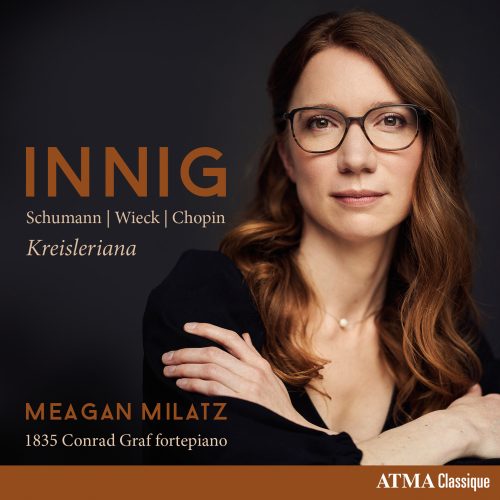
For this album, titled Innig, a German word that resists precise translation and evokes an interiority that is both spiritual, emotional, and intellectual, she undertook a thorough work of reflection and analysis in order to perhaps reach the essence and meaning of this masterpiece.
Based on readings (Hoffmann, of course, but also Schumann’s correspondence and subsequent analyses on him and his music), meticulous research, listening, and informed intuition, she has constructed a kind of musical thesis on the Kreisleriana, in relation to other works by Schumann as well as in the historical-musical context of the time of their composition.
She deduced three keys to understanding in order to grasp this music. Many other analyses of Kreisleriana exist of course. Without revolutionising the exegesis of the piece, the Montreal based artist nevertheless brings a personal vision that has a specific colour: the use of a 1835 pianoforte, signed by Conrad Graf. An instrument whose sound is certainly the one that would have emerged from Schumann’s own fingers, or Clara’s. We’ll come back to it.
The first key is the idea of “illuminating reminiscence.” Ability, she says, to look back on the past and understand everything that has happened in an entirely new light thanks to information revealed late. She identifies in the first piece of the cycle, “lost bass notes” that are found in the final piece, transformed, transfigured. Milatz therefore pushes her reading and understanding of the score into remote, very intimate interstices.
The second key identified is the role of madness and the musical fragment, intimately linked both in Hoffmann’s literary Kreisleriana and in Schumann’s musical iteration.
The very end of Schumann’s Opus 16, where the bouncy rhythms gradually disintegrate until they are nothing but distant fragments, seems to constitute a perfect musical transposition of this description of Johannes Kreisler’s apparent state of mind.
Hoffmann’s Kreisler reveals himself to be a thinker of great lucidity, capable of depth and humour.
I see a true key to understanding both the supposed madness of Kreisler and the one that seems to inhabit Schumann’s Kreisleriana.
In an essay by Hoffmann titled Letter from the Kapellmeister Kreisler to Baron Wallborn, the author has Kreisler say: So many things simply stem from the spells led by my own notes. Often they come to life and leap from the white pages like little black devils with a thousand tails. They drag me into a furious whirlwind, and I make extraordinary leaps and indecent grimaces. But a single note, emerging from a sacred glow, calms this tumult, and I become pious, kind, and patient once more!
Milatz returns to it when she justifies the title of the album, which refers to this tumultuous intimacy, finally calmed by music in Schumann, the Innig.
Finally, the pianist identifies the third key as the discovery of a fragment of Der Dichter Spricht (The Poet Speaks) from Kinderszenen, op. 15, buried at the heart of Kreisleriana.
At the very end of No. 2, in the three concluding measures marked Adagio in the original version of Kreisleriana, a subtly disguised quotation of the first five notes of Der Dichter Spricht appears.
Thus, Milatz certainly brings a very personal, somewhat bold but justified perspective. In my opinion, the pianist possesses one of the most clear and articulated playing techniques of the current generation of Canadian pianists. Her intelligence and narrative coherence make her one of the best “storytellers” on the musical scene. Under her fingers, and through a subtle and discreet sensitivity, the scores of the core repertoire come to life, taking shape transparently, while the complex constructions give the impression of being easily understandable.
The lady does not deviate from her habits here. The Kreisler/Schumann duo loses its hermeticism to frolic in the spotlight. Maybe even a bit too much? By placing so much emphasis on structural understanding, one somewhat abandons the necessary nebulosity that should envelop the score and magnify its ineffable charm. For example, the intuitive poetry of Murray Perahia is here replaced by a fascinating and inspiring discourse, but more Cartesian. On the dynamic side, the sometimes violent contrasts, almost extreme (Horowitz), do not inform Milatz’s interpretation. Her attacks are more respectful, perhaps even tender. But, always, those impeccable phrases, that clarity of lines, and that mastery of the narrative and its multiple nuances that foster emotion and the pleasure of active listening.
Beyond all that, the main hallmark of this recording is the use of the aforementioned Conrad Graf pianoforte, which plays an important role in its colour and illumination. A brilliant sound, which initially appears gaudy, but warms up to the ear as one progresses. It might also be because of this somewhat raw brilliance, which reveals the work like X-rays reveal an individual’s skeleton, that a bit of poetry and mystery are taken away from this reading, as I mentioned earlier.
If the idea is good and historically justified, I remain unsure about the final result. The muted tones, the natural shading, and the fleshy, organic muscularity of modern pianos in most reference versions are what I miss. After five attentive listens, that said, I am warming up to the result, and I increasingly appreciate Meagan Milatz’s initiative. It’s a good sign, I want to go back often.
The strength of this album also lies in its conceptual programming, which highlights the Kreisleriana in their social and cultural context. In addition to illustrating some of the ideas that support its relevance, such as these echoes of Kinderszenen (Der Dichter Spricht) in Kreisleriana (and by playing, in turn, two excerpts from Kinderszenen), Milatz also adds four Preludes from Chopin’s Op. 28, and four Soirées musicales from Clara Wieck-Schumann’s Op. 6. The entirety of the spectres that inhabited Schumann’s mind during the writing of Kreisleriana is thus invoked, like witnesses for the prosecution, confirming that the composer’s mental maelstrom was based on values as assured as they were ineffable.
If the pieces in question were chosen (particularly in the case of Chopin) for their timbral character allowing the Conrad Graf pianoforte to showcase the extent of its sparkling qualities, they also provide a beautiful resonance to the expressive contrasts and knife-cut change of ideas, of Kreisleriana.
Inning is much more than just an album; it is an enlightening commentary on Schumann and one of his most misunderstood works.