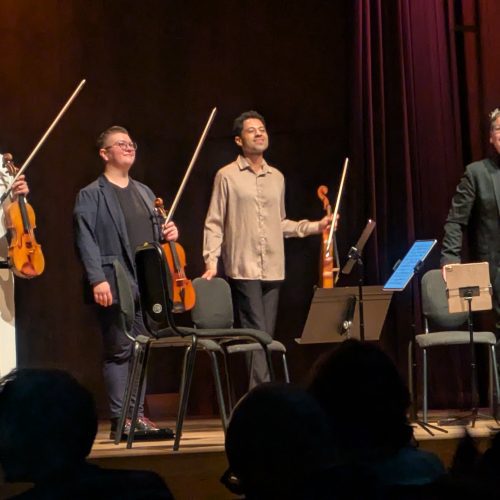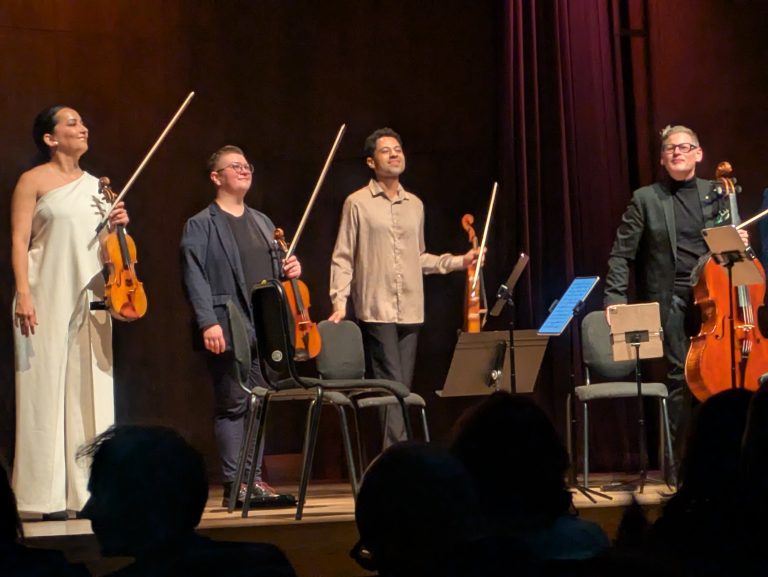
A beautiful program of discoveries and sure values, linked by evident stylistic coherence, that is the essence of last night’s lineup at the Bourgie Hall. At least the conceptual essence, because at the musical and artistic level, it was a demonstration of excellence. These four artists are, together, fabulous storytellers. Each piece, each movement becomes an episode of an exciting series that we devour while waiting for the next one. It’s a shame that the audience felt obliged to applaud between each movement.
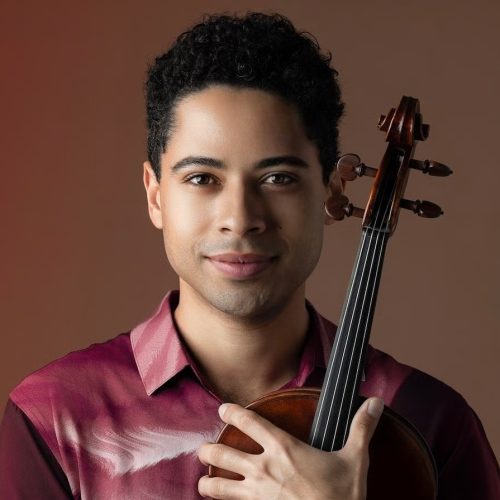
In this program featuring two well-crafted works by Afro-British (and partially Sierra Leonean) Samuel Coleridge-Taylor (1875-1912), namely the Five Fantasiestücke for string quartet, op. 5, and the Clarinet Quintet in F-sharp minor, op. 10, as well as Dvořák’s String Quintet No. 3 in E-flat major, op. 97, “American,” the Catalyst Quartet was joined by violist Jordan Bak, who integrated into the ensemble in two of the three works on the program (the two quintets).
From the very first movement of the Fantasiestücke, one is captivated. The clarity of the lines, the surgical precision of the articulations, and the passion infused into the music evoke beautiful emotions in music lovers. These are youthful pieces by Coleridge-Taylor that we discover here, but they already demonstrate a solid mastery of the essential foundations of great music: a sense of construction, the creation of notable colours, and above all, evident melodic skills. Pieces based on folklore that above all testify to a real sublimation of the original material. It is Dvořák-like, of course, but excellent Dvořák. One might say that Coleridge-Taylor does not yet exhibit a strong personality, which is probably to be expected in a young man, but the qualities that are evidently combined in a single mind are impressive enough to suggest a bright future. Which will be the case, but too briefly, as Coleridge-Taylor will die at the age of only 37 from pneumonia. Listen to his cantata Hiawatha to be convinced of the expressive and creative power of the one whom some called in his time, the “Black Mahler.”
The violist Jordan Bak joined the Quartet for the next piece, the Clarinet Quintet by the same Coleridge-Taylor. Obviously, the clarinet was replaced by the alto here. The difference in timbre between the clarinet and the viola may not do the latter any favours. The “blend” with the rest of the strings often makes the extra viola disappear. Originally, the colour of the clarinet was enough to make its interventions stand out compared to the strings, which is not the case with the viola.
It truly becomes a string quintet, in fact. But a most charming quintet with, once again, Coleridge-Taylor’s innate sense for effective construction and seductive melodies. Bak and Catalyst gave their all, revealing a work that one will want to hear again and again.
I would like to highlight the series of four albums (titled Uncovered) released by Catalyst Quartet on Afro-descendant composers, which I strongly encourage you to explore at this link. Coleridge-Taylor, of course, but also William Grant Still, Chevalier de Saint-Georges, George Walker, Florence Price. The series, played with such authentic respect, is captivating.
The evening ended with Dvořák’s Quintet No. 3, the heart-pounding centrepiece of the concert. Catalyst unfolds, without a hitch, a remarkable discursive clarity. Everything is crystal-like, every twist, every bounce, every transition of the score has its place and suffers from no narrative ambiguity. The clear resonances with the style and melodic themes of the 9th Symphony are more than evident, and magnified by the musicians. Vibrant solos of intensity are to be highlighted (Paul Laraia on the viola and Abi Fayette on the violin). Impeccable technique, assured accuracy, total commitment.
In that, Bak stands out more strongly than in Coleridge-Taylor. Of course, his score was designed to complement that of the other four instruments in a relevant way. Now, one perceives from him a beautiful warm and ample sound, displaying a seductive dark colour, but quite clear. This makes one want to hear him in a concerto setting or as a soloist more detached from the collective play.
The concert was organised in collaboration with the Afro-Canadian Cultural Center of Montreal (CCAM), the Jamaican Association of Montreal (JAM), and the Round Table for Black History Month. An admirable initiative.
It was the first visit of the Catalyst, and Jordan Bak, in Montreal. If the programmers have any sense at all, it won’t be the only one.