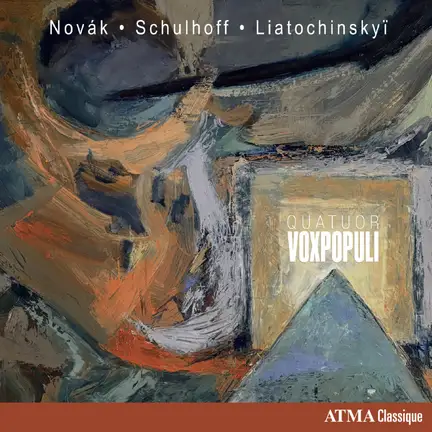
The Voxpopuli Quartet secures a privileged place on my list of the best releases of 2026 with this masterful program dedicated to three lesser-known composers of the 20th century. Represented are the Czech Vítězslav Novák (1870-1949), the Austro-Czech Erwin Schulhoff (1894-1942), and the Ukrainian Borys Liatochynsky (1894-1968). For each of them, a powerful masterpiece of compositional richness. Let’s take a quick tour.
Novák’s String Quartet No. 2 dates from 1904 and was composed after a stay in the forests of the Wallachia region. The two movements (unusual structure) are densely constructed with rich, dark, and serious harmonies. The first movement is a long, opulent fugue like dark purple corduroy velvet. One quickly gets the impression of being enveloped by this generous texture. The second movement takes on the guise of folk music, deployed with dramatic energy. The theme of the fugue returns at the end. It is a work straddling the Late Romanticism and the beginning of Modernism that deserves to be heard much more often. An undeniable masterpiece.
Erwin Schulhoff is one of those Jewish composers whom the Nazis declared “degenerate” before sending them to die in the death camps. The Five Pieces for String Quartet WV68 are short character works based on as many folk dances (a waltz, a serenade, a “Czech dance,” a tango, and a tarantella). The rhythms and intonations particular to each have been filtered through the sieve of harmonic modernism but in a manner that recalls Stravinsky’s neoclassicism. It’s full of colours and stimulating textures.
Liatochynskyï is another composer who was systematically erased from history. Ukrainian in a highly Russified USSR, his name was deliberately forgotten by the Soviet authorities. But art is not so easily obscured, fortunately. The Quartet No. 4 is also titled Suite on Ukrainian Themes and was written during the Second World War, in 1943. The five movements progress the music from an initial feeling of gloom towards more light, particularly in the last movement, which resonates most clearly as material inspired by national folklore. There are moments of magnificent musical beauty, such as in the third movement (Allegro ben ritmico) where the composer creates a short episode of superb luminosity between the two outer, dancing sections. This gem is rarely heard, and this interpretation by the Voxpopuli Quartet provides a rare opportunity to hear it.
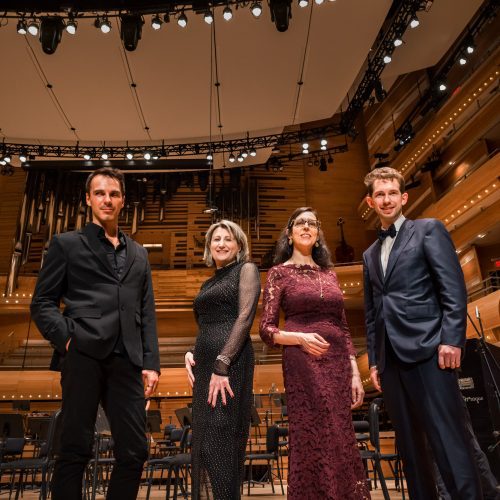
Especially since the four Quebecers, Antoine Bareil (violin), Uliana Drugova (violin), Lambert Chen (viola), and Dominique Beauséjour-Ostiguy (cello), are clearly deeply invested in this touching and captivating music. A performance full of nuances, without tonal flaws, supported by a strong conviction in the quality of this music, a conviction that ultimately reaches us completely.
An important album, if only to allow us to hear music that has been too long overlooked and which finds here interpretations that leave a mark.
The Voxpopuli Quartet will perform all the music from the album in concert on June 11, 2026, at the Sainte-Hilda Hall in Montreal.