Additional Information
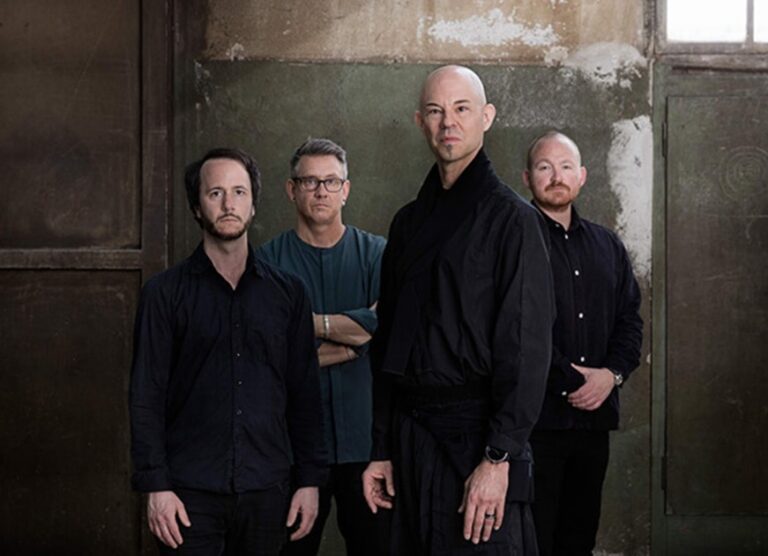
For almost two decades, Helvetian pianist and composer Nik Bärtsch and Ronin, his futuristic jazz quartet, have been perfecting a solid blend based on the composition of contemporary structures and the assumption of a groove based on rhythmic phase shifts, with less emphasis on long improvisations. His many albums bear witness to this singularity, and the pianist and composer can be described as a visionary for having achieved this perfect fusion. That’s why a visit to this group is an absolute must for fans of small contemporary jazz formations. Sunday evening at the Gesù! For PAN M 360, Alain Brunet asked Nik Bärtsch a few questions while he was on tour on this continent before taking part in the Montreal en lumière Festival.
PAN M 360: Two decades ago, your ensemble emerged as a beautiful hybrid between new jazz and post-minimalism, kind of close to the Steve Reich concept of phase shifts but it would be reductive to qualify it that way. Are you still building on the same foundations?
Nik Bärtsch: Yes, since also already there we matched more ingredients: groove culture and percussive band organism play. We developed our own path by blending these ingredients and we’re constantly evolving – on the one hand me as a curious consequent composer and on the other hand the band an evolutionary organism that has played every week together since 2004. Every Monday we play a concert at my club EXIL in Zuh since 2004.
PAN M 360: Can you remind us of those foundations?
Nik Bärtsch: I started with Boogie-Woogie, Blues and Jazz, shifting into Latin and via Gershwin into modern Classical Music like Bartók, Stravinsky, then Reich, Ligeti, and Feldman and always was interested in rhythmic concepts and group instrumentation. So I developed a view for rhythm strategies through all styles.
PAN M 360: Can you explain briefly the main steps of your musical language evolution through your discography since Ritual Groove Music?
Nik Bärtsch: We started with the acoustic group MOBILE. I wrote a chamber music piece for my final recital at the music university. It was influenced by Bartók, Reich, and Japanese Ritual Music. Earlier I wrote groove cycles inspired by Steve Coleman and Reich. So this led to the first MOBILE record RITUAL GROOVE MUSIC, which we recorded after a 36-hour-long live musical ritual in Zurich, our first performance in that spirit. Important was the combination of clearly composed material and the freedom to work with it modularly during the open minimal parts in that constantly ongoing live music ritual. Thus was the fundamental and fruitful experience for us as a band with the strategies of groove, interlocking rhythms, polymetric cycles, elliptic beats, polar scale fields, and structural harmonies – this sounds a bit intellectual but it was actually a very sensual experience creating a new sound and way of band play. So this led finally to an evolution of 14 main albums till today with SPIN as the newest result. Every album explores a certain phase and every composition touches a new essential musical idea.
PAN M 360 : The notion of improvisation is still included in your music but not that much as we can observe. Where do you see it in your craft?
Nik Bärtsch: Improvisation is very important. I was always present in music as a part of a triangle with composition and interpretation. But improvising does not necessarily mean soloing. So we use a lot of improvisation strategies that do not sound like a solo. For example, we work with freedom of instrumental blending and colouring, ghost note developments – like adding little notes in the dramaturgy of a piece – or with one free voice in the band as a “context spot.” This means that the player has the role of moving in a musically-composed context like an animal who hides itself in the surroundings: when it moves you see it when it doesn’t, you just see the whole picture. Improvisation is also often used in our music laconically, like for example Duke Ellington just played a few notes or lines to give a part a certain flavour.
PAN M 360: Do you see yourself more as a composer than a performer or vice versa? Do you rather aim for a perfect balance between playing and imagining music? Or do you see things in different ways ?
Nik Bärtsch: The performance is the truth. The best composition does not sound if the band or context is not appropriately chosen. So my/our work is a combination of both: I have the ambition to bring a high-quality composition into the band by responding to the quality of the band or performer. That’s why we play so long and every week together. The performance is the composition and vice versa.
PAN M 360: Would you see your colleagues roles closer to classical interpreters or jazz people? Or somewhere between both?
Nik Bärtsch: I was longing for a third way, combining the freedom of jazz world and the precision in interpretation and instrumentation of the classical world. So that’s who my modular way of making music evolved: precise composition in relation to the quality of the interpreting players and bands.
PAN M 360 : Tell us about your team of musicians, their role, their strengths,and what they have to do for your artistic building.
Nik Bärtsch: First of all it is important to know that I have played together with drummer Kaspar Rast since we were kids. We started making music (and playing soccer on the same team) together when I was ten and he was nine years old. So his drumming influenced my way of writing essentially, also because I also played drums as a kid. Reeds player Sha, who is ten years younger, came to the band when he was 19 years old. He had a fresh mind and developed on the bass clarinet a form of percussive beatboxing. He also was a passionate soccer player and therefore his knowledge about team play and team spirit was highly developed compared to all the jazz artists mainly focusing on being a capable soloist. This led to true team in working. This also means that my colleagues give valuable feedback regarding compositions. When the bass player change came six years ago we found in Jeremias Keller a like-minded musician with enormous qualities also as producer. This is a real working band, socially, energetically and aesthetically. Very difficult to put together in these times!
PAN M 360 : We shouldn’t care about where you sit stylistically, only the result matters. But are you mainly reaching out to jazz aficionados because of the instrumentation and its rhythmic proposal?
Nik Bärtsch: We want to listen to the resonance of the audiences. There is interest from very diverse scenes – beautiful! We also have a lot of followers from rock and electronica people or from spiritual music scenes. I never was interested in styles when they were meant as musical ideologies. I find inviting and sharing interesting. I try to create simple music that is complex in the deep when you dive into it. But mainly it should offer you energy and focus.
PAN M 360 : Spin, your last recording, was released last year. For you, what are the main achievements of this specific project?
Nik Bärtsch: The record shows the phase of the band: two completely new pieces, one as a combination of new material with older one, two very early pieces in completely new arrangements. So the record first of all shows the sound and energy of the new quartet with new bass player Jeremias Keller. And then it shows our journey. Forward to the roots, back to the future.
PAN M 360 : Is your band going to perform your recent material in Montreal, next Sunday?
Nik Bärtsch: Yes, we will play almost the whole record and the great piece “A” by reeds player Sha, which was on our last album AWASE. The whole material has already evolved again live…And of course, we have surprises for you!
PAN M 360 : Many composers need a specific band to express their music. When it’s done by others, it doesn’t work so well because they don’t get the real vibe, because they just have an intellectual understanding of your work. What do you think?
Nik Bärtsch: This is an important issue. Actually every new music needs such an understanding. Also in times of Mozart and Haydn, very often the ensembles worked longer together for a certain Duke or King or whatever dude. Capable ensembles with the understanding of a certain music culture are essential to make the music sound. To think, a musical masterpiece is the composition just on paper or in the head is negligent. It’s as if you would live in an architect‘s plan instead if a real house. Of course, a capable composer or architect must be clear and as precise as possible for the context but you name it: without the vibe, the culture, the understanding nothing feels right.
PAN M 360 : About your work for other ensembles or orchestras? I don’t even know if this work exists.
Nik Bärtsch: Yes, I wrote several pieces for external groups for example chamber music works, often for percussion ensembles but also a few full orchestra pieces. Although it is the “same” music, I have to adapt to the circumstances because of the reasons we discussed above. The most known ensembles for which I wrote were for example Third Coast Percussion from Chicago, Bang On A Can from New York, Britten Sinfonia from London or the Basel Sinfonietta in Switzerland.
PAN M 360 : You also have connections with other musicians or bands from all over the world, some of them are releasing stuff on your own label. Can you talk about this aspect of your creative life?
Nik Bärtsch: I find it important to share knowledge-how and to create platforms also for others. If you do nothing for others, nothing changes in a community. Therefore I founded my boutique label Ronin Rhythm Records and I co-founded the music club EXIL in Zurich and the contemporary music festival CURRENTS in Zurich. These initiatives give upcoming artists and colleagues with like-minded ideas chances to perform and to evolve. We for example will release the new album Ce qui tourne dans l‘air by Montreal avant folk band L‘Oumigmag in April on my label.
PAN M 360 : What are your next projects?
Nik Bärtsch: Staying on these projects! Too much work…I also have two beautiful duo projects: a piano duo with pianist Tania Giannouli and one with my daughter Ilva Eigus, who is an extraordinary violinist, already more capable than me with only 17 years!