Additional Information
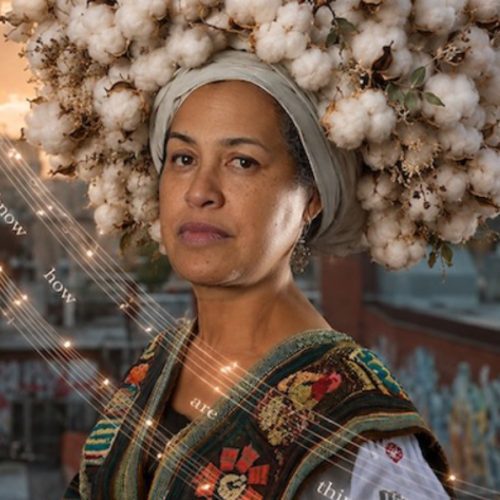
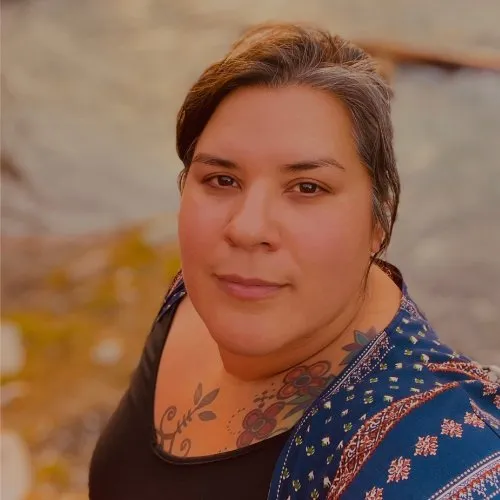
Indigenous chants, melodies, and traditional songs from Europe and the Americas for voice and instrumental ensemble—that’s what the closing concert of the Festival du Bic has in store. PANM 360 caught up with multidisciplinary Indigenous artist Natalie Sappier (Samaqani Cocahq) to discuss her artistic practice, as well as her role in the upcoming August 8th concert.
PANM 360: For someone who is maybe less familiar with your work as an artist. Can you tell me a bit more about yourself and what do you do as an artist?
Natalie Sappier: Samaqani Cocahq, I am a Wolastoq Indigenous interdisciplinary artist. I live in Tobique First Nation, New Brunswick. I have been creating for close to 20 years paintings, designs, songs, plays. I’m mostly known for my paintings and design work that is inspired by our Wolastoq Wabanaki motifs. In my first play, Finding Wolastoq Voice, I wrote it but also composed the music of the play. That was the first Wolastoq play that hit the stages in New Brunswick as well as toured in Canada, in places such as the National Arts Centre, Winnipeg, Toronto.
I work a lot closely with other Indigenous artists, dancers, creators, musicians, writers, and language carriers. That’s pretty much what I do. I tell stories in many ways.
PANM 360: Can you tell me now a bit more about what was your part in the conception of the concert?
Natalie Sappier: I’m coming in as the main performer and I brought along my friend, Judy Aquin, to come in to share the songs with me. She’s been part of creating some of the songs with me for my play Finalistic Voices, the background vocals, extra vocals, and chants.
I thought it’d be wonderful to bring her along so we’re able to share songs that come from New Brunswick, but also a language that carries through Quebec as well. I was really inspired that the concert, Wolastoq’inil, is being performed by the river. I wanted to honour songs of the water because as Wolastoq’inil people, what has been translated into is the People of the beautiful river. I was very inspired by that.
I’ll be performing some of my own chants, but as well as our traditional chants. It’ll also be narrated by my partner, Justin Mann. As for the second one, I really wanted to bring some of our traditional songs forward and to share songs of friendship, ancestral songs and callings. I was just very excited to share our songs, to be able to sing them for people, to build new friendships, and to connect with a place of land I never performed in.
PANM 360: The concert will be with other artists singing in other languages from other countries. What do you find interesting about mixing those different melodies from different traditions into one concert?
Natalie Sappier: I think it’s beautiful. It carries many languages. We may not understand the words that they’re saying, but we can feel what they’re expressing.
That is a very beautiful and powerful way of getting to know each other. I think it’s very important, especially at this time, for us to gather as much as we can to share stories of our history and our culture and what we are feeling and what is happening and what we want to move forward with. And also teachings from all over the place, teachings of how to get through life, teachings of love and compassion and courage. I’m very excited to witness some of the performances. I really look forward to that.
PANM 360: Finally, what do you want the audience to keep from this concert?
Natalie Sappier: In what we do, there are a lot of songs of gratitude regarding what is around us, which is the creation, the land, the water, the sky.
It gives gratitude to our Mother Earth. And I hope it inspires others to feel that connection to Mother Earth, that it is their mother and it is our responsibility to take care of her. It is our responsibility to sing for her because she sings for us every day.
You hear the wind, you hear the waves, you hear Earth every day. And I think that it’s good medicine for us to sing to her as well. And that we are all brothers and sisters, right?
So, for us to build those relationships and nourishing those relationships are very important. And to collaborate and to create and share music is a wonderful way to do that.