Additional Information
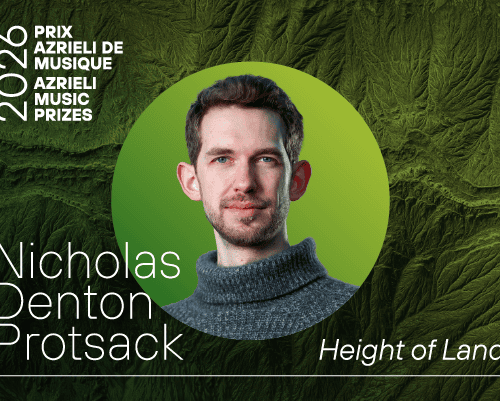
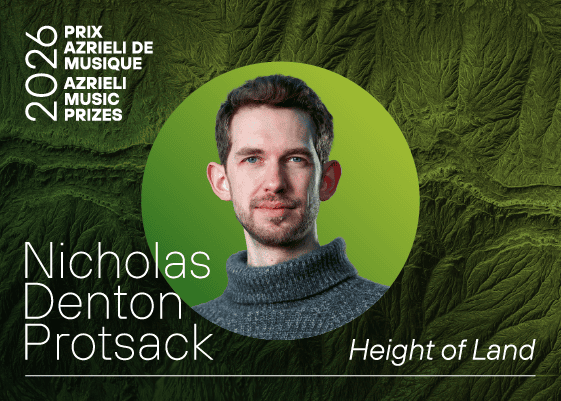
In just a little over a dozen years and six editions, the Azrieli Music Prizes have become one of the most prestigious music composition competitions on the planet when it comes to contemporary music. They were created in 2014 by Sharon Azrieli and are divided into four categories: the Azrieli Commission for Canadian Music, the Azrieli Commission for International Music , the Azrieli Commission for Jewish Music, and the Azrieli Prize for Jewish Music. Three original creations, then, as well as a prize for an already existing, but recent, piece of music. Each prize is worth approximately $250,000, which includes $50,000 in cash, as well as a value of around $200,000 for stage performances, international broadcasts, recordings, etc. It’s substantial. The gala concert that will present the works chosen for the 2026 edition to the public will take place on Thursday, October 15, at the Maison symphonique de Montréal, with the Orchestre symphonique de Montréal, the OSM Choir, and various soloists under the direction of Asher Fisch. PanM360 spoke with each of the composers. HERE, CANADIAN NICHOLAS DENTON PROTSACK (2026 Azrieli Commission for Canadian Music).
PANM360 : In one short sentence, what is your composition about?
NICHOLAS DENTON PROTSACK : The most fundamental aspect is that it asks the following question : can classical music, as we know it, exist in reciprocal terms with the natural world? That is, whether you can create a work of concert music that isn’t just about the natural world, but is created in collaboration with the natural world, for the benefit and advocacy of the natural world.
And I think there are many dimensions to that question. There’s many ways that one can approach it. And this work, basically, in its 17-ish minutes of duration, looks at the many different facets from the way in which one can approach that question and the complexities that exist around that question.
PANM360 : How does this piece answer the question that you just asked, and not be talk about nature, like others do?
NICHOLAS DENTON PROTSACK : One thing I will say is that it isn’t actually necessarily about answering the question. I don’t presume to have the answers for the complexities of these questions, but rather the piece is the question itself. And I would say that the ways in which I encounter this question and sort of allow the audience to draw their own conclusions about it is that there are parts of it in which I really try to work directly with the sounds of landscapes that I’m very familiar with.
PANM360 : Do you mean tape sounds?
NICHOLAS DENTON PROTSACK : No, not like that. What I mean is it’s metaphorical. In a lot of other kinds of music, there is an attempt often to bring sounds from nature into the music such that they are used in a way that would be seen as musical.
But for me, the approach that I have taken with this work is actually the exact opposite. I am trying to find a way to bring music into these sounds. I don’t attempt to use the sounds in a way that is made musically palatable.
I attempt to create very, very close representations, close reproductions of these sounds using the instruments. Maybe similar to the way that a spectralist might. Again, with spectralism, it’s about working with the characteristics of the sound to develop a musical language.
But for me, the musical language itself is the sounds. I just basically put them together and work with them in such a way that they are allowed to speak on their own terms as much as is possible from the perspective of a subjective person like myself. So, that’s one element of the work.
PANM360 : I guess this doesn’t mean either that there is pure imitation?
NICHOLAS DENTON PROTSACK : It’s not pure imitation, no. Again, it’s very complicated and there are a number of different elements at play. One thing that I find very interesting, if you look at the music of certain indigenous populations, non-urbanized cultures in places such as Papua New Guinea or in Central America, there is a very interesting encountering that occurs between the sounds of, for instance, birdsong and music.
If you look at people like the Mayos Yoreme, who are in Central America, there are certain musical practices where one plays flute and the drum at the same time. I’m getting to a point with this where essentially, to maybe a Western ear, it would sound as if someone is just imitating birdsong. But then if you were to talk to a practitioner of this music, what they say is that, no, I’m not just imitating birdsong. Through music, I am becoming a bird. When I play this music, I’m a bird.
PANM360 : Ok, this is a much deeper involvement…
NICHOLAS DENTON PROTSACK : Yes. One thing that I’d like to talk about in my research is that there is a difference between evoking nature and invoking nature. Do you see what I’m saying? I think, again, part of the difficulty of this piece is the question of whether concert music as we know it is furnished with the tools that would allow one to invoke nature. That’s why I think this piece is a question and less an answer. It’s an attempt, it’s a struggle to try to invoke nature, to try to exist with it on reciprocal terms. Perhaps the piece fails. Who knows? I think it’s up to the audience to decide whether it is successful or not.
PANM360 : Are you satisfied with what you came up with even though you don’t answer the question?
NICHOLAS DENTON PROTSACK : I feel satisfied with the explorations that I have done. I feel that I’ve created something that is true to my voice and to what I wish to say as a composer. I would say that I strove a lot for authenticity, at least in the elements in which I’m encountering with these sounds of nature.
That’s one part of the work and I’ll get into the other part in a second. I specifically wanted to encounter sounds that I grew up with, ones that I would have lived around in the Okanagan Valley (British Columbia), ones that are deeply internalized by me. But I think that it was actually a very challenging process because I had to ask myself some difficult questions in trying to create this authentic kind of music.
Like for instance, do I in my music really collaborate with nature or am I just looking for elements in nature that I find interesting and extracting those interesting elements and using them to kind of populate my music with novelties? And I had to ask this question very deeply and sincerely to myself. I think the music that I have come up with for this work does, to my own ear, feel like an authentic expression of my understanding of the natural world.
But the other movements of the work, and this is the secondary part, they also discuss the difficulty of thinking of oneself as separate from the natural world and the violence that people encounter when the prevailing attitude is such that humans are separate from nature. The violence that humans commit against nature and against one another. So there are elements of the work that for a little while actually go a bit away from simply interacting with these natural sounds and instead describe and metaphor this kind of violent history that has existed between nature and humanity and also just thinking of land as something that is owned by people rather than the other way around.
So in that way, the work is also an attempt to advocate for the agency of nature, I would say as well. So there’s a two-pronged approach in the work that encounters this question, this central question.
PANM360 : You are Canadian, but are based in New Zealand. What brought you there?
NICHOLAS DENTON PROTSACK : It’s sort of a long story, but to make it short, during COVID, I became really interested in the work of a composer there named Michael Norris. I also became really interested in the kind of new music scene that exists in New Zealand. And I felt that both Michael’s music and a lot of the music that is being created there was quite aligned with the kind of music that I was interested in making at the time and still am interested in doing. A kind of music that’s very aligned with and thinks collaboratively about the environment. He wrote a work called Rerenga for taonga puoro, orchestra and live electronics. The taonga puoro is an indigenous instrument from New Zealand. I just thought that the colors of this work were incredible, and the way that he thought of the orchestra as kind of an environment for the taonga puoro to live in, I just loved. Making the orchestra as an environmental entity, a kind of sonic landscape. I found it very, very inspiring and interesting. So I went there to do my PhD, and stayed. I also met my wife, Kate.
But I still think of myself very much as a Canadian composer. And I do think actually, in many ways, being in New Zealand has given me a different perspective on Canadian music, and it really enriched my perspective on it.
PANM360 : What do you mean?
NICHOLAS DENTON PROTSACK : I think that, oddly, New Zealand and Canada actually have quite a lot in common in their histories. They’re both countries that have a very complicated past with colonialism. They’re both countries that are quite sparsely populated, considering the land masses that exist there.
They have a very complicated and violent, but very rich history as well, between First Nations people and the broader sort of colonial societies that have formed there on whole. As a result of all of these elements, there is a very interesting culture that has emerged in both New Zealand and Canada that is quite concerned with interaction with the environment. In Canada, you can see quite a history of music like that in the kind of, for lack of a better word, post-classical music world, like with Hildegard Westerkamp, R. Murray Schaeffer, Barry Truax, those sort of soundscape movement composers. In New Zealand, there is very much a similar movement that has occurred there, but I would say is occurring right now. And seeing the ways in which those ideas are cropping up in New Zealand has given me new perspectives on the ways in which those ideas have cropped up in Canada in the past.
And I would just say in general, there’s a lot of other funny coincidences. In the case of New Zealand, you have a country with a very historied and tight relationship with a bigger country next door. And New Zealanders are seen as very friendly and sort of soft-spoken, compared to their bigger neighbour. Australians are seen as a lot more, you know, maybe gruff, which would be a bit of a stereotype, of course. But it’s just an interesting thing to look at Australia and New Zealand’s relationship versus the US and Canada. Yeah, I think they’re very, in some ways, we’re sort of sibling countries.
PANM360 : How do you feel about receiving the 2026 Azrieli Commission for Canadian Music? What does it represent for you?
NICHOLAS DENTON PROTSACK : It was an incredibly humbling experience, I have to say. This is a very prestigious award and one that I did not expect to receive at this point in my career. It was the kind of thing I thought I would be applying for many years for and potentially not winning ever. I really wanted to put everything that I could into expressing some of these fundamental ideas that I’ve been sort of exploring a little bit in some of my other works and really digging into them and utilizing this opportunity to its fullest potential. Because it really is an incredible opportunity. The resources that are put into a work like this, the incredible artists that I’ll be working with, it’s very humbling and something I’m extremely grateful for.
PANM360 : Thank you