Additional Information
Let’s face it: the nephew of the great Franco-Lebanese essayist Amin Maalouf has achieved comparable fame, this time in the world of cutting-edge global music. In April 2027, he will perform in front of 40,000 people in Paris as a soloist with guest artists. As of July 2026, Ibrahim Maalouf has been performing in Montreal for several years to generally sold-out venues, and embodies the diversity of the jazz scene in France, where he grew up.
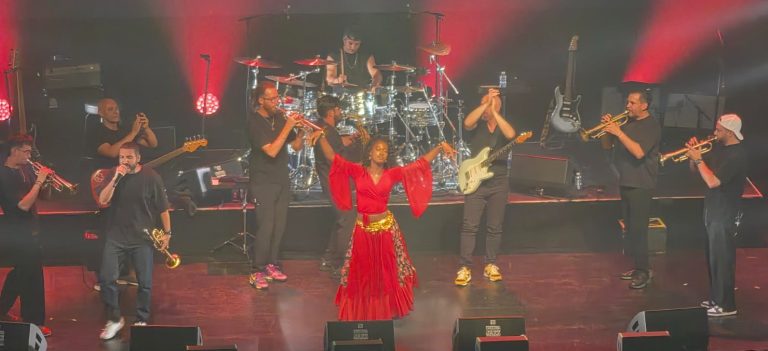
On Thursday evening, the MTELUS was packed to capacity to celebrate The Trumpets of Michelangelo.
Spanning two albums (Vol. 1 and Vol. 2), this project features five modified trumpets, with the aim of showcasing this instrument, for which its inventor—Ibrahim’s father—had envisioned a bright future half a century earlier. Equipped with four valves instead of three, this trumpet can play Eastern modes and faithfully reproduce their melodic lines—allowing for the use of quarter-tones in addition to Western semitones.
Today, my son is still one of the few people who play this modified trumpet, which has led him to promote it through a successful artistic project. As proof, Ibrahim Maalouf plays to sold-out crowds wherever he goes. And his fans go wild—needless to say.
An excellent motivator and a true showman, the musician takes his charm all the way to proposing marriage to the audience, who spontaneously play along, drawing even closer to the host.
Thus, Michel-Ange’s *Les Trompettes* leave no room for overthinking and treat us to a string of tracks perfect for dancing and celebrating—complete with a dancer! Drawing inspiration from Arab and Middle Eastern traditions, as well as African-American, Afro-Brazilian, Nigerian Afrobeat, and even Arab-Iberian influences, these pieces lean more toward popular styles than serious ones and allow plenty of room for improvisation, with jazz-oriented trumpets and alto saxophone, and a rhythm section rooted in Levantine traditions yet equally solid in jazz and other genres.
With the pedal to the metal, these musicians fuel the excitement of the audience, who are swept away by these wild tunes. A perfect storm!
Prior to that, Ibrahim Maalouf welcomed PAN M 360 into his dressing room for the following interview, conducted by Alain Brunet.
PAN M 360: Where do you stand today?
Ibrahim Maalouf : When I made my first album in 2007, I knew there would be two more albums like it because I was already working on them—I had them planned out, and I knew they were coming. But I really thought that once I’d done that, I’d done what I had to do. And I realized that exactly the opposite happened.
In other words, every time I felt like I was letting something out of me—freeing myself from what I’d wanted to express—15 other ideas would pop into my head. And over time—imagine, across 21 albums—I’ve accumulated a huge number of ideas that have emerged over the years and that I want to bring to life. And I have a list of projects in mind—some of which I’ve already recorded.
PAN M 360: So what are we talking about here?
Ibrahim Maalouf : “Les trompettes de Michel-Ange” is a trumpet ensemble accompanied by a rhythm section—bass, drums, and guitar—with a brass section and an alto saxophone up front, which gives my music a slightly gypsy-like feel. My saxophonist, Mihai Pîrvan, is an authentic Romani, and he brings something that’s very close to what I want to champion with this project.
PAN M 360: Where did this project originate?
Ibrahim Maalouf : Michelangelo’s Trumpets is truly one of those projects that was there from the beginning, one I was determined to bring to fruition. I dreamed of doing what I’m doing now. But I couldn’t because I lacked the experience to assemble the necessary group, and I also lacked the money. And above all, because legitimacy comes with time. And I’m independent; I’m not signed to a label. What’s certain is that freedom and independence can sometimes be a handicap; you have far fewer opportunities to finance what you envision. So it took a long time to finally find trumpet players who can play the instrument invented by my father 60 years ago, who are capable of playing the maqams (melodic and rhythmic patterns of classical Arabic music) and the quarter tones associated with them. It took me a very long time to achieve this. For me, Michelangelo’s Trumpets is the culmination and result of a project I’ve had in mind for over 30 years.
PAN M 360: Do you limit yourselves to Arabic maqams or do you also include Ottoman maqams, or even Persian dastgahs?
Ibrahim Maalouf : In fact, the scales of these cultures are remarkably similar. Personally, I don’t see any marked difference. It’s the same concept, the same families of melodic scales. I don’t really differentiate between them; I don’t think we should limit these identities, otherwise it becomes narrow-minded, and besides…
PAN M 360: Your uncle spoke so well about it in his essay “In the Name of Identity: Violence and the Need to Belong”.
Ibrahim Maalouf : This is my bedside book!