Additional Information
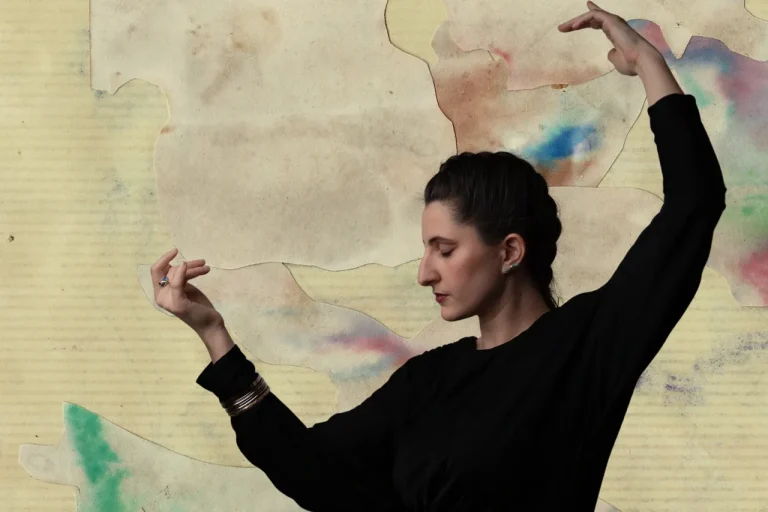
On the occasion of the Flux 2026 festival, composer Liberté-Anne Lymberiou will present her Frotae volume 2 for five saxophonist-improvisers at the Chapelle des Hospitalières. Let’s note the special appearance of the poet and slam artist Stella Adjokê. It will also be the occasion to launch the album of the same music, released on October 2, 2026, by Halocline Trance. So, I took the opportunity to meet the artist and chat with her about her music.
Also presented during the evening: The Mubone Collective, a musical ensemble that transforms physical gestures into spatialised sound. The concert is co-broadcast with Innovations en concert, Smallscale Music, and Mardi Spaghetti.
PanM360: Hi Liberté-Anne. Tell us about yourself first, if you don’t mind.
Liberté-Anne: I am primarily a composer, but also an improviser. I have several ensembles, including two main ones, Frotae, which is a saxophone quintet with whom I have released an album, and also a big band. I come from the jazz side (experimental jazz, contemporary jazz), so I work a lot with people from that field. Over the years, my practice has focused on composition. Now I am somewhat between two worlds, between jazz and contemporary music, musique actuelle, and there are many disparate influences in there. Everything is a beautiful blend, after all.
PanM360: What instrument do you play?
Liberté-Anne: I trained in singing. I have always played the piano on the side. In concert, I sometimes perform on the piano, improvising, and I also sing sometimes. In Frotae, I am in musical direction and artistic direction mode.
PanM360: Let’s talk about Frotae…
Liberté-Anne: As I briefly mentioned, I started my journey in a big band. In a big band, there are always five saxophones, two altos, two tenors, and one baritone. Several years ago, while doing a sectional of my compositions (a rehearsal) solely for the saxophone section, I was suddenly struck by the beauty of this section, just by itself.
I was so struck by the sound, the vibrations, and the quality of the breath and texture, that I thought I would like to do a project dedicated solely to saxophones.
PanM360: Frotae volume 2, it’s the first album. Where is Volume 1?
Liberté-Anne: Volume 1 is on SoundCloud, for the really curious nerds. But it was the first version of Frotae. In fact, Frotae has existed since 2017-18.
But the lineup has completely changed. Volume 1 represented my first experimentation with the group in 2018. We recorded a small demo, but the project stopped there for various reasons. But for me, the idea remained just as valid and intriguing. Then, the pandemic happened, so it was really difficult to resume the project. Finally, we have arrived here.
In my opinion, in Volume 1, there are all the materials, all the initial sketches of sonic and compositional interest. But now, I think we have really matured.
PanM360: How does Frotae volume 2 sound?
Liberté-Anne: We are in something meditative. We are also in a rather particular research area, which is microtonality. The entire album, except for the single that has already been released, is played in just intonation. It’s really nerdy, but basically, we’re stepping outside the equal temperament framework. I was curious to explore other systems, and in a way, we can invent systems too.
But I wanted to take on a challenge, from a philosophical standpoint. You know, we’ve forced world music so much to fit into our framework of twelve equal tones… We should make a reversal and try to enter a tonality that is not natural to the instrument. Obviously, the saxophone is designed to play in twelve equal tones, but there are all sorts of ways to step outside of that and do it in a very interesting way, with a lot of beauty, and I focused on that.
We spend a lot of time on the melody, but also on the texture of the sound and the reverb. There are many meditative passages. It’s very introspective.
PanM360: I can confirm that it’s very contemplative, quite ethereal. It sounds good. In your quintet, there is a glissotar. What is it?
Liberté-Anne: It’s a wind instrument (with a reed), invented around 2010, in Hungary. And it was the saxophonist Naomi McCarroll Butler, in the band, who introduced me to this instrument that she was already playing. This instrument has the ability to be played like a saxophone or a clarinet, but instead of having keys, there is simply a long magnetic strip that opens and closes a long slot to create notes. But since it slides, like a violin, like any fretless instrument, you can more easily reach all those fractions of notes. We use it in the show and on 2-3 tracks of the album.
Physically, it looks like a soprano saxophone or a clarinet. Then, there is a kind of long rubber band.
PanM360: What is the fundamental difference between Volume 1 and Volume 2? What evolution has there been?
Liberté-Anne: Volume 1 was heavily inspired by the principle of organising around bata ensemble structures, Afro-Cuban ritual percussion. When I lived in New York, and when I played a lot of big band, I was quite focused on the language of Afro-descendant percussion. I had a teacher, who continues to be a teacher-mentor to me, who placed a lot of emphasis on understanding the language of the drums, because jazz comes from there.
So it influenced me a lot. And then, little by little, by chance, I made significant trips to Cuba. I was able to understand how to translate certain concepts, certain principles of playing and improvisation of percussion, and then apply them to the saxophones.
In Volume 2, we focus more on microtonality.
PanM360: Very interesting ideas, we can’t wait to dive into this! Thank you!
Artists of Frotae:
Geneviève Gauthier (alto sax),
René Zeledon (tenor sax),
Allison Burik (baritone sax),
Philippe Lauzier (alto & soprano sax),
Naomi McCarroll-Butler (tenor sax & Glissotar)