Additional Information
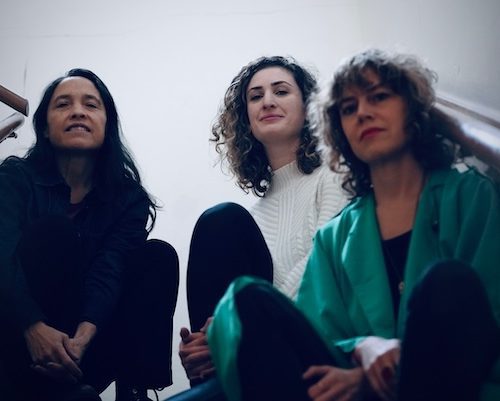
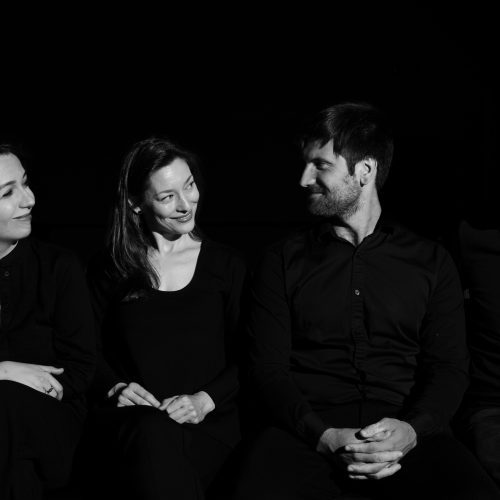
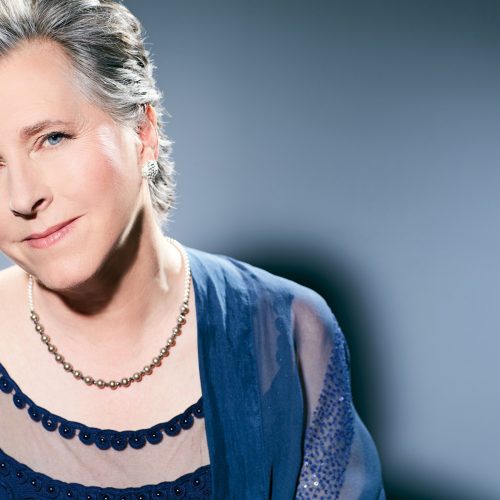
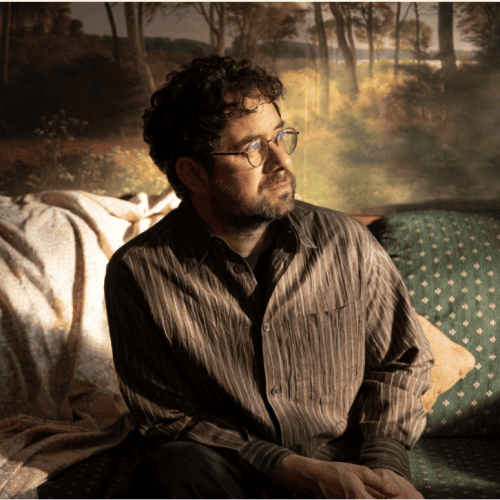
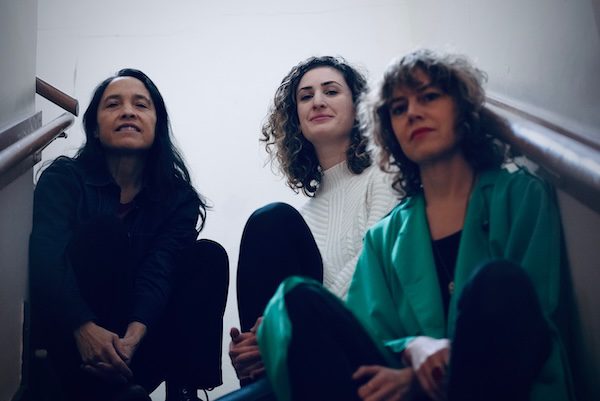
On the occasion of the Flux 2026 festival, No Hay Banda, as the presenter, offers a very interesting double program this Sunday, October 4, at La Sala Rossa: In the first part, the trio Beatings are in the Body, formed by Erika Angell, voice (Thus Owl), Róisín Adams, piano (Hildegard’s Ghost) and Peggy Lee, cello. A trio from Montreal (Angell) – Vancouver (Adams, Lee), therefore, offering raw and spontaneous music, informed by free improvisation, contemporary classical music, and experimental rock. In the second part: Daniel Áñez on piano and Adrianne Munden-Dixon on violin present Tallado en el aire (carved in the air), a “retrospective” of the Suoni per il popolo Festival 2009, 2017, and 2018, in which excerpts from the festival’s archives (music, backstage voices, presentations, etc.) are mixed with live music added by the two artists on stage. I spoke with Erika Angell and Daniel Áñez to explain their respective projects.
PanM360: What is Beatings in the Body?
Erika Angell: Beatings Are in the Body is a progressive trio featuring the experimental voices of Peggy Lee (cello), Róisín Adams (piano/Wurlitzer), and myself (vocals). The band’s name was coined by Canadian poet Meaghan MacAneeley, whose poetry has also inspired and been incorporated into the group’s compositions and improvisations.
PanM360: How did the idea for this trio come about?
Erika Angell: It began as a kind of blind date in 2018. Cole Schmidt, curator of the Vancouver International Jazz Festival, was working on a project that brought musicians from out of town together with Vancouver-based musicians to collaborate.
I, from Montreal, was paired with Róisín Adams, and after a few phone calls and email exchanges, we decided to invite Peggy Lee to join the collaboration. It turned out to be one of those lucky encounters: we immediately loved playing together. The music and chemistry was so fluid and fun that we decided to continue as a trio.
PanM360: What type of music do you make?
Erika Angell: Our music moves freely between acoustic and electronically processed improvisation, contemporary composition, and poetry. There is a lot of air in our music, sometimes chamber like in its character, but also raw and unpolished at other times, with streaks of electronically processed voice elements added to the mixture.
PanM360: What are the topics, the angles addressed in this music?
Erika Angell: We recorded and released a self-titled album, Beatings Are in the Body (2023), in which poetry and music explore the idea of “stored memories in the body”—the ways life experiences can manifest as sensations or pain in our bones and muscles. Our music is a sort of listening inward: tuning into the body and its history, allowing it to reveal the way forward and inspire the music. Living across a nation from one another, we are especially grateful for every opportunity we have to play together. It has been a while since our last performance, so we are very much looking forward to returning to the stage this Sunday at Sala Rossa!
PanM360: Hello Daniel. Tell me about Taillado en el Aire.
Daniel Áñez: The piece was composed by Daniel Guizamon, a Colombian composer we already introduced in our concert series last January. It’s a piece that was written for violin, piano, and electronics.
The violin will be played by Adrianne Munden-Dixon and the piano by myself. And then, the electronics, it’s not a tape. It’s more of a series of instructions, with recordings that were made at the place where the piece will be performed (La Sala Rossa).
PanM360: With clips from the audio archives of the Suoni per il Popolo festival….
Daniel Áñez: Exactly. When we saw that we needed to use this (audio archives, as specified by the composer), we thought we would take advantage of the fact that Suoni per il Popolo had its 25th anniversary and delve into its archives.
We went to get two big boxes with hard drives, CDs, DVDs, archives since 2008, I think. Sometimes, we have multitrack recordings, like bits of recordings from consoles and microphones. Sometimes, we have mix-ups of all that. So, we searched the archives from 2008, 2012, 2017, 2018. We listened to everything that had been done at the Sala Rossa.
We listened to all the concerts. Then, we chose things that went well with our play. For example, we will have the voice of Johanne Hétu, the harp of Sarah Pagé, the voice of the venue technician, Sylvain, when he talks to someone.
Then, we will also hear the voice of Michael Gira from Swans, who presents a song project. All of this is mixed with the music that Daniel Leguizamon wrote to accompany it (and played by the violin and piano).
PanM360: What is the idea behind the work? What is the common thread?
Daniel Áñez: Leguizamon proposes a construction in five categories of archives. There are the A, B, C, D, and E recordings. Each one has a different theme. Some offer more noisy things. Some offer very short recordings, others offer more continuous recordings. Based on that, we chose, let’s say, our category A, which consists only of sounds of the audience talking before or after the concert. Our category B consists of recordings from other concerts. Our category C consists of concerts where No Hay Banda was present. Our category D consists of the voices of people who introduce the concerts. That’s where we have Johanne and Michael Gira. And our category E is the mandatory one. It’s a recording of us playing this piece!
PanM360: What is the story behind the composition of this work?
Daniel Áñez: It was written in 2020 during the pandemic. At that time, there were many Latin American composers who recorded their daily lives, all the little sounds of the house, the washing machine, the microwave, the shower, the silence of the house, the noise of the window. I think this project fits into the reflections that were made at that time, when we were all confined at home.
PanM360: Are you improvising?
Daniel Áñez: No, it is completely written. There are certain passages where there are repeat boxes. And then the boxes have certain arrows under certain notes. The composer asks that these notes be played in reaction to something happening in the recording, either silence or a beat or something. So, we are always reacting to the recordings, but for the rest, it is completely written in a very traditional way.
PanM360: What roles do you play, as acoustic instruments, in relation to sound recordings?
Daniel Áñez: We are somewhat the glue between all the archival elements.
PanM360: How would you describe the music?
Daniel Áñez: Daniel, when he wrote this piece, he wrote it for my duo with Geneviève Liboiron, which is called Wapiti. To give you an idea, we played the complete music for violin and piano by Morton Feldman. I would say that it is music that is sometimes very repetitive, sometimes less so, but it is still quite austere. It is almost always played softly. She is not virtuosic at all. On the contrary, she is peaceful. It’s more of a creation of colours and atmosphere, and textures too, to tie it all together.