Additional Information
For the third consecutive year, the Montreal International Music Competition once again assembled a jury of emerging artists. Working in parallel with the main international jury, the emerging artists’ jury is tasked with evaluating the violinists’ performances and, at the conclusion of the competition, awarding its prize after assessing the 24 competitors in the first round according to its own evaluation criteria. What exactly are these criteria, and what kind of experience does this represent for these young violinists? These are among the questions posed to the jury’s chair, Canadian-Serbian violinist and professor Ana Drobac, by PAN M 360 contributor Alexandre Villemaire.
PAN M 360: For those who may not be familiar with it, what is the Young Artists Jury at the Montreal International Music Competition, now in its third year? Could you say a few words about what it is and what it means for the young people in the competition?
Ana Drobac : The Young Artists Jury provides university students—specifically those pursuing bachelor’s and master’s degrees—with the opportunity to sit alongside the international jury, just behind them on the balcony of Salle Bourgie, and listen to all the candidates in the first round. Their mandate is to award a prize to the violinist whom they deem the winner. This prize, accompanied by a cash award, will be presented following deliberations on Friday, May 29, in the afternoon. It is also an opportunity for them to interact with the members of the international jury—not to discuss the contestants, but simply to talk a bit about music or their future, and perhaps even to network. It is truly a wonderful opportunity that the Competition offers young artists to interact with great masters and see how they approach a competition, because who knows—perhaps among these young people there will be future contestants.
PAN M 360: As chair of the jury for emerging artists, what role do you play in this capacity with these young musicians?
Ana Drobac : Above all, it’s about guiding them effectively as they listen, encouraging them to ask themselves what the key elements are, what characteristics we look for in a winner; is it someone with perfect technique, or someone who moves us with their personality and whose performance we’ll remember, making us want to buy a ticket to hear them again, or an artist we’d like to follow in the future, someone with a strong personality who can convey the composer’s message and the emotions of the works—perhaps someone who brings tears to our eyes or makes our hearts beat faster, you know, like awakening all our emotions.
So, I think my role would really be to guide them and enrich the conversations we’ll have after every three or four candidates, but also to refocus them and remind them: “What’s the jury’s goal? What are we looking for?” But at this point, it’s also a bit personal—what we like. Sometimes, we like artists who are like us. So, if we’re passionate, we’ll look for someone like that, but if we’re more reserved, maybe someone who’s like us will resonate with us more. Sometimes we like things that we also play as violinists—we can feel it—but sometimes it can be the opposite; we’re really drawn to or we like things we don’t have.
PAN M 360: Based on what you just said, what balance do you think there should be between emotion and the perhaps more rational aspect, which includes instrumental technique?
Ana Drobac : You know, every member of the jury is human. Sometimes it might depend on how we’re feeling that day. We might be more emotional because something is going on in our personal lives, so we might be a little more sensitive to the phrasing in the slower movements, or if we’re so happy because the weather is nice in Montreal after six months of winter, maybe we’ll be drawn to someone who’s more virtuosic. So we really get to see each candidate’s personality through the works they’ve chosen. That’s the hardest part because we only get one chance! If that person plays the day before, or with a different jury, maybe the result will be different. It’s really a perception in the moment—what we feel.
When I went to hear Christian Tetzlaff perform Bach’s sonatas, it was among the most beautiful things I’ve ever heard in my life. It’s truly a model for me when I teach Bach to my students. It’s like a reference for how it should sound. That’s what we’re looking for: the moment when the candidate leaves us with the strongest impression—one we can’t forget.
PAN M 360: How was this jury of emerging artists selected?
Ana Drobac : Each institution has selected its candidates. At the Conservatory, we met with violin professors Anne Robert, Alexandre Read, and Andrée Azar to decide on the profile we were looking for.
Our three candidates are truly exceptional violinists who will likely benefit from this experience and may even, eventually, find themselves among the contestants in the competition one day. It gives them a different perspective, since most of the time, we’re always on the other side of the coin. It’s truly rare to begin serving as a jury member in a competition as important as the Montreal International Music Competition.
PAN M 360: In your opinion, what challenges do you think they will face, particularly when it comes to evaluating peers who are roughly their own age?
Ana Drobac : Honestly, I don’t think they do this often enough. I think the challenge is to maintain a balance, to really look at the whole picture from a very broad perspective. When you have a deep knowledge of the repertoire, you can often judge pieces you’re familiar with or have already performed better than a work you’re encountering for the first time. That’s the challenge facing the emerging artists’ jury. It requires great intelligence and careful thought to choose and arrive at the right result—ideally, one that comes close to the official jury’s choice.
Even though they’re exceptional students—some of whom are almost the same age as the competitors—they might feel like they’re not quite at the same level, but I hope that will motivate them and that they’ll take it in a constructive way, inspiring them to push themselves even further and go the extra mile. Ultimately, I think the challenge will be ensuring that, at the end of this process, they’re all happy with the choice they made. If we end up having to vote because we can’t reach an agreement, there shouldn’t be any hard feelings if our candidate isn’t chosen. That’s part of the challenge, too!
Choosing the next generation
The challenge of evaluating the 24 competitors in the first round by the emerging artists jury resulted in the selection of one candidate from among the 10 violin students from the Université de Montréal, McGill University, the Conservatoire de musique de Montréal, and the Royal Conservatory of Music. With her passionate performance of Jörg Widmann’s Étude No. 3, Johann Paul von Westhoff’s Suite for Solo Violin in A Major, and Maurice Ravel’s Rhapsodie de concert (Tzigane), it was Dutch violinist Charlotte Spruitt who won the Richard-Trempe Prize from the Emerging Artists Jury. The prize is awarded in partnership with Richard Tremblay and comes with a $1,500 grant.
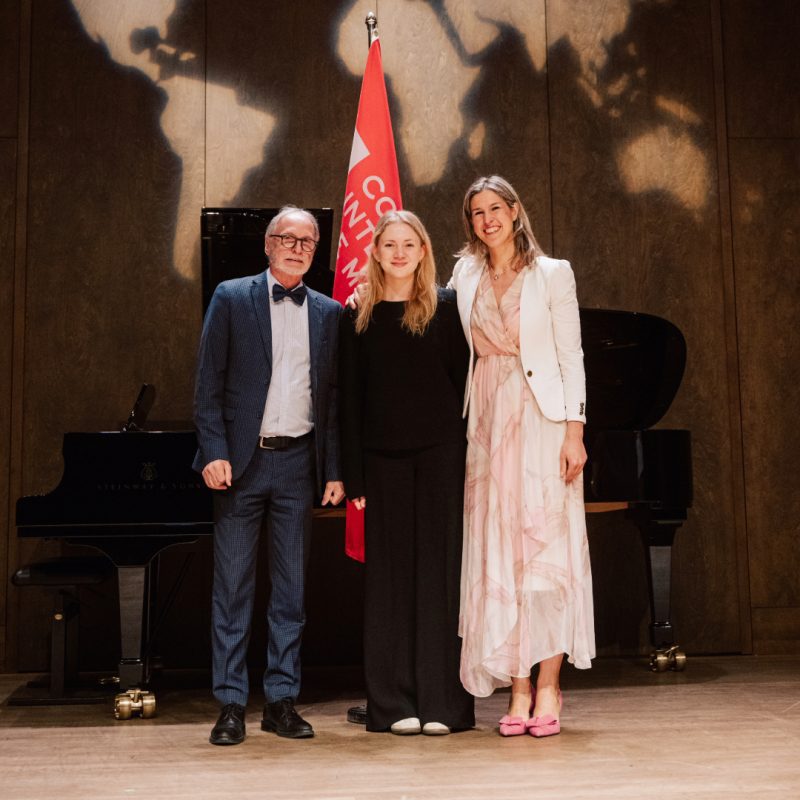
Photo credit: Tam Photography