Additional Information
Next Sunday April 26 at Sala Rossa, Codes d’accès promotes Constellations corporelles, this program gathers emerging composers from Quebec who explore « the body and unusual aspects of staging ».
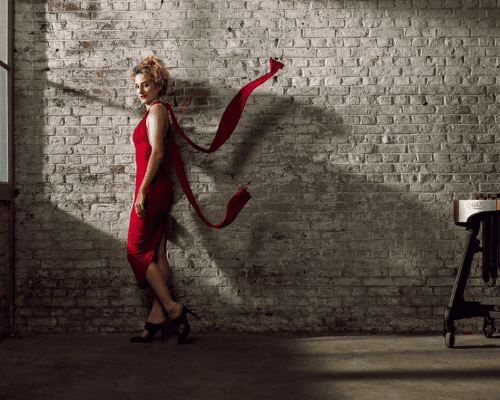
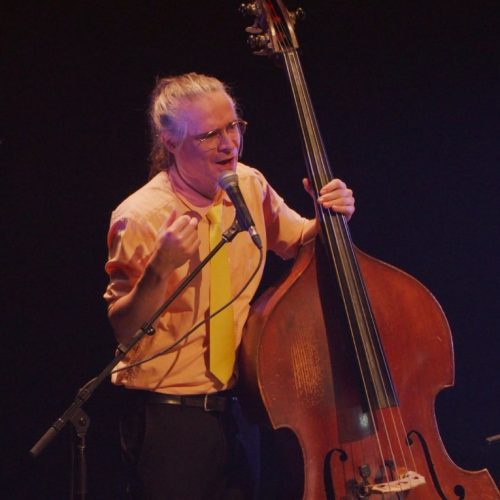
Alexis Blais presents a piece for violin viola and speakers placed on the audience’s lap, inspired by the interactions observed between a comedian and his audience. Gabo Champagne and Rebecca Gray have composed together a piece of musical theater that pushes the emotional limits of the audience, and the physical limits of the singer, by fusing classical singing with performance art.The duo Gabriela Tomé and Christophe Lengelé offer a performance of electronic music, guitar, visuals and voice, inspired by the theory of black holes and cosmic forces.
Nicholas Ma’s “Assembly Line Apparitions” is a work for cello and electronics. All the electronic elements are created from cello recordings, edited to appear as ghostly apparitions beneath the live performance. This piece is presented in collaboration with the Vivier Interuniversitaire (ViU).
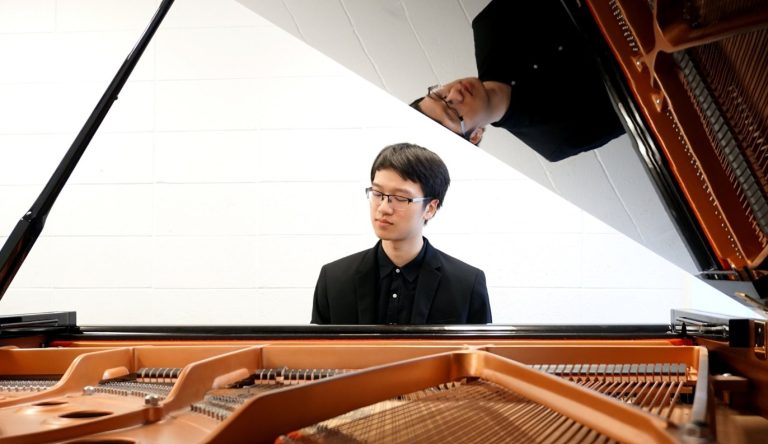
Here is our PAN M 360 conversation with Nicholas Ma, who explains briefly and clearly his creative process for his piece, and tells us about his emerging career.
PAN M 360: Please tell us about your academic and professional background.
Nicholas Ma : I am a composer and pianist currently completing a Master’s degree in Composition at McGill University, where I also completed my undergraduate studies as a double major in Piano Performance and Composition with a minor in Music Theory. My work has been performed by ensembles such as Esprit Orchestra, and I have received multiple Young Composer Awards from the SOCAN Foundation. Alongside my compositional practice, I serve as President of the McGill Association of Student Composers and am on the Board of Directors for the Canadian Composers Orchestra. I have also previously served on the Vivier InterUniversitaire Committee, the NextGen Advisory Council, as Composition Area Representative for the McGill Music Graduate Students’ Society, and as co-founder of the Off-Topic Ensemble.
PAN M 360: What are your aesthetic preferences in composition?
Nicholas Ma : My music often explores the interaction between rhythmic vitality, playfulness, and contemplative rigor. I am particularly interested in situations where energetic or humorous surface materials coexist with deeper structural or expressive foundations. This layering between immediacy and reflection is a fascinating area to engage listeners quickly while sustaining longer-range musical meaning beneath the surface.
PAN M 360: How do you view the interplay between electronic and acoustic instruments in your works?
Nicholas Ma : In my work, electronics can function in several different relationships to acoustic instruments such as mirroring instrumental gestures, blending closely enough to create perceptual illusions about what the live performer is producing, or contrasting sharply with the acoustic sound world. In Assembly Line Apparitions, the electronics consist of a fixed track created entirely from recordings of cellist Jaeyoung Chong, for whom the piece was written, so that he performs alongside transformed versions of his own earlier sounds. This effectively creates an interaction with a recorded “ghost” version of his instrumental past, which is what the “apparitions” in the title refers to.
PAN M 360: Please explain the structure of the piece on the program.
Structurally, this piece mimics a late-night factory shift. The music moves between tightly looped rhythmic cells and more abstract textures. The middle section breaks away from the groove into sustained tones and metallic effects, before returning to a denser, more distorted version of the opening material. The “assembly line” in the title refers to two things: the repetitive, mechanical groove that drives the piece, and the step-by-step process of transforming acoustic recordings into electronic material and then back to acoustic. In this way, the piece itself was constructed like an assembly line: from performance, to editing and transformation, then finally back into performance again.
PAN M 360: What are the challenges of performing this piece?
Nicholas Ma : The piece includes several free-time sections in which the cellist listens to the transformed electronic material and responds to it via improvisation. These passages require the performer to make interpretive decisions about how closely to blend with the electronic track or strongly to differentiate themselves from it. While these passages can be demanding in terms of responsiveness and improvisational judgment, they allow the live performer to participate further in the assembly-line feedback loop that shapes the work.
PAN M 360: What are your upcoming projects?
Nicholas Ma : One of my upcoming projects is a work for saxophone quartet and multimedia electronics on the theme of doomscrolling, combining the fragmentation of attention spans, algorithmic gratification, and cat memes together in order to examine how platform-mediated listening environments are reshaping contemporary attention and musical perception.