Additional Information
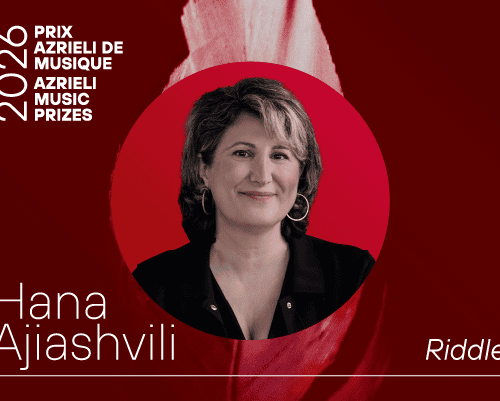
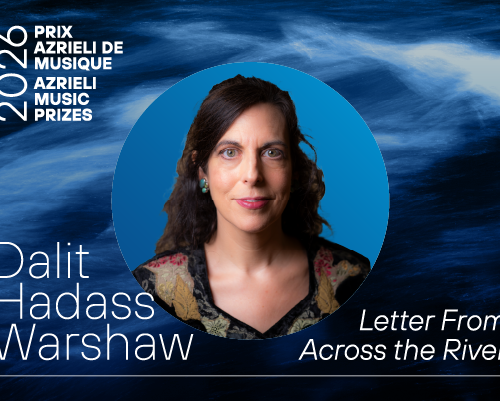
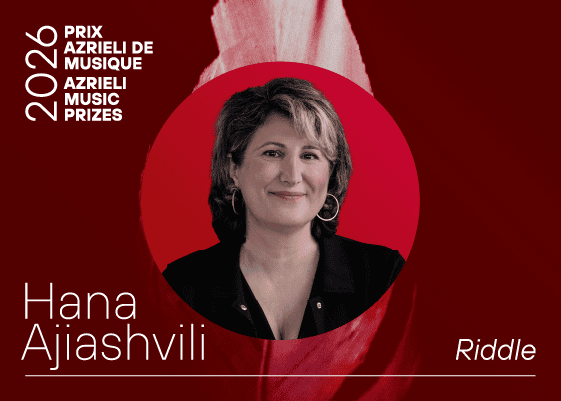
In just a little over a dozen years and six editions, the Azrieli Music Prizes have become one of the most prestigious music composition competitions on the planet when it comes to contemporary music. They were created in 2014 by Sharon Azrieli and are divided into four categories: the Azrieli Commission for Canadian Music, the Azrieli Commission for International Music , the Azrieli Commission for Jewish Music, and the Azrieli Prize for Jewish Music. Three original creations, then, as well as a prize for an already existing, but recent, piece of music. Each prize is worth approximately $250,000, which includes $50,000 in cash, as well as a value of around $200,000 for stage performances, international broadcasts, recordings, etc. It’s substantial. The gala concert that will present the works chosen for the 2026 edition to the public will take place on Thursday, October 15, at the Maison symphonique de Montréal, with the Orchestre symphonique de Montréal, the OSM Choir, and various soloists under the direction of Asher Fisch. PanM360 spoke with each of the composers. HERE, GEORGIAN-ISRAELI HANA AJIASHVILI (2026 Azrieli Prize for Jewish Music).
PANM360 : In one short sentence, what is your composition about?
HANA AJIASHVILI : Riddle is a musical adaptation of a mystical text from the 12th century by the poet Yehuda Halevi: “What is fine, empty, and smooth, but whose blood ‘flows from the mouth’?” The answer — the pen that signs the execution orders — is suggested rather than stated.
PANM360 : How do you expose and construct the subject?
HANA AJIASHVILI : The piece begins with a very strong and short chord. For me, it’s almost like an impact. These gestures come back several times in different forms. And after that, there are chromatic lines moving up and down, often in unison between the choir and orchestra. The whole piece is like a journey from impact to movement. To the appearance of voices and finally to a kind of collective sound where many individual voices exist together. This is about a quill that sadly kills people. But Yehuda Halevi left his riddle without an answer. And I like that. I would also like the music to leave some questions open.
There is a moment in this piece when it is a choral, heterophonic music. And in this choral, there is catharsis. In this place, they sing only one word, Adam. Which means Man. Or Human. I play with the word which becomes A-Dam, in which Dam means Blood.
PANM360 : What does this connection mean to you, personally?
HANA AJIASHVILI : This connection between the human being and blood is very important for me. Because blood gives us life. It permits us to live. Without blood, we die. So it’s like blood is something that gives us life. Adam, human, he could not be alive without his blood. But when people are killed, there is usually blood spilled.
I wrote this piece before October 7th. Like six months before. After this tragedy, something sounds different for me in the music, perhaps it has more pain.
PANM360 : Your piece is constructed in a very expressionist way. The sound timbres are very scintillating. At the same time, it’s largely abstract.
HANA AJIASHVILI : Well, there are melodies appearing later on.
PANM360 : So is there a musical family or school of composing that you would feel closer to in your compositional style?
HANA AJIASHVILI : Colour of the sound is very important for me, yes. So spectral music is close to me. Like Grisey. Or Murail. I really love their music. On the other side, I love the shadows and the silence in the music of Sciarrino, for example. I like to do write gestures that come from silence. And after that, they go back to silence. When I hear Sciarrino’s music, it’s really the same. All his shadows and colours and lights. Wonderful. This is very close to me and to my language. I also love Romitelli.
PANM360 : How do you feel about receiving the 2026 Azrieli Prize for Jewish Music? What does it represent for you?
HANA AJIASHVILI : For me, it’s a very big deal. I’m coming to Montreal, and one of the greatest orchestras will play my music and also a great choir and Hila Baggio (the soprano) and Asher Fish, the conductor. And, of course, the recognition of my work is important. I worked so hard. I started from nothing when I came to Israel from Russia.
Everybody said to me, you have to change your profession because nobody needs composers here. Some people said, we know some composers. Now they are assistants of a doctor or a dentist! But I could never be one more assistant of a dentist. I worked very hard to succeed in this profession. I built myself step by step, and this prize means a lot now. It’s one of the greatest prizes in the world
PANM360 : Thank you