A standout appearance at the Rencontres Trans Musicales in Rennes, an audio-visual recording broadcast by the famous American website KEXP, a global craze on music websites, all the way to national recognition on the show Tout le monde en parle… and the ensuing public schism—a spectacular cultural divide between enthusiastic fans and unabashed morons. Beyond the tensions within the French keb tribe, all the blogs and websites of international coolness are currently vying to be among the first to analyze, dissect, and weigh the artistic value of our two microtonal clowns, Khn de Poitrine and Klek de Poitrine.
Undoubtedly the musical sensation that will achieve the most success on planet Earth in 2026… and may be the biggest international rock success by French Kebs since Voivod. So? It’s really too early for grand analyses of a social phenomenon; let’s calm down and appreciate this mega buzz coming from here.
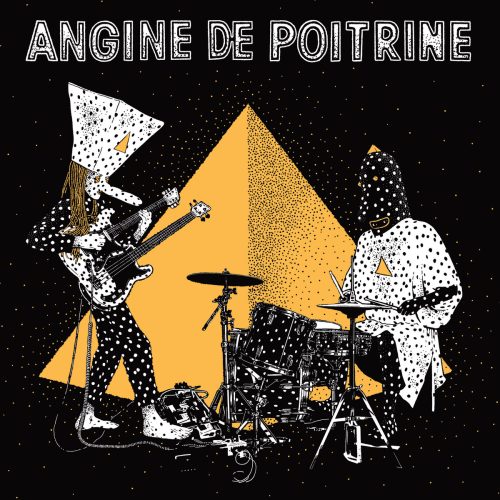
All we can say for now is that these anonymous creatures from Saguenay/Lac have hit the nail on the head, riding a perfect storm: unconventional music, mostly instrumental, groovy, slightly complex, joyfully strange, all wrapped up in a fantastic psycho-carnival party atmosphere with hilarious costumes, not to mention those comical vocal interludes, drawn from the depths of the solar plexus.
Is Angine de Poitrine one of a kind? Today, absolutely, but there have been many precedents. Rock or electro-rock musicians wearing masks and outlandish costumes—we’ve seen that before: The Residents, Daft Punk, Sunn O))), and surely others. Electric guitar-drums duos—we’ve seen that too: The White Stripes, The Black Keys, Death From Above 1979, Royal Blood, etc.
We’ve heard microtonal approaches in rock before: King Gizzard, Altin Gün, House Lords, and… microtonal scales have existed since time immemorial, across multiple cultures and musical styles.
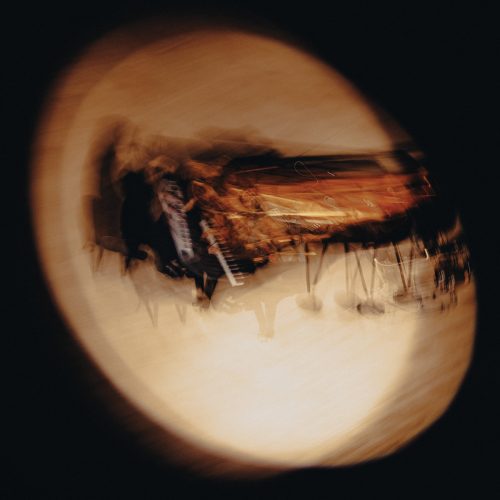
So what about Angine de Poitrine Vol. II, undoubtedly the most anticipated album in Quebec this spring?
Several consecutive listens lead to this conclusion: there are no marked differences between the duo’s first and second albums, and that’s entirely understandable: if it ain’t broke, don’t fix it—they continue to build on an excellent idea in the second chapter of their inspiration.
And since no one else is doing it, to help us better understand this kid’s work, let’s go over a few explanations of its musical foundations, which you’ll all understand if you read the following carefully:
1. Played by Khn, the microtonal guitar. bass guitar (with two necks) discussed here produces melodic loops and then layers them over the drum beats. The scales used here are not equal-tempered, as is usually the case: in Western music, as most of us know or experience it, the tempered scale is the tuning system that divides the octave into equal chromatic intervals. The most common of these systems is a division into 7 notes (C-D-E-F-G-A-B) spread across 12 intervals (semitones). However, a microtonal scale can have a different number of intervals connecting the 7 notes, and thus these intervals can be of varying lengths (quarter-tones, eighth-tones, etc.). Consequently, microtonal scales are not tempered, given the unevenness of their intervals.
This also explains why there are only 2 notes chords and no harmonic progressions in Angine de Poitrine’s music if you listen closely: melodic lines played on the bass guitar are layered on top of one another because microtonal scales would require years of grueling work to create a variety of listenable chords—something Angine de Poitrine barely dips a toe into, keeping it well hidden beneath their robes. We can deduce that a guitar chord based on a microtonal scale would sound dissonant to ears raised on Western music. And that’s why Angine de Poitrine chooses to trace non-tempered melodic lines, which can sometimes resemble Eastern scales—Arabic, Turkish, or Persian.
2. As heavy as can be, Klek’s drumming is clearly inspired by prog rock, math rock, math metal, or even jazz rock. Its mysterious performer makes use of polyrhythms—that is, compound time signatures like 5/4, 12/8, and so on. Is this new? Not at all: polyrhythmic playing has been developing in the West since the 1950s, so what we hear here is nothing special in that regard—and we could perhaps have done without this polka-rock (the track “UTZP”), a binary structure that doesn’t quite fit the overall concept. Nevertheless, we applaud this solid masked drummer.
3. The interplay between the electric guitars and the drums is absolutely brilliant; you can really feel the sheer fun and rock-and-roll self-deprecation in these guys disguised in cassocks, masks, and polka-dot hoods. These bards of the global village have thus created irresistible grooves, punctuated by a few battle cries and other jubilant onomatopoeia. Clearly, these guys are capable of taking their ship far and inviting us aboard.
Can this formula last? A few years, certainly. However, if it remains exactly as it is during this honeymoon period that Angine de Poitrine (which means angina pectoris) is enjoying with its new mass audience, we’ll grow tired of it after a while. And we’ll move on to the next global sensation. Elbow tendonitis? Chronic bronchitis? Cerebral thrombosis? Agricultural shingles? Stroke on Stroke? To be continued…