During the last weekend of May—specifically on Thursday, Friday, and Sunday, the 28th, 29th, and 31st—the Molinari Quartet took over the concert hall at the Montreal Conservatory of Music to perform the complete cycle of fifteen string quartets by Russian composer Dmitri Shostakovich. Quite a challenge.
But how does one do justice to an event of such magnitude? Especially since this is not only one of the most significant chamber music works of the 20th century (and indeed of the entire history of music)—one of the richest and most expansive—but also one of the most demanding in terms of performance.
Imagine more than 6½ hours of highly challenging music presented in bursts over three nearly consecutive evenings—but above all, the perfect opportunity to hear these works performed in concert in chronological order (from 1936 to 1974) and in close succession, allowing the audience to clearly trace the composer’s evolution. When you consider that he originally planned to write 24 of them—one for each key, in both major and minor!
But the best part was undoubtedly having Olga Ranzenhofer, the ensemble’s director, as our guide on this journey. Olga has always had a genuine passion for these quartets and knows them inside and out—both their strengths and their pitfalls. The Molinari has frequently included them in its programs over the years and, about a decade ago, presented the first complete cycle, although the result apparently did not quite live up to Olga’s expectations. So this time, under her leadership, the Molinari succeeds in making the score shine with a thousand lights.
Speaking of incandescence and brilliance, this Shostakovich cycle also served as a sort of baptism by fire for the new violist, Cynthia Blanchon. Since joining the ensemble last summer, she had certainly had the opportunity to showcase her immense talent by participating in various programs, but this Shostakovich cycle represents, in a way, her true initiation. Since she rose to the challenge with flying colors, just like her colleagues Antoine Bareil on violin and Pierre-Alain Bouvrette on cello, she can already be considered a full-fledged member of Le Molinari.
The early quartets, numbered 1 through 6 and all in major keys, share a distinctly symphonic style. Although they are fairly classical in style, they are by no means conventional, as the composer constantly draws on a wealth of inventiveness that requires his performers to remain alert and to demonstrate as much flexibility and agility as they do energy.
One of them—the fourth, written in 1949—remained in the composer’s drawers and was not premiered until after Stalin’s death in 1953. Shostakovich feared that it would be banned, or at the very least censored, because he had incorporated Jewish and Eastern European folk music into it, whereas the party’s very strict line condemned anything that did not exalt the distinctly Russian character of the Soviet Union.
Since Shostakovich composed a great deal of large-scale music—operas, symphonies, festive music, and film scores—chamber music served as a kind of refuge for him, where he could give free rein to a more personal, more intimate style of composition. The 7th is thus dedicated to his first wife, Nina, who had died a few years earlier. It alternates between a mournful atmosphere, rage, and anger before giving way to a gentle dance.
For Shostakovich, the quartets of his middle period—specifically Nos. 7 through 10—also provided an opportunity to break free from formal constraints and express himself in an increasingly personal way. His anxieties and bitterness are evident in these works with considerable intensity, yet this did not prevent him from continuing to innovate and create.
The period during which he composed Quartets Nos. 11 through 15 (most of them in minor keys) coincided with his years of physical decline. These included heart problems, paralysis of the hand, and inflammation of the spinal cord, among other ailments, compounded by bouts of depression. But none of this could stop him from writing and continuing his work, so the music takes on very dark and painful introspective turns, and at times even jarring ones, as in the 13th, which ends with a viola solo in the highest register in a sort of heart-wrenching sigh.
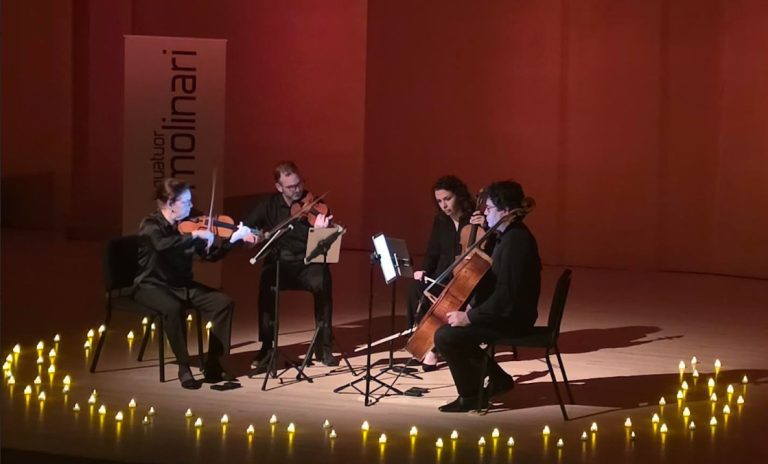
For the very last quartet, which is in a sense a long funeral oration, the musicians had swapped their white shirts and coats for black ones; they were surrounded by a circle of small lanterns, and the lights had been dimmed. Briefly unsettled by the flurry of sixteenth notes in the intermezzo, the six slow, desperate movements followed one another relentlessly. Here, Shostakovich engages in a sort of dialogue with death. It is heavy, powerful, and deeply poignant, yet at the same time imbued with a certain serenity in the face of the inevitable.
Once the final notes had faded away, we sat in silence for quite a while, still stunned by the heart-wrenching beauty of this existential distillation of humanity, before the applause snapped us back to our senses and brought us back to reality.
Thank you to Olga, Cynthia, Antoine, and Pierre-Alain for this wonderful journey. For all the music lovers who gathered on those three evenings, it was a time of pure joy.