Additional Information
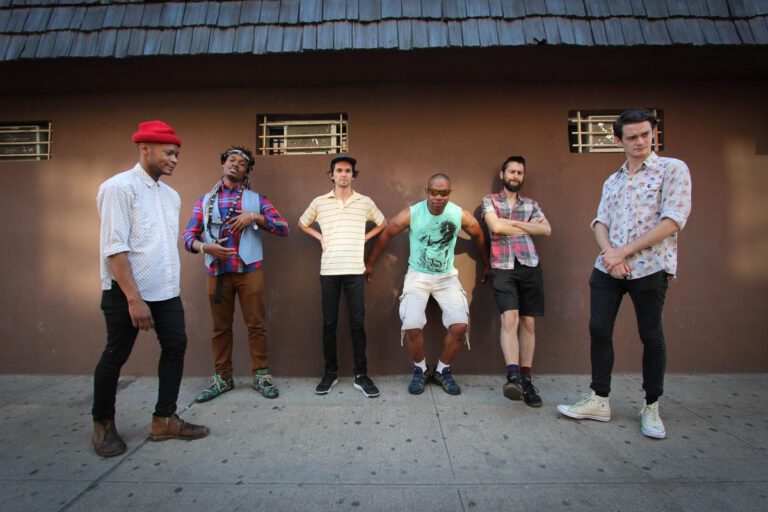
The seasoned Afrobeat group from New York City will be making an appearance at this year’s Festival International Nuits d’Afrique. I spoke with drummer Daniel and guitarist Eric about their music and their upcoming show.
Kaleta & Super Yamba Band will play at Club Balattou on the 15th of July at 8:30 PM.
PAN M 360 : Hey thanks for being here! Are you tuning in from Brooklyn then?
Daniel: Yep! I’m with my friend Eric, the guitarist, we just finished a rehearsal.
PAN M 360 : Well I’m sure you must be busy these days, especially when the covid restrictions were first lifted. Has Afrobeat come back with a vengeance?
Daniel: Well for sure there’s a demand for live music generally, and afrobeat of course makes for an especially good time. People know that. So I would definitely say so.
PAN M 360 : It feels like there is sort of an Afrobeat resurgence, with groups from London especially. Do you see yourselves as part of the same sort of movement, or not really?
Daniel: I think that resurgence has actually been going on for a while now, at least in New York. I mean it goes back to the Fela Broadway shows and that brought a lot of mainstream attention to the genre but that was a while back now. I’ve been here ten years now and that well before my time. As a group, we’ve been around since 2014, which is a good amount of time, but we still feel like a newer band on the scene in general, but then again we’re also touring with Kaleta, and he’s someone who’s been doing this since the 1970’s. So it’s kind of like, you know, there’s two different movements within the movement,
PAN M 360 : Would you make a distinction between modern Afrobeat and classic Afrobeat?
Daniel : That’s a great question. I mean, you know, you hear people definitely putting a modern spin on it nowadays. But I mean, even like, I don’t know, even listening to Tony Allen’s discography, it progresses and it gets more modern. His early records from the 70s are very like, you know, they sound like the early Fela records and then, later in his career, he’s doing techno stuff with Jeff Mills and working with Jimmy Tenor, so maybe it is a natural progression of things. Afrobeat itself, when Fela created that style, it was clearly a blend of so many different things, so bringing in different things is in the DNA of this music.
PAN M 360 : I would love to know how you guys got interested in this music and how the Super Yamba Band came to be.
Daniel : Yeah, it’s kind of interesting. Obviously we didn’t grow up on West African music. I grew up on blues and rock and jazz and I’m sure Eric’s kind of in a similar boat. But a few of us were living in North Carolina before we moved to New York and we just kind of randomly met this man named Mamadou Mbenge who was a Senegalese talking drum master. Just like a phenomenal talking drum player. And he actually got us hip to African music.
He taught us some of the like rootsy Senegalese drumming traditions. Our band started to take in some of that stuff and because we were the only band nearby that fused any kind of like an African beat, we started getting new opportunities opening for bands that were touring. We ended up opening for Fela’s son, Seun Kuti and Egypt 80. We opened up for Antibalas a couple of times. I still haven’t been to West Africa, so I don’t really feel like an expert, but we’ve just been kind of around this stuff for a long time now.
PAN M 360 : Is that how you ended up meeting Kaleta?
Daniel : Well sort of. We moved to New York shortly after that and started Super Yamba as a way to explore Afrobeat and to play gigs up there at some of the clubs that cater to that style. And, you know, for whatever reason, it all happened pretty quick and we started gigging a bunch and started to build a following. We went to make our first full-length album and the idea behind that album was to record different tracks that we could have guest singers on, you know, singers from the different regions and countries of Africa.
Somehow we felt like we could never find one singer that could sing all these specific styles. So, anyway, we were making the record, and I actually asked a friend of ours, Nick Hill, who used to be the bassist for Antibalas, for a recommendation for someone to sing our Nigerian songs and he put us in touch with Kaleta. We knew who he was since he had been playing in Fela’s band Egypt 80 and with King Sunny Adé. We learned he was from Benin and when we showed him some of our more Benin inspired stuff, he was like, whoa, let me hear the other tracks. He ended up singing on 8 songs!
PAN M 360 : So at this show will you be mostly playing from Mèdaho?
Daniel : We have a lot of newer songs, but we have a bunch of tunes at this point, but it’s usually about half and half, because we have to play the classics, you know.
PAN M 360 : Afrobeat has been historically a music of protest and resistance, do you still see the music in those terms?
Eric : I mean we do, but to be perfectly honest I don’t know the lyrical content of all of our songs, because I think they are in about seven different languages. Kaleta, who has lived some of that stuff, is coming from a different place than us, and so we definitely have some numbers that speak to certain political and cultural situations.
PAN M 360 : I’m sure the both of you must have some really great recommendations. Aside from Fela and King Sunny Adé, what are some other names that you think we should be aware of?
Daniel : Of course. I have so many favourites and a lot of them are just like part of some random compilation or a 45 where I don’t know how to find more from this particular band. Aside from Fela and King Sunny Ade, there’s a band called the Funkies. There’s also the Psychedelic Aliens, which is a wild name, but they are really awesome, and they are from Nigeria as well. .
Eric : Ebo Taylor and Pat Thomas. The Super Djata Band from Mali have been a big influence on us.
Daniel: Yeah, that’s a few, that’ll get you all up.
PAN M 360 : Much appreciated guys. Have a great show!