Additional Information
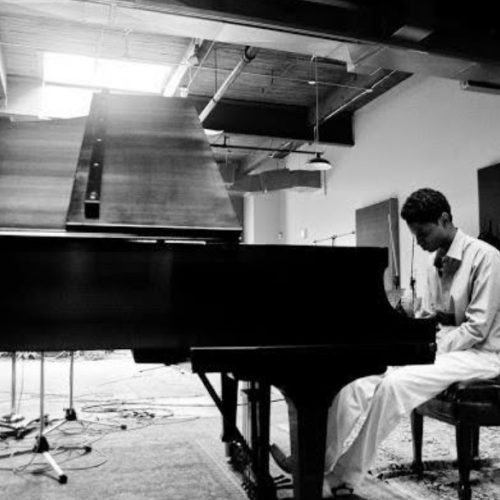
Thundercat is undoubtedly THE jazz bass star of the nujazz world, but this notoriety is also due to his associations with Kendrick Lamar and his jazz friends, including Kamasi Washington. Meanwhile, there are other superbassists of the same generation who make less of a media splash and play just as well. Such is the case of Derrick Hodge, African-American bass virtuoso invited to Studio TD on July 1. Many knew him alongside Robert Glasper in the zero-ties, and jazz and groove aficionados have not lost track of him. Playing as a power trio (bass, drums and keyboards), Derrick Hodge delivered a solid performance to the free concert audience, inspired by an important album released on the Blue Note label: Color of Noize, the subject of this conversation with this excellent musician.
PAN M 360 : So let’s talk about the recent work. How is it going? How was the production aspect, the composition aspect, and how is it translated on stage now?
Derrick Hodge: Yeah, glad you asked. Color of Noize, man, it started as an idea. It started as, you know, pre-COVID and through COVID, there was a lot of just discussion. I thought people had just free time.
PAN M 360: Yeah. Everybody composed a lot at that time.
Derrick Hodge: Yeah, yeah, and I read and see a lot of descriptions of myself and kind of how I’ve been prescribed and defined, and I just noticed the diversity of that. Yeah, there’s a diversity of that and what people are saying and how rare I actually take time to actually think about that myself and how little I even really, even after seeing that, how much I cared about that. It was just like, no, I’m just being myself. So in that, it started with taking some of those words and realizing, man, maybe that’s an emotion in itself. And that’s what Color of Noize is about.
It was like seeing some people might say something kindly about me that they also may have said things negative about others and not even knowing, I respected that sound that they’re speaking of. I’m actually a product of all of these things. I’m a melting pot. And I really try to allow that
PAN M 360: It’s also a reflexion about noise as a concept.
Derrick Hodge: Yes. What is noise? You know, what is colour? What is beautiful? What is harmonic? Our perception is always changing.
PAN M 360: So Color of Noise is accepting the sound where it happens, and being here and now, right in the moment.
Derrick Hodge: That’s what this is all about.
PAN M 360: What you did achieve, we know, we can comment on, and we can have different versions, as you say, different perceptions, different emotions reacting to your craft, to your work, and some performance you’ve presented in front of us.
Derrick Hodge: And that’s a beautiful thing because it’s a very human thing. It’s a real thing that, you know, so acceptance, it was about acceptance, accepting that and finding the beauty in it. And that, what the opportunity was right in front of me was my upcoming Blue Note record with Don Was – also president of Blue Note Records. I wanted him to produce it with me. I wanted it to be about Color of Noize and really document that experience.
PAN M 360: The process of this album, released in 2020, was singular, wasn’t it ?
Derrick Hodge: People don’t realize they’re listening to first takes through the whole record. We recorded that entire album in about 18 hours. And it was more so about me explaining that idea, I would play the themes that I’d worked on, and then let’s see where we land with the sheet music and every musician on that record. The album features Jahari Stampley and Michael Aaberg on keys, Mike Mitchell and Justin Tyson on drums, and DJ Jahi Sundance on turntables. I played myself bass, keys, guitar and vocals. They all took that and really owned it in a way where I couldn’t have controlled it if I did it myself. It was just like, no, it’s gotta be this. It was about letting go.
PAN M 360: Yeah you let them play. And that’s what’s led to the expansion of Color of Noize.
Derrick Hodge: Yeah, and I’m thinking about other projects, and that idea of Color of Noise, self-love, acceptance, that was on the mind even back then when I was working on that years ago. So to see it now full circle, the idea of self-love coming through by musicians, if I don’t meet a single symphonic player, they’re honouring the music in that way, because I’ve tried to take care as if each moment meant something.
PAN M 360: Can we pinpoint some colours that are more prominent, I would say? Not trying to describe the whole thing, but some sources of inspiration.
Derrick Hodge: So I’ll say that that is truly the thing. Color of Noise is truly about whatever you take from it when you hear it, I’m totally fine with how that’s defined. The people who are playing it, for example, like I said, when we recorded that, they had no preconception. We just made sure everything was set up. The drummer who arrived didn’t even know.
PAN M 360: They didn’t know they were going to be playing two drum sets.
Derrick Hodge: They didn’t know. So it was about true acceptance.
PAN M 360: You did the setup, and they jumped in.
Derrick Hodge: They jumped in. And what people are hearing is truly them taking it and embracing it. But it’s an artistic direction in the same time.
PAN M 360: Yeah you let them free, but you have prepared the sessions.
Derrick Hodge: So the guidance is showing them the genesis of, this was the period of what that idea is. I would let them hear, oh, this idea, this was the theme I worked on at my PM. I would let them hear that, not even hearing how I’d like the final result to be with them.
I just let them hear that, and they had the sheet music. And where we landed was truly how they embraced that within their lens. They were actually reacting to each other.
And as the pieces went, as we ended them, just calling out endings as we got there. But that’s been the beauty of it, and that’s what’s allowed the Color of Noise sound. The moment someone thinks they can define it fully, they might be able to define the record version, but that’s totally different than the orchestras that’re touring the country right now.
That’s totally different from the string quartet that I’m doing.
PAN M 360: Yeah, you can have different versions of the same compositions in different sizes, different instrumentation, different orchestrations.
Kendrick Hodge: Right, right, right. But the same root. Kind of. I mean, so when you see the performance, the start of Color of Noise was certain music, but it really does vary.
So the root might be my composition, or it might be even using an orchestra, but completely other sounds, other things, other compositions where I put on my arrangement hat and go within that framework. It’s really about saying, okay, you know what? Really, if we throw these same people into different situations with me, let’s see where we land.
PAN M 360: Let’s present the setup of this actual tour.
Kendrick Hodge: Yeah, tonight’s going to be, it’s fun, it’s the trio. Mason Guidry, who is one of my favorite musicians, a drummer, incredible, I’ve known him his whole life. His dad put me on my first recording session, I believe at 13, 14 years old. It’s come full circle now that his son and I are playing together. He’s just an orchestra all in himself. And Bigyuki (Masayuki Hirano), who is one of my favorite musicians, creative, just a free thinker, creative. I don’t even want to say he’s a keyboard player, he’s a sonic orchestra. So between the three of us, we start that dance. I react to the energy of the audience. It could be from the first clap. If it’s something different, I see.
PAN M 360: You can shift.
Derrick Hodge: Yeah, totally shift. And that might be from the very first song. So it’s very Color of Noise focused where I give them a journey into my process of making that record and how they respond. That’s what the band situation is. I throw themes and then do variations of it.
PAN M 360: Excellent ! So it’s a power trio version this time.
Derrick Hodge: Absolutely. Yeah, and every time it’s different innately because they’re reacting based on how their day went.
PAN M 360: Do you have some favorite achievements during that cycle? In what kind of version or performance?
Derrick Hodge: You know, I haven’t gotten to that point yet. Well, it’s not important. Where there’s a favourite yet. I’ve really loved it because certain parts of it just remind me of kind of a sweet element of it all. Like, oh yeah, that was a moment. How I cracked that together for that record in succession to it. So I haven’t separated it to a point where certain parts of the show are a favourite. I’m loving it all, man!
Photo: Emmanuel Novak-Bélanger