Additional Information
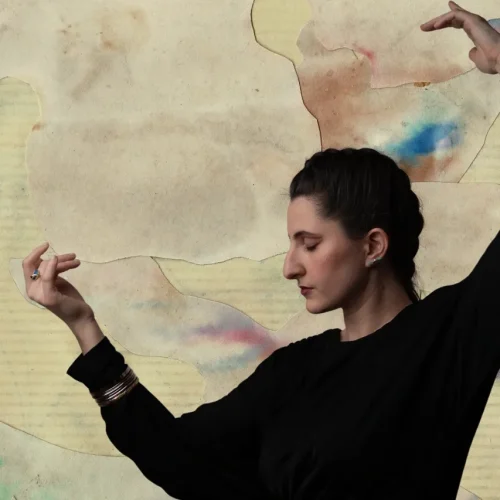
Quebec-born Gabriella Olivo offers a soaring sound at the confluence of Latin traditions and modernity. Fluent in French, English and Spanish, the young artist impresses with the delicacy of her voice and the sincerity of her art.
Backed by the excellent A todos mis amores, her second microalbum, the Quebecoise took to the biggest stage of the Festival de Jazz de Montréal last Friday. The result: an enveloping, gentle performance. Radio-Canada Revelation of the Year 2025-2026, Gabriella is on the rise on the Quebec music scene. It’s a safe bet that her next album, expected towards the end of 2026, will propel her even further.
Born of the union of a Mexican mother and a Quebecois father, she fashions a hybrid music that is deeply personal. “I marry traditional sounds like classical guitars with cumbia or reggaeton rhythms. I’m influenced by indie rock, folk and electro-indie,” she confides.
Recorded for the most part in Mexico City, A todos mis amores plunges us into the heart of his mother’s hometown. Created in collaboration with the Mijares brothers, the arrangements of percussion, guitars and synthesizers are hypnotic. A todos mis amores is savored from start to finish, and leaves you wanting more.
PAN M 360: Hi, you’re one of six Révélations Radio-Canada this season. What does this honor mean to you?
Gabriella Olivo: I feel truly blessed and touched to have been selected from among so many talented artists. For me, it’s a wonderful recognition that soothes a little the imposter syndrome I sometimes feel as an artist. At the moment, I’m writing my very first album, so it’s a great boost and a pat on the back to keep going.
PAN M 360: For those who are just discovering you, how did your passion for music come about?
Gabriella Olivo: My relationship with music began very early. I started taking piano lessons at the age of 7 and never really stopped. I also played trumpet and saxophone in high school; I was in vocal jazz and in a choir, Les Petits Chanteurs de Charlesbourg. Music has always been a part of me, but it intensified when I moved to Montreal. Before, it was a hobby. During the pandemic, I took the time to write and produce my own songs.
PAN M 360: With two EPs to your credit and an album in the pipeline, how would you describe your musical universe?
Gabriella Olivo: It’s a mixture of several genres. I blend traditional sounds like classical guitars with cumbia or reggaeton rhythms. In CEGEP, my musical awakening was heavily influenced by indie rock, folk and electro-indie. My long-time favorite band is Beach House – I love those textures and synths. I like to mix it all up: modernity, digital and analog effects, autotune… In short, it’s a happy mix of textures, genres and also languages, as I alternate between French, English and Spanish.
PAN M 360: You navigate between three languages in your songs. What does this allow you to express?
Gabriella Olivo: Spanish has a romantic richness in its lyricism. French is very pure. When I write, it comes naturally, I don’t think too much about it. It’s organic, and each language supports the emotion specific to each piece.
PAN M 360: You mentioned in an interview that, although your mother is of Mexican descent, your interest in Latin music came from within. What is it about these sounds that attracts you?
Gabriella Olivo: I’ve traveled a lot to Mexico in recent years, so I’ve heard a lot of it. Mariachi really comes to me… boleros too. They’re sounds that really move me and that I love. I drew on these influences in a very instinctive way.
PAN M 360: Your latest project, A todos mis amores, is a superb six-track EP released last October. What universe would you like to transport your listeners into?
Gabriella Olivo: It’s a melancholy, nostalgic, dreamy, soaring universe. As you say, I like to take people on a journey with my music. I’m very focused on the musical arrangements, more than on the lyrics – that’s what comes first, and it’s always been that way. That’s still true of my first album, although I take more care with my lyrics now.
PAN M 360: You recorded the majority of this EP in Mexico City, your mother’s hometown. How is this trip reflected in the project?
Gabriella Olivo: I think you can really feel the energy of Mexico City, but in a contemporary version. I worked with Santiago Mijares, a well-known producer down there, and his brother Patricio. They’re both extremely talented musicians, composers and songwriters. You can feel the vibe of the city in the instruments, especially as most of them were played by Santiago. I’d say that’s the imprint of the trip – except for the piece Tonterías, recorded in Montreal with Léo Leblanc.
PAN M 360: You also played a few instruments on this EP, didn’t you?
Gabriella Olivo: Yes, I played some of the guitars and synths. It was really a collaborative effort. I always come up with demos that are already well advanced. Then, with Santiago, we reworked them. A lot of the lines and scores had already been written.
PAN M 360: The St-Valentin piece immediately grabs your attention. What’s its story?
Gabriella Olivo: Funny you should mention that one! I wrote it about six years ago, at a time when I never thought I’d have a career in music. It was in the midst of a burst of creativity and heartbreak. I’d recorded it on GarageBand, and then it stayed in my archives. I played it to Santiago, who loved it immediately, and we reworked it in the Mexico City style.
PAN M 360: What are the themes running through this EP?
Gabriella Olivo: In my last two EPs, I talk a lot about relationships. There’s also a song about mourning. But right now, I’m writing more about family, and I’m tending towards more committed lyrics, more rooted in current affairs. Less romanticism, let’s say!
PAN M 360: And what’s next?
Gabriella Olivo: I’ve got a lot of shows this summer, and I’ll be traveling around Quebec and even New Brunswick. And between shows, I’m working on my first album. If all goes well, it should be out by the end of 2026.