Additional Information
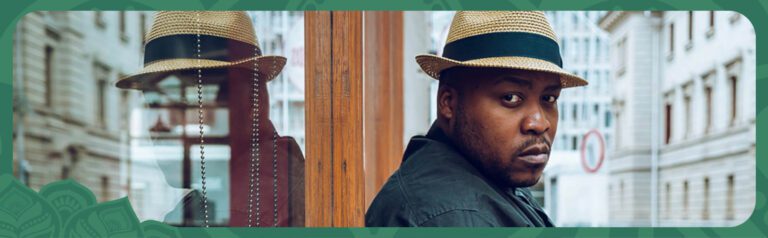
On Friday July 11, the Festival Nuits d’Afrique welcomes a South African rapper well established in his country: Stogie T, real name Tumi Molekane. This will be his second visit to Montreal, his first as a solo artist. Stogie T has no tongue in cheek, and has tons to say about his life, his career and South Africa, a country whose destiny remains complicated, despite the end of the racist Apartheid regime 31 years ago. It’s not every day you meet a rapper from this country. Our contributor Michel Labrecque spoke to him about all these different aspects. Fasten your seatbelts!
PANM360: Stogie T, tell us a little bit about yourself, you were born in Tanzania, grew up in South Africa and have been rapping for over twenty years!
Stogie T: You’ve said it all, I’ve got nothing more to add (laughs). I was born in Tanzania to South African parents in exile. I may have been conceived in Russia, when my parents were there for military training. But I have no family ties with Tanzania; I lived there until I was 12, when we returned home.
PANM360: So your parents were anti-Apartheid activists? Did that have an impact on you?
Stogie T: Exactly, my father was a pastor who became a soldier in the ANC (African National Congress, now the ruling party). But he died when I was a year old. But my mother was very involved in the struggle, right up to the end. There was always this idea of the “promised land” and that I had to find a goal. That’s been my framework right up to the present day. I just had to find my own way.
If I compare myself to a pair of glasses, this mission idea was the frame, hip hop my lens, and then finding my own voice meant getting rid of the glasses (laughs) and discovering my own vision.
PANM360: In South Africa, you lived in Soweto, the huge black neighborhood on the outskirts of Johannesburg. How did music and rap come into your life?
Stogie T: Mainly by walking the streets, playing basketball and talking to family members. When I listened to rap music as a kid, I wanted to go further. When a rapper mentioned Miles Davis, I wanted to hear it, when it talked about AK-47, I wanted to know more (laughs), but my musical range expanded, while remaining centered on rap.
And since I wasn’t good at sports or skateboarding, hip hop helped me climb the social ladder of testosterone-filled adolescence. Little by little, I freed myself from American rap influences to tell stories about my community and my country.
PANM360: In 2004, you formed a band called Tumi and the Volume, which became famous in South Africa and toured all over the world. It was an adventure that lasted almost a decade.
Stogie T: At the time, we represented what people were calling the “new South Africa”; a white guitarist from Mozambique, a white Jew, a black man rapping about Nelson Mandela (the first post-Apartheid black president), it was a breath of fresh air. Our international tours also allowed me to share the stage with greats like Salif Keita and Manu Dibango. It opens your ears and makes you admire the great African musicians.
On the other hand, there’s one hurdle we’ve had trouble getting over. Abroad, a South African band always has to carry a political message. For me, this became a cage. Because I’m South African, I can’t write a song about flowers or butterflies! Politics is important, but it’s not the only thing in life.
PANM360: In 2012 Tumi and the Volume disbanded, and in 2015 Stogie T’s debut album was released.
Stogie T: The split was amicable and we’re still friends. Afterwards, I discovered that I was suffering from “cyniscosis”, the disease of cynics, which I self-diagnosed (laughs). Because South Africa’s liberation project turned into a comic tragedy. Most of the politicians we admired when we were young turned out to be corrupt, made fools of themselves. We believed that the magic of Mandela would make this rainbow nation immune to imbecility. But in the end, we’re just as greedy and full of shit as humans are.
PANM360: So, Stogie T is back to political lyrics. Your latest EP, released recently, is called Lasours, which is a title in French: la source.
Stogie T: Yes, I made this album with a musician from Reunion Island, Aleksand Saya, who comes from this place called Lasours. He’s an incredible musician and producer who mixes maloya music, a style from the island, with electronica. I loved working with him.
PANM360: In addition to this latest offering, you’ve released four albums. How is Lasours different?
Stogie T: I’m talking about the violence in South Africa, one song is dedicated to a young rapper who was murdered, it’s also about Reunion Island, a French department not so far from South Africa. People shouldn’t forget their roots, even when they go to study in Paris. We also hear Ntsika, a great South African singer who is part of a famous acapella group.
PANM360: What will we hear at your July 11 concert at Balattou?
Stogie T: You’ll hear a mix of hip-hop, African music, jazz and soul. With a wonderful singer called Bonj, to whom, frankly, I’m more of an accompanist (laughs). I don’t think anyone is like us, for better or for worse (laughs).
My band and I are already in Montreal, there’s so much to do, I hope my band will still be up and running on the 11th.