Additional Information
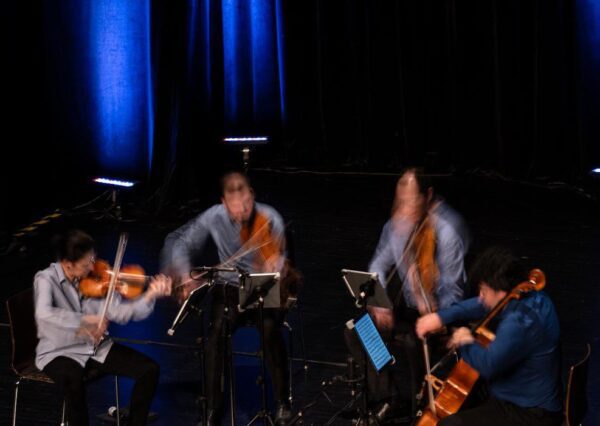
Luciano Berio (1925-2003) is the first Italian name that springs to mind when one thinks of contemporary music from the second half of the 20th century. Primarily known for his instrumental music, but also for his explorations into electroacoustic territory, Berio earned a monumental reputation in the institutional avant-garde, through his American, French and, needless to say, Italian residencies. From 1947, the year he entered public life with the performance of a piano suite of his own, to his death in 2003. Berio composed five string quartets, in this case superbly mastered. The Quatuor Molinari took the time to study these works in depth, perform them in public and finally record them. The complete string quartets have now been released on the ATMA Classique label, so let’s take advantage of this still recent release to talk to Olga Ranzenhofer, first violin and artistic director of the Molinari. The interview was conducted by Alain Brunet for PAN M 360.
PAN M 360: Remind us of Quatuor Molinari’s history with these works, which were performed before an audience before they were recorded.
Olga Ranzenhofer: Indeed, we’ve been living with these works for two years. We played the complete five quartets by Luciano Berio for the first time in May 2023. It’s always good to let works lie dormant and then pick them up again. We reworked them in the summer of 2024, then played them in concert in the autumn just before recording them. The year 2025 is the composer’s centenary, and we’ll be doing the complete works again this time for a major symposium to be held at McGill University next October, entitled Gestures, Words, Sounds: The Creative Worlds of Cathy Berberian and Luciano Berio. It’s really satisfying to be able to play these masterpieces over and over again, because with each performance we feel that our interpretation is maturing, that we’re becoming more and more at ease with the quartets.
PAN M 360: In the aftermath of the Second World War, Berio’s first works were made public, including his first string quartet, Study, in 1952. Where was the composer then, still associated today with this wave of post-war contemporary music?
Olga Ranzenhofer: As the title suggests, it’s an early work, a study. Written during a summer course at Tanglewood in 1952, it is the work of a young composer whose hand is already sure, but who has not yet found his own voice. It contains all the elements of classical string quartet writing: accompanied melody, imitations, homorhythm, harmonic richness, countersubjects and so on. Berio described the quartet as having a certain Viennese spirit.
PAN M 360: What are its features? What are the performance challenges?
Olga Ranzenhofer: It’s a very tricky work to play: some nuances are very soft, so you have to find the right sonority and transparent colour, while other passages are powerful and intense and homorhythmic. Study is a short work, full of contrasts, which is very pleasant to play and hear.
PAN M 360: Quartetto per archi was premiered in 1956. How would you describe this music as “generalized serialism”? How is the work constructed? How does Molinari approach it?
Olga Ranzenhofer: What a long way we’ve come in the four years since Study! It’s the writing system that dominates over the theme in this work. I see this work as Webern exposing 10! As in Webern’s music, every note is essential and of paramount importance. The main characteristic of serialism is that all the notes follow a predetermined order, which is called a series. In this work, even the nuances follow this method. What’s more, there is no hierarchy, all notes are equal; in terms of nuances, a ppp is just as important as an fff!
There are so many parameters to master in a work like this: notes, rhythms, numerous tempo changes, articulations, playing modes, nuances, vibrato speeds and so on.
To master all this information, you must start working hard on your own. One of the great difficulties is also to feel the tempo changes together, as a quartet. Pierre-Alain, our cellist, created a “click-track” for us, i.e. a metronomic track incorporating all speed changes. This was an essential tool for integrating the work’s changing rhythms. Once you’ve mastered all the parameters, the satisfaction and pleasure are great. It even becomes intoxicating!
PAN M 360: In 1964, Sincronie was born. This work is said to have emerged from a period of “great creative euphoria.” At the heart of the ’60s, Berio was also one of the pioneers of electroacoustic music, without abandoning instrumental music. How did this “creative euphoria” play out in Sincronie? What are the challenges of this work for each Molinari performer?
Olga Ranzenhofer: There is no longer any question of melody or harmony in this work. All that remains of the previous quartets are the highly evolved timbre games of Quartetto per archi. Berio’s primary concern in Sincronie is gesture. This impulse is sometimes synchronous in the 4 instruments, sometimes all seem to evolve in different worlds. Berio expresses the notion of synchronicity very clearly: “the four participants elaborate the same sequence of harmonic blocks, simultaneously saying the same thing in different ways”.
The work is divided into numerous contrasting sections. These are sometimes almost inaudible, gentle or meditative, while others are extremely violent and loud.
This work is probably the most difficult Molinari has ever played. Technically, the challenges for each instrumentalist are enormous, and then there are the complex rhythms to be played homorhythmically and all the tempo changes. Once these challenges have been mastered, the result is very impressive.
PAN M 360: In 1993, the Alban Berg Quartet commissioned Notturno (Quartetto III), dedicated to conductor Lorin Maazel. There’s a gap of 29 years between this work and its predecessor. Why is that?
Olga Ranzenhofer: In the almost thirty years between Sincronie and Notturno, Berio wrote a lot for the voice. Even his instrumental works became more vocal, more expressive. In Notturno, his masterpiece for quartet, the voice is that of the victims of the Holocaust. In the score’s exergue, Berio quotes Paul Celan, writer and survivor of that horror: “To you, the word silenced”. The quartet features whispers, sighs, snatches of hushed conversations, dramatic screams and confrontations. The work is emotionally charged. Berio indicates the desired characters in each new section: lontano e parlando, agitato, dolcemente e semplice, deciso, misterioso, obsessivo, immobile, sospeso, etc.
The extreme nuances of pppp permeate the score, as do the interplay of colours obtained by bariolage on several strings of the same note, creating an effect of fragility. Expression is at the heart of this beautiful work.
PAN M 360: Glosse was published in 1997. What are the formal differences between this latter part of his life and the ’40s, ’50s and ’60s? How does this manifest itself in the writing of this quartet?
Olga Ranzenhofer: Berio’s last quartet is a competition piece. He had already put sketches for a new work on paper when he was asked to write the compulsory piece for the Borciani string quartet competition. So he took his sketches and put them together, without trying to create links between the different sections or to create a homogeneous, structured score. Of course, a competition piece involves great technical and ensemble difficulties, as well as showcasing the qualities of each instrumentalist in the quartet. Berio described this work as a commentary on a virtual quartet, a work that doesn’t exist. We can only smile when we consider that, at the time of writing Glosse in 1997, we were only at the beginning of this new era in which the virtual has become omnipresent in all spheres of daily life.