Additional Information
What better way to wrap up a weekday afternoon than with early songs performed by two specialists, accompanying themselves on lute and violin?
As part of the concert series presented at Le 9e, ArtChoral welcomes the duo Ménestrel, who will appear on the top floor of the Eaton Centre this Tuesday at 5 p.m., presenting their new self-titled album released on the Leaf Music label.
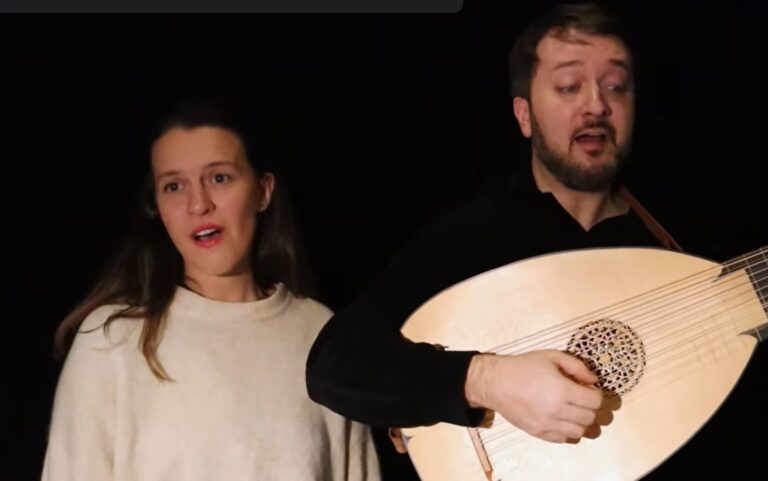
Ménestrel was co-founded by Janelle Lucyk and Kerry Bursey, who blend early repertoire with Canada’s oral folk traditions. Beyond traditional venues, Ménestrel is committed to bringing the transformative magic of music to unexpected places.
An angelic-voiced singer, violinist, and producer, Janelle Lucyk is part of a new generation of artists specializing in this repertoire. She serves as artistic director of Ménestrel, producing music drawn from early sources and orally transmitted folk traditions. She is also Artistic Director of Musique Royale (est. 1985), which presents concerts in historic spaces across Nova Scotia. In this case, Janelle also directs the new ArtChoral series at the Art Deco Le 9e Grande Salle, recently reopened to the great delight of Montreal audiences and beyond.
Kerry Bursey is a tenor and plucked-string instrumentalist whose voice is admired for its “radiant quality.” He is one of the rare tenors of this kind who accompanies himself on the lute.
On the eve of Ménestrel’s concert at Le 9e, Kerry and Janelle answer PAN M 360’s questions.
PAN M 360 : Tell us about the foundations of the project—your original motivations.
Kerry Bursey: With Ménestrel, we enjoy bringing all kinds of songs back to life—sometimes works that are already part of the classical canon (John Dowland’s lute songs, monodies by Monteverdi and Frescobaldi, songs by Josquin Desprez), sometimes pieces forgotten after their original publication and later unearthed from dusty collections (songs by Binchois, airs de cour by Guédron and Ballard), and sometimes old folk songs that have become commonplace but that we revisit and recontextualize (À la claire fontaine, En montant la rivière – Ernest Gagnon collection). Others are largely unknown to the general public yet feel, upon first hearing, as though they’ve always been with us (The Outlandish Knight, Fear An Bhata, Robin Hood & the Peddler – Helen Creighton collection).
We make no distinction between learned and popular music. Our goal is to make this repertoire accessible and help our audience forget what era they’re in. By digging into the past, we rediscover an incredible and timeless wisdom. It’s important to us to keep certain songs quite literally alive.
PAN M 360: How did you choose to combine classical early music with traditional Francophone and Anglophone songs?
Kerry Bursey : It came very naturally for us to combine these two worlds, classical and traditional. What we call early music isn’t just written music—it’s also orally transmitted music. Many Canadian traditional melodies actually originate in older European classical repertoire, sometimes directly from Baroque collections of court airs.
It’s fascinating to see how melodies survive and mutate over centuries. When written music becomes oral—like many Quebecois tunes—it transforms, almost like a game of telephone. Sometimes a folk melody is later reworked by a composer into a theme and variations over a repeating bass.
In terms of folklore, we focus mainly on Quebec and Nova Scotia, which naturally leads us to the classical traditions of France and England—places where the lute flourished. The lute even made its way to Canada, though it didn’t survive as long here. Ultimately, we’re interested in these worthy sounds that have been forgotten.
PAN M 360: How was the recording conceived?
Kerry Bursey : The recording took place in Lunenburg, Nova Scotia, a UNESCO World Heritage Site, in the second-oldest Protestant church in Canada (St. John’s Anglican Church). Lunenburg and this church are central to the duo—it’s where Ménestrel gave its very first concert in 2019 and continues to perform several times a year, including an annual reduced-scale Messiah in December (a 12-voice choir, one player per instrumental part).
It’s also the home base of Musique Royale, directed by Janelle. The church is a very special place—a cultural and spiritual pillar for many Nova Scotians.
The album was recorded by Jeremy van Slyke of Leaf Music. There’s an almost “live” quality to the recording that captures Ménestrel’s concert spontaneity. It’s essentially a selection of what we consider the “hits” of our repertoire—a survey of the various styles we’ve explored over the years.
PAN M 360 : How does the stage performance differ from the recording?
Kerry Bursey: Performing live is what Ménestrel does most naturally. Many artists record first and then tour. For us, it’s the opposite. Since 2019, we’ve given numerous concerts, toured across Canada multiple times—in 2024 alone we performed in every province and territory—and also appeared in Europe.
PAN M 360: Tell us about your professional and artistic relationship.
Kerry Bursey: We met in Nova Scotia in 2019 and have been making music together ever since—not only in Ménestrel but also with several major early music ensembles across Canada.
A strong musical cohesion developed quickly between us. At first, our repertoire was primarily learned and written music—Renaissance and Baroque lute songs—but gradually our interest in early music expanded to include oral traditions and historical folk music.
We both began as classical instrumentalists who became deeply involved in vocal music, especially choral and ensemble singing. This helped shape our sound and distinguish us from more operatic vocal projects.
Our singing isn’t rooted solely in operatic bel canto. One unique aspect of the lute—and plucked strings in general—is the ability to accompany oneself while singing. This practice largely disappeared from the classical world but remained alive in traditional music.
Janelle Lucyk : Since meeting in 2019, we’ve collaborated extensively, both within Ménestrel and beyond. We strike a delicate balance between seeking a unified sound while maintaining enough artistic differences to complement each other. Once you’ve heard Kerry Bursey’s beautiful voice, you too will want to collaborate with him!
PAN M 360 : How do you present yourselves on stage?
Kerry Bursey: We are both singers and instrumentalists, so we accompany ourselves. Even when I sing, I play the lute. Janelle often plays violin to harmonize or provide introductions and interludes. The image of the minstrel is not just a singer but also an instrumentalist—often a lutenist—which was the premier accompanying instrument for nearly 400 years.
PAN M 360 : What does the role of the minstrel mean in 2026?
Janelle Lucyk : As the world evolves, we continue to turn to music for entertainment and comfort. The minstrel’s role remains. Music fulfills emotional, social, and spiritual needs in ways no other art form can—but only when the intention is sincere.
These old songs will remain alive only as long as they continue to speak to us. Human emotions haven’t changed much in 400 years, even if language has. If we can bridge the centuries, the emotional power of these songs remains immense. For now, we’re here to play them.
Kerry Bursey: The term “minstrel” suits our approach. We embrace the modern image of a traveling, versatile musician sharing melodies and stories from court to village, regardless of style or instrument.
There’s a freedom in that approach—a duality between learned and entertaining, written and oral. We aim to unite those worlds, blending classical and popular traditions while respecting historical practice. We try to recreate the experience of a song—without being overly rigid about musicology—offering a timeless sound that feels both detached from current trends and fully accessible.
PAN M 360 : What’s next for Ménestrel?
Kerry Bursey: We’ll continue refining our repertoire, sound, and mission. For something different, we’re touring as a trio with Vincent Lauzer through Prairie Debut, traveling to Western Canada with playful early arrangements of modern songs. We also have duo concerts scheduled across Canada in the coming years. Check out our online schedule!