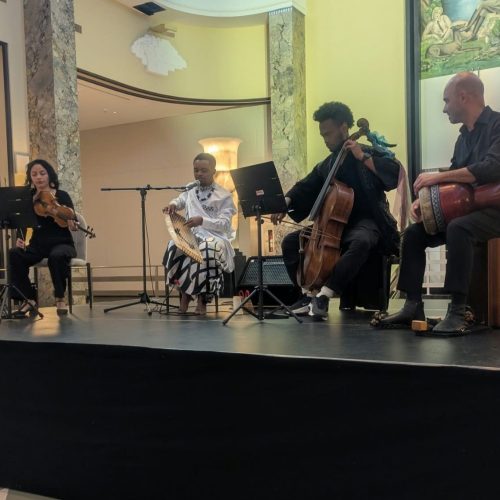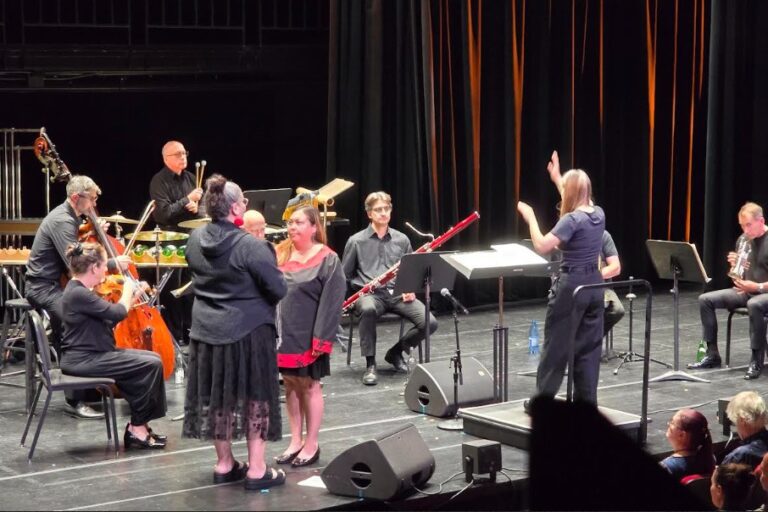
Dina Gilbert, a conductor who has been closely associated with the OSM for several years (she was assistant conductor from 2013 to 2016), conducted this small ensemble on a journey “from Vienna to the Far North.” She appeared on Saturday before a nearly full Fifth Hall.
The idea was to divide the program into two distinct parts for the same ensemble: violin, double bass, clarinet, bassoon, trumpet, trombone, and percussion. This instrumentation corresponds to that chosen in 2008 by maestro Kent Nagano for a tour of Nunavik with the OSM. A commission was then placed with Inuit composer Alexina Louie, which was performed in various Arctic locations.
First, Gilles Bellemare’s arrangement of Wolfgang Amadeus Mozart’s Eine kleine Nachtmusik, more specifically Serenade No. 13 for strings in G major, a well-known piece that every Westerner has heard. The effect is rather average in a small ensemble in front of an audience, and this has nothing to do with its performance. It feels like listening to a mini military band from the pre-industrial era, and the choice of complementary piece to the main work could have been very different. While it is understandable to want to popularize music among these novice music lovers who systematically applaud between movements (no one has told them not to, mind you), linking contemporary music with such a mega-hit by Mozart, composed in the 18th century, seems questionable in this particular context.
A better complement would have been preferable to accompany the pièce de résistance, an Indigenous work imagined by an Inuit composer. Alexina Louie is one such composer, educated in Western music faculties and keen to pass on her Indigenous culture. In this case, the composer evokes the Arctic landscape, dog sledding, summer mosquitoes, and other elements of traditional Inuit daily life through sound, adding two throat singers to this classical ensemble: Taqralik Partridge and Julie Larouche were called in at the last minute because their colleagues were unable to fly this weekend for reasons we can imagine.
It should be noted that Inuit women’s throat singing is primarily a game that 20th-century ethnologists and composers found to be very musical. Since then, interest in throat singing has remained high, as we regularly see projects featuring it—Oktoecho did so just a few days ago at Présence autochtone.
Throat singers are no longer the exotic curiosity they were in the 1970s and 1980s. They have developed their technique, and the variety of their guttural textures, the rhythms of their performance, and the patterns of their phrasing have evolved considerably. However, the sound material remains fairly basic, and the musical potential of throat singing remains limited. Ultimately, more work is needed to develop the language. As for the instruments of the “South,” we were at the service of a rather consonant work, marked by repeated motifs and leaving room for individual expression. Worthy of interest, certainly…
ARTISTES
Taqralik Partridge, throat singing
Julie Larouche, throat singing
Marianne Dugal, violin
Ali Yazdanfar, upright bass
Alain Desgagné, clarinet
Mathieu Harel, bassoon
Paul Merkelo, trumpet
James Box, trombone
Serge Desgagnés, percussions
Works
Wolfgang Amadeus Mozart (arr. G. Bellemare), Une petite musique de nuit (16 min)
Alexina Louie, Take The Dog Sled (21 min)