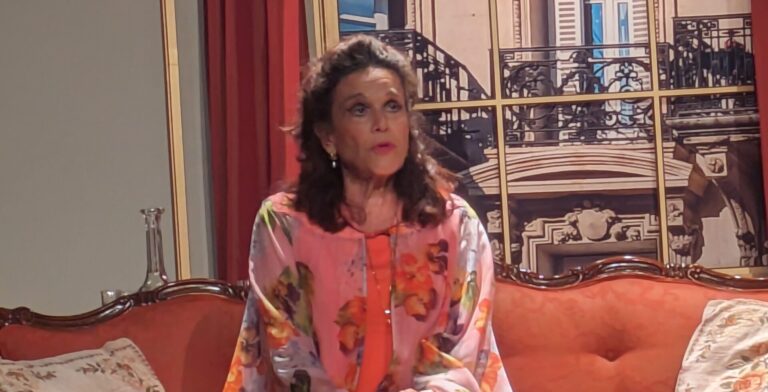
The Fête de la musique kicked off last night with an off-site presentation (in the village church of Mont-Tremblant) of the play Callas : une voix pour être aimée (Callas : A Voiced to be Loved) starring Sophie Faucher as the divina at the end of her life, Marc Hervieux as Giuseppe di Stefano, tenor and companion on her final years, and Dominic Boulianne as pianist and coach Robert Sutherland.
I won’t go into the details of this play, which tells the story of the singer’s last (plausible, but fictitious) moments before she was found dead in her Paris flat. For that, I invite you to listen to the interview I conducted with Sophie Faucher and Marc Hervieux (in French).
I have to admit that I hadn’t yet had the chance to see this play, written by Sophie Faucher and Anne Bryan, and which premiered in autumn 2023. What I saw and felt yesterday was above all a Sophie Faucher inhabited by her role. Here we are, with a gracious lady who is no more than a shadow of her former artistic self. And yet she still has greatness. We’d like to tell her so. We’d like to get up on stage and retort when she says that her voice was everything, that her voice made her. To tell her that no, it was she who made this voice, who gave it its unique character. It was her passion and extreme artistic integrity that built an instrument that has become iconic. That’s how much we believe in it. Marc Hervieux (tenor Giuseppe Di Stefano) is sunny, the polar opposite of the depressed star. But he has his dark side. He loves Callas with all his heart, but he too clings to the past. To the time when she still had her powers, and with whom he could reign on the stage. This forthcoming tour of Japan, which he has come to rehearse at his friend’s house, is a lifeline to which he is clinging after a family tragedy (he has lost his daughter). So he is only partly attentive to Maria’s despair. As for the pianist, he doesn’t really know what to say, other than generic platitudes most of the time.
It’s a shame, then, that Maria Callas’ last moments (if they ever took place like that) were weighed down by the inability of two men to understand the pain of a woman torn apart. The inability to commune with her tragedy, and to pierce her dark shell of regret, absence (maternal love) and resignation (she will sing no more). In fact, Callas’ final moments in this play are the story of a failure. A failure of communication. Perhaps it was possible to break through the defences behind which the exhausted diva had repressed herself, this certainty that she was no longer of any use without singing? She says: ‘The best way to serve music from now on is to keep quiet’. But serving music could have been a matter of passing on the knowledge she had acquired, of giving inspiration to another generation, and so on. Who knows, perhaps with the right words, the right arguments, Maria could have survived ‘Callas’ for a while longer. She could have avoided the trap of having to die out like one of her much-loved characters, Traviata, Mimi, Tosca, Aida.
All these things run through our minds during the hour and a half of the show. And it’s the proof that Sophie Faucher’s acting is so strong, because we dream of intervening, of finding the right arguments, where these two gentlemen fail.
Hervieux is also good and fair in the role of Di Stefano. We can forgive him a few stammerings, but he is genuine in his outpouring of tenderness and love for his friend. The same feelings that drive him to become harsh and even cruel when she doesn’t (or no longer) live up to the idol he still holds her up in his mind. The advantage he has is that he can sing, too. Which he does very well indeed, and with generosity.
Dominic Boulianne plays pianist Robert Sutherland, caught off-guard by this rehearsal that goes nowhere.
The staging, by Marc Hervieux, is very classical, in the form of a three-person huis clos in the realistic setting of a Paris flat with hints of faded luxury. The movements and set-up are designed to help us understand the emotions of the protagonists.
If you understand French (there is no English translation yet) and especially love opera, I encourage you to dive into this play with all your heart. You will be moved.
DETAILS AND TICKETS FOR THE NEW CALLAS : UNE VOIX POUR ÊTRE AIMÉE TOUR