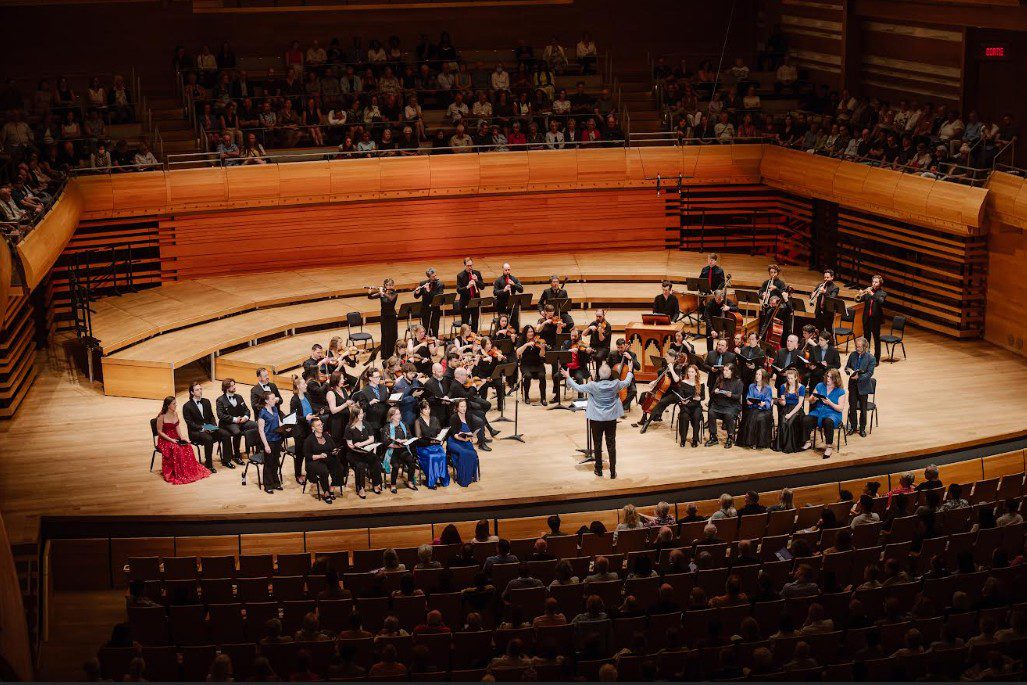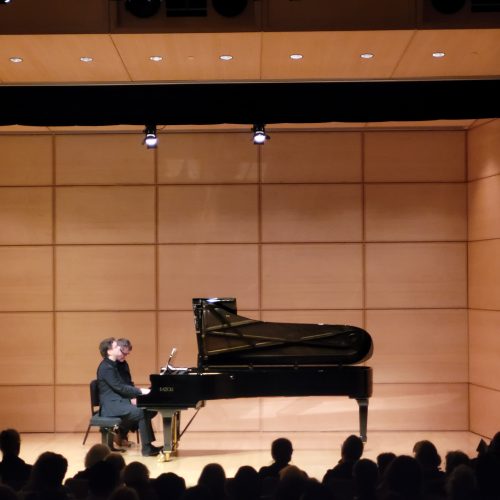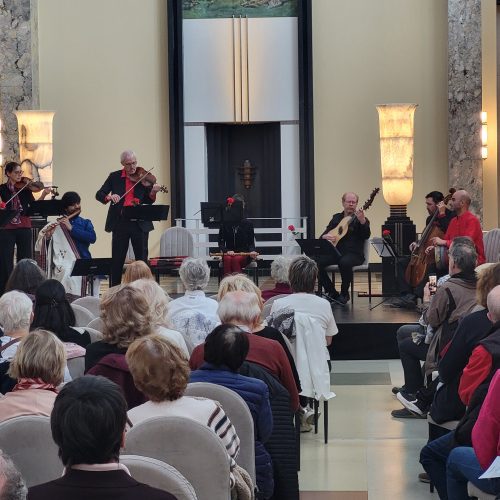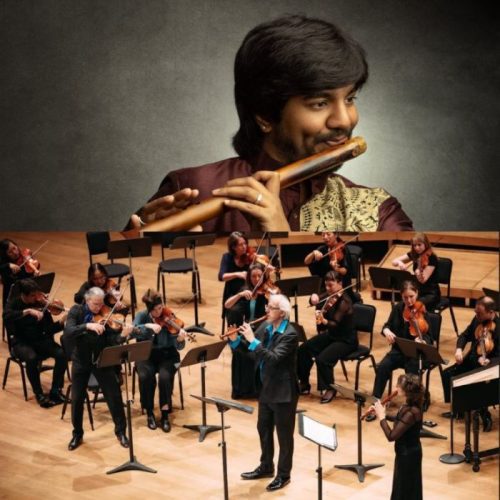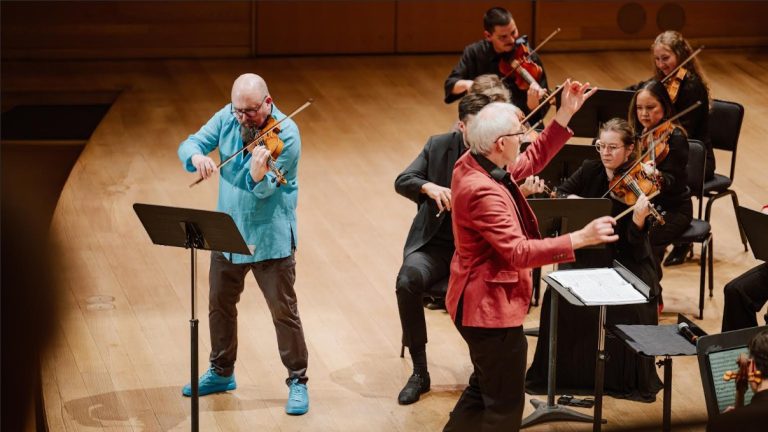
Under the direction of Matthias Maute, the Ensemble Caprice and the Ensemble Art Choral have capped off their 2025–2026 season with a bold venture: welcoming concert violinist Mark Fewer, an iconoclast of the classical world. Dressed in a sweater and turquoise sneakers, he first takes the stage with a performance of Bellatrix, introduced by alternating cries and random phrases on the violin—a chromatic discourse reminiscent of free jazz or other forms of free improvisation, yet composed by Jeffrey Ryan.
For music lovers familiar with this style, there was nothing new under the sun in this contemporary vocabulary, but for the Caprice / Art Choral audience, it was perhaps an invigorating plunge into uncharted waters. Many laughed in surprise, many were entertained, no disapproval was expressed; rather, there was a sense of openness to this dose of new music, proof of how far this kind of musical aesthetic has come.
Mark Fewer also served as soloist for Felix Mendelssohn’s Violin Concerto No. 2 in E minor, Op. 64, MWV O 14, which premiered in 1845 and consists of three movements: Allegro molto appassionato in E minor, Andante in C major, and Allegretto non troppo – Allegro molto vivace in E major. The guest violinist’s flamboyant style suited the orchestral configuration (some forty musicians) well, as his musical expression was clear from start to finish. The orchestra, conducted by Matthias Maute, was clearly at the service of the soloist and the featured work—a piece that is extremely well-known and performed here by an orchestra whose period instrumentation inevitably produces a different, softer sound, with instruments distinct from those of the Baroque era. Once again, this is a daring trait of Maute and his two orchestras: transgressing the repertoire, superimposing eras, and thus producing unique sounds that break away from the classical norm and offer music lovers a fresh experience.
After the intermission, Johann Sebastian Bach’s Magnificat (BWV 243), premiered in 1723 in Leipzig, is the program’s centerpiece, preceded by a choral version of the world-famous “Jesu, meine Freude” (BWV 147), a melody deeply ingrained in the Western collective imagination and beyond. The work recounts the visit of the pregnant Virgin Mary to her cousin Elizabeth, who was also pregnant. The Magnificat is divided into 12 movements; this time, the work was performed by Caprice and the Art Choral choir arranged on stage alongside the instrumentalists (rather than behind the orchestra), with soloists including soprano Janelle Lucyk (who, as the conductor revealed, is pregnant like Mary!), tenor Angelo Moretti, countertenor Ian Sabourin, and baritone/bass Dion Mazerolle.
Here is an outstanding performance of a seminal work from the Baroque repertoire, performed by Baroque musicians. True to the Baroque aesthetic and its distinctive vocal techniques, the soloists shine in the 2nd movement (soprano), the 5th (bass), the 6th (countertenor and tenor), the 8th (tenor), the 9th (countertenor), the 10th (soprano), the 11th (all soloists and choir), with the other movements reserved for choral singing, culminating in the 11th and 12th movements with the instrumentalists and their attentive conductor, who also proved to be an outstanding entertainer before his Montreal audience.
The combination of the two parts of the program thus took us beyond Baroque orthodoxy or purism; we were treated to a surprising blend of three eras, proving that it is possible to travel through time—at least for the duration of a concert.