Additional Information
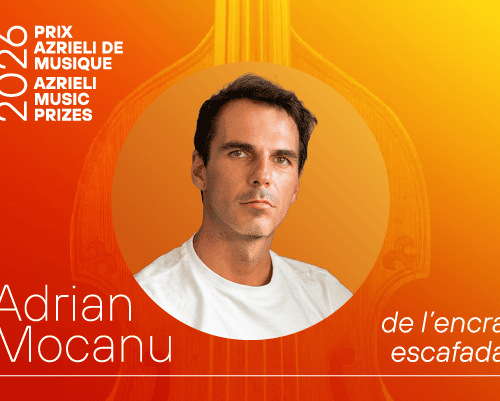
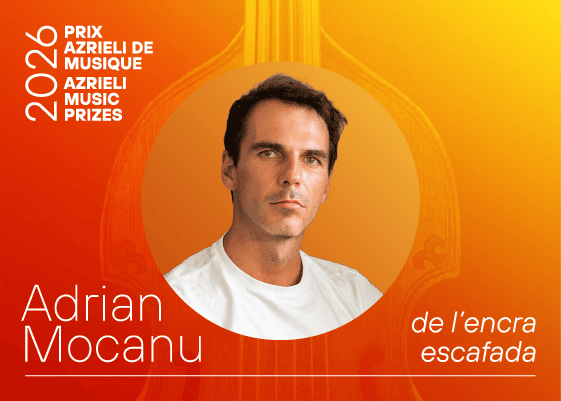
In just a little over a dozen years and six editions, the Azrieli Music Prizes have become one of the most prestigious music composition competitions on the planet when it comes to contemporary music. They were created in 2014 by Sharon Azrieli and are divided into four categories: the Azrieli Commission for Canadian Music, the Azrieli Commission for International Music, the Azrieli Commission for Jewish Music, and the Azrieli Prize for Jewish Music. Three original creations, then, as well as a prize for an already existing, but recent, piece of music. Each prize is worth approximately $250,000, which includes $50,000 in cash, as well as a value of around $200,000 for stage performances, international broadcasts, recordings, etc. It’s substantial. The gala concert that will present the works chosen for the 2026 edition to the public will take place on Thursday, October 15, at the Maison symphonique de Montréal, with the Orchestre symphonique de Montréal, the OSM Choir, and various soloists under the direction of Asher Fisch. PanM360 spoke with each of the composers. HERE, ROMANIAN-UKRAINIAN ADRIAN MOCANU (2026 Azrieli Commission for International Music – De l’encra escafada (“from faded ink”)).
PANM360 : In one short phrase, what is your piece about?
ADRIAN MOCANU : This piece is a reflection of a troubadour song from 800 years ago that is filtered through a contemporary musical language. More precisely, it is about one song, the only one that has survived to us, by a woman troubadour, or trobairitz, named Beatrice de Die.
PANM360 : What is your personal attachment to this subject?
ADRIAN MOCANU : Well, I have an emotional attachment with early music in general. Not specifically this one, but it forms part of my field of interest in general. Yes, I’m really fond of this period of music, and also for the piece as well. This is interesting that this one piece that she wrote 800 years ago was the only one that was preserved. It is possible that she may have written more, or many of the anonymous works that we now know that are marked like anonymous, it is quite possible that they were written by female authors, but we don’t know that for sure, because it was common at that time for female authors to sign their works as anonymous. So, this is the only one that we definitely know that she wrote, and we have the music and we have the lyrics and the notation.
PANM360 : This is quite precious. How do you treat and develop this theme in the piece?
ADRIAN MOCANU : The melody is present in some parts in the piece, but I am more working with the lyrics that are in Occitan language. But this is not an arrangement. It appears subtly here and there through the use of the viola da gambas, but it’s not an arrangement. The original melody is very simple, one line. But I’m writing for a big choir, which has 40 something singers and I’m using it with Debussy. So, there are eight parts in general, right? It would be quite difficult to work with material that would be that simply melodic, which would have just one voice. So, I am trying to split it, you know, divide it, like a split tone. I use extended techniques and stuff like that. So, the melody is present, but it is much filtered.
PANM360 : So the choir doesn’t sing in a traditional way?
ADRIAN MOCANU : Not really, no. They have to use all sorts of extended techniques, inhaling, noises, whatever.
PANM360 : I guess it’s a difficult part for the singers?
ADRIAN MOCANU : Yeah, they were complaining a little bit about the excessive use of extended techniques.
PANM360 : You require four viola da gambas as soloists. This instrument is not vey powerful in terms of sound projection. How do you balance their presence with the symphony and the choir, that can easily overcome them?
ADRIAN MOCANU : That’s why I have four of them (laughs). And that’s why there are four bass viola da gamba. So, it’s like a string quartet. I use them as a kind of an extended soloist. Of course, each of them has their separate part, but it’s more like an extended soloist. And of course, I will be using some amplification for the soloists
PANM360 : Symbolically, what do they represent?
ADRIAN MOCANU : For me, the use of the viola da gambas is a reference to something ancient. We associate viola da gambas with early music, not specifically with the music of the troubadours, because the violas da gamba came a little bit later. But still, they are closer to the medieval time than they are closer to the modern symphony orchestra. So, this is an approximation, but it’s an allegorical way of introducing early music into a contemporary symphony orchestra.
PANM360 : Generally, as a composer, what is your main focus?
ADRIAN MOCANU : Well, recently, it’s vocal music. It just comes naturally. I like to use extended techniques, and also graphic notation and elements of improvisation, which is also present in my piece, not only with the voices. There are moments when the orchestra has something fixed, and the gambas have these patterns that they can freely combine for a fixed amount of time.
PANM360 : How do you feel about receiving the 2026 Azrieli Commission for International Music? What does it represent for you?
ADRIAN MOCANU : When I got the news, it was a bit of a shock, because I know that there were a lot of submissions, I don’t know how many, but around 300 or so. So, I didn’t expect it to happen. I just wrote this proposal, which was very specific in the requirements. It was a complex thing to build this proposal. So, I was very much surprised. Of course, it is a big honor for me, but also a big challenge, because one thing is to design the concept of the piece. But then I had to do it for real. It took me, I think, a couple of months just to figure out the way to start writing this piece. When I actually found the way, I had so little time that I think like three months of looking for the material, and then maybe three or four months to actually finalize it.
PANM360 : Well, all the best with the premiere on October 15
ADRIAN MOCANU : Thank you