Additional Information
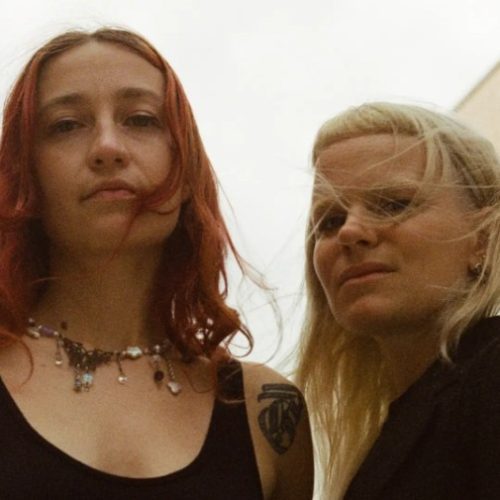
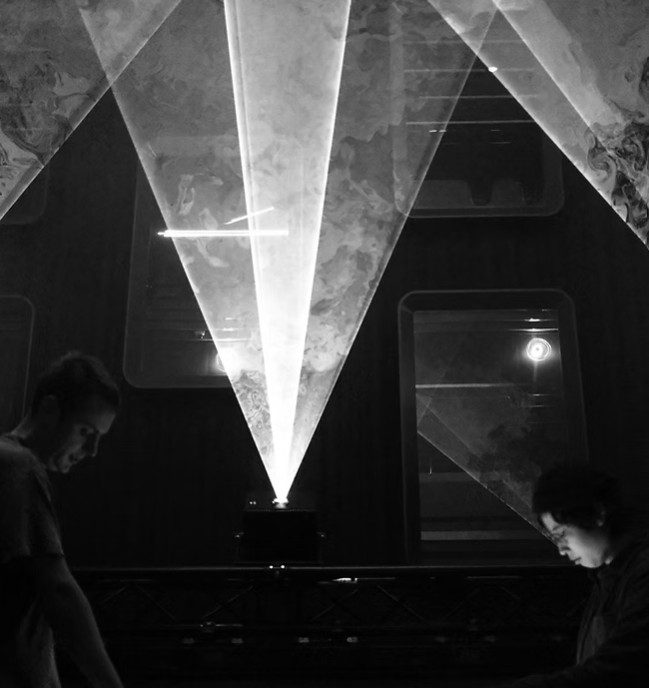
London based artists Tom Holland (UK) and Wawa (Taiwan/Canada) make a pair behind the audio-visual project Super Galaxy Meow Meow. On the 30th of August, as part of the electronic music festival Mutek, they will be presenting the North American premiere of their performance “Reciprocity”, which uses laser-generated sounds to create an experience where visuals and sounds become fully intertwined. They give us an insight into the technical nitty-gritty of the project and its creative challenges to be presented at MUTEK Montréal, Play2 series, Sunday August 30th, 2PM.
PAN M 360: Hi guys, nice to meet you today.
Tom and Wawa: Nice to meet you too. Thanks for having us.
PAN M 360: It’s a pleasure. Let’s just start by introducing you: What is Super Galaxy Meow Meow as a project and how did it come to life?
Tom: It started because Wawa and I work together. We’ve been involved in lots of creative show design for other people. And then, the two of us decided that, rather than doing creative work for other people, we’d like to do it for ourselves and have our own creative project to nurture. And so, we joined up together to start a duo.
Wawa: I’ve been DJing and playing music for a while, and I think our collaboration started when one of Tom’s friends organized this rave event in London, and asked us if we were interested in playing together.
Tom asked me: do you want to do a dual thing? It was at this art space, and we had lasers and multi-layer projection designs. It was really fun.
And so we thought: Oh, this could be a really cool project for us, to combine fun with an experimental approach, to create our own experimental playground with this project.
PAN M 360: Is “Reciprocity”, the performance you’ll be presenting at MUTEK, your first project as Super Galaxy Meow Meow or were there previous collaborations between you two?
Tom: I guess we’ve had previous collaborations. But kind of more in a club scene setting. “Reciprocity” is going to be our first dedicated experimental A/V (Audio-Visual) setting rather than us putting on a show.
PAN M 360: “Reciprocity” will be an audiovisual performance where the sound will be informed by the visual component of the performance. I was wondering about where did the idea come from? Mixing of visuals and audio makes me think of early visual sound experiments, such as the soundtracks of some of Norman McLaren’s films being created through drawing on the optical track.
Did the idea come about from historical inspirations, unrelated technical exploration, something else? Please expand on that.
Wawa: It came from being very curious, from a place of curiosity. We basically asked ourselves: what does a laser sound like?
Tom: Yeah. A lot of the work that Wawa and I do, outside of Super Galaxy Meow Meow, is visuals that react to the audio. And it was kind of about flipping that on its head and trying to have a sound driven by a visual starting point rather than the usual way around.
A nice avenue we found is that, when you send data to a laser to tell it to do laser things, the information that the laser receives is kind of like a sound wave. And so, if you want to draw on like a big laser sheet, what you’re actually doing is telling the laser: “I want you to draw a dot, and I want you to move it from side to side really, really quickly”.
It’s like moving across a big sheet, and that movement from side to side is basically a sine wave. And you can use that sine wave and convert it directly into audio.
We wondered about all this information that we are sending all the time to a laser, which is kind of like a silent sound. And we thought: in a big stage show, you have loads of lasers and they’re all sitting there, listening to this whole “song” that’s happening, outside of the show, and which nobody gets to hear except for all these little laser boxes. So, we’re kind of trying to get that sound out from inside the box and hear what it sounds like.
PAN M 360: OK, so that’s the way in which you code the lasers that is then directly converted to sound?
Tom: Yeah. When we’re sending the information to the lasers, we split it off right before it gets to the lasers. So, one set of information goes directly to the laser and then we take a copy of that information and send that information straight to Wawa.
And it becomes this kind of interplay where we make these laser patterns and that generates a sound. Wawa then takes that sound and she samples it and plays with it, adding reverb, beat repeating it, and manipulating it in all these weird and wonderful ways. But then she also sends that sound back to the lasers.
It becomes this loop where, suddenly, I’m sending out some audio to the lasers as I am getting that audio from Wawa. It also affects the lasers, and it becomes this continuous feedback loop.
PAN M 360: And for you, Wawa, how do you work with that generated sound? Do you simply take what the lasers’ information generates and then transform it? Do you bring in other sounds, other sonorities? How does it work from your side?
Wawa: So initially it will just be the laser sound. And how I do it is that I use Ableton and I have it always listening to the lasers. I’m not going to resample the laser sound. I’m just having it come to live all the time.
And then I will use effects to mold it and tame it. And I will also add my own sound, which is very minimal, more like rhythmic sounds, because like Tom said, it’s a back-and-forth thing. So the percussion and the things I add will affect the visual.
It’s almost like we’re conversing with each other. I will add my own elements, and he will respond to that. But the main sound, all of the external sound that is added, is here to support the laser sound.
I also use Granulator 3 in Ableton, which you can use for live capture. If I really like a segment generated by the laser I would further sample that segment into a granulator and then generate melodies with that. I would say that only the rhythmic element is external sounds, but like the drone, the melody, the bass, it’s all done through effects and live granulator capture.
PAN M 360: Could you explain a little bit how the granulator works? I’m not familiar with that tool specifically. And the audience might not be either.
Wawa: Granulator 3 is basically taking like a piece of audio and then chopping it into little pieces. Then, you can play back the little pieces differently. You can scroll through the sample and play a bunch of small pieces or grab a small piece from the audio sample and then use that one sound.
So, it’s chopping up audio into a bunch of pieces. And what I like about that is that it has a function where you can capture live recordings. That’s the main reason I use this specific version. A granulator is super cool.
PAN M 360 : I’m curious about how this collaborative performance furthers your artistic practices. How does it expand on your previous experiences?
Tom: I’ve done a bit of work in laser design for different artists. I’ve done work on visuals designs for artists too. And there’ve been a couple of cases where I’ve had the opportunity to do a little bit of both for the same artists, where we’ve had a visual and a laser tracing the visual, which is quite a quite popular technique at the moment.
This project goes a lot further in that the entire setup is built in TouchDesigner and using the new family POPs (Point Operators), which has been really, really cool. That has opened up a whole new world, particularly for this kind of laser visual combo where I can now have a fairly big TouchDesigner patch that’s running lots of different visuals, all of them with a straight up visual element, a laser element and a laser tracing element.
It’s been pushing me in a lot of different ways, particularly building this live patch. Along the way, since it’s all kind of fairly new, particularly with POPs, there’ve been lots of unforeseen stumbling blocks and hurdles that we’ve come through. There’s been a lot of conversations with TouchDesigner and also with the guys who make the end laser part of this setup, debugging little problems that have come up.
And, you know, it’s been really exciting for me to explore all of that, especially since a lot of this stuff is quite new.
Wawa: I think for me, the raw laser sound basically challenged me because it sounds horrible. And it’s a challenge finding ways to make it sound cool and sound nice, because it can sound harsh a lot of times. And to be doing that live. In the past, I’ve always performed in a more controlled environment, where I know the music and the songs that I’m playing. But here, I’m basically composing based on what I have on the spot, it’s quite exciting.
And the laser sound that Tom sends in isn’t always the same. It’s different every time because it depends on the visual and laser visual that he creates. Even a slight movement will change the pitch or change the tone.
You have to react to it in real time. It’s almost like improvising. Using this limited source to make something that is musical, in a live environment, that’s something that challenged me.
I learned how to build systems in Ableton that can control chaos and react to unpredictability, to be able to respond to that. That is a new way of performing that is quite exciting for me.
Tom: It was super funny the first time that we tried it out, wondering what a laser is going to sound like? We turn it on and we’re like, oh, my goodness, it sounds so horrible! Wawa has done an amazing job, sculpting and crafting the pretty rough sound that comes out into something that people would actually want to listen to.
PAN M 360: What is the part of improvisation versus preparation in the performance? What are the elements that you know will be there in advance, the methodology you have built, and the parts where you go with the flow of the moment?
Tom: Effectively, the whole set is improvised to some degree. Obviously, all the work that Wawa is doing is live sampling and audio manipulation and all the visuals that we make are all live generative visuals. While there’s a framework, and while we have a number of visual styles that we will move through throughout the performance, effectively anything could happen. And anything that Wawa does sonically affects the visuals in real time as well, and we always have this, like a feedback loop going on.
I think we’ve now worked out a little bit of a structure and the more that we play and perform together a vibe and a structure, a kind of trajectory, starts to form between us. We know that there’s visuals that we want to end on and sounds that will trigger other visuals.
There’s a kind of a structure to the madness, but there’s still like a lot of madness.
Wawa: It’s improvised, but because of so much practice, I can kind of predict what kind of laser sound is going to come through. And I feel like, at least for me, how I understand, and approach sound design is always down to the pitch, timbre and volume. I have tools like a filter or a pitch shifter and reverb, and I can alter those three elements.
It is improvised, but I strategically have tools. When I’m sculpting the sound, I know what I’m doing. And if it gets too chaotic, I just hit repeat, and the sound will stay the same. So there will be elements of control that I can use, so I can have a little bit of breather.
But, I have three channels in total of laser sound coming in. So while I repeat one, there will still be another channel for Tom, because he’s still responding to me. He might introduce a new laser sound and that process will repeat.
Also, because it is a performance, we did plan out the intensity throughout, we don’t want it just to be chaos, we did structure a bit. I will introduce sounds that will increase the intensity of stuff.
Tom: Also, while both of us are there, twiddling parameters that are sculpting our parts and keeping them together, and moving through the set, we’ve also got one shot that we can play at each other, in improvisation. While we have this big picture element, we also got these more playful improvisations, working as a call and response to each other.
PAN M 360: Last question: an open-ended one: Is there anything we didn’t touch upon, that we didn’t talk about during this interview that matters to you and that you would like to bring in?
Tom: One thing that matters for me, and that has been really cool, is just this big appreciation for MUTEK. For the opportunity, for their attitude and their help with all of this, their willingness to get us all the way from the UK to Canada. Setting up things like talking to you, I think it is really special. The kind of support and passion that those guys have shown to us throughout this whole process has been super inspiring. I think they’ve been awesome.
Wawa: I guess I will touch a bit upon the name of the performance, “Reciprocity”.
For me that name came before everything else. I think “Reciprocity”, as a concept, is that whatever we do, there’s always a back and forth with each other, especially with art.
I feel that art is like a community, and it’s built from people. Whatever we do in art, it’s going to go back into the culture. And I wish that people realized more that it’s all back and forth. It’s never a one-way thing.
PAN M 360: Thank you two for those answers, and thank you for being here today. It was a pleasure. Tom, Wawa, thank you.
Tom and Wawa: Thank you, Ariel. It was really nice talking to you.