classique

Thus Spoke the Trombone and the Cello

by Alexis Desrosiers-Michaud

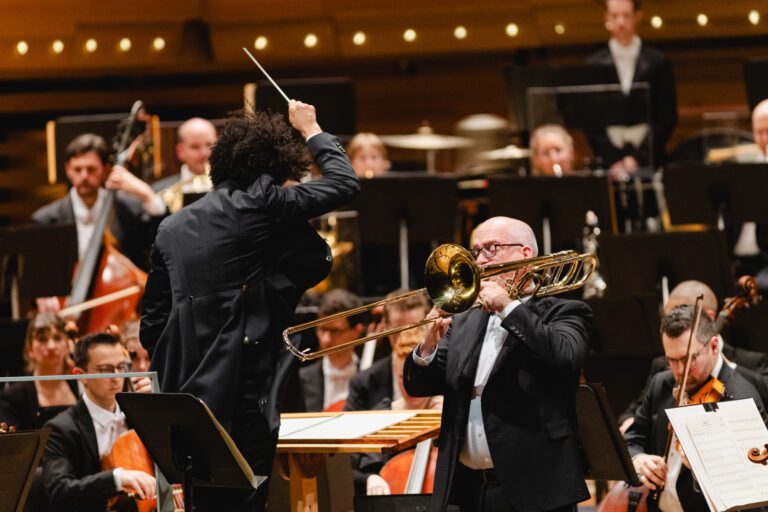
This week at the OSM, there is not one, but two concertos, with two house soloists: trombonist James Box in Samy Moussa’s Concerto “Yericho” and cellist Brian Manker in Ernest Bloch’s Schelomo: Hebrew Rhapsody.

Moussa’s concerto takes its name from the city of Jericho, which, according to the biblical story, was surrounded by Israel before falling within a week. It is an intense work from beginning to end, which gives its performer no rest. Strongly inspired by minimalist music and the presence of an organ, the terror is felt from the first minutes of the work, with a motif of two descending notes (the opposite of Jaws) repeated many times sounding the alarm, and the soloist will be the last to play it. What follows is a series of virtuoso sequences for both orchestra and soloist, leading to climaxes reminiscent of Shostakovich with abundant percussion and strings in the extreme treble, in particular. James Box delivered an exceptional performance combining his powerful, wide-ranging register and flawless coordination. Yericho will keep the audience on the edge of their seats until the very end, who will jump to their feet to congratulate the orchestra, soloist and composer.

Brian Manker would later distinguish himself in a completely different way. As King Solomon, his musical proclamations and phrasing are impeccable, so much so that the massive orchestra behind him never overwhelms him. Like his colleague, his technique is tested, but, like a king, Manker never falters. Like Yericho, Schelomo is a seamless and more fluid work. The musicians play the role of the faithful wonderfully, chanting wildly whenever the king falls silent.

While there is a clear religious connection between the two concertos, the comparison ends there. This is partly because neither Richard Strauss nor Friedrich Nietzsche were Jewish, and partly because the opening of the concert was from the opera Tannhaüser by Richard Wagner, a notorious anti-Semite. This version was very successful, thanks to the accuracy of the woodwinds and the dexterity of the strings, but also to the majestic sound of the brass in the final theme.

The pièce de résistance of this long concert was Richard Strauss’s symphonic poem Also sprach Zarathustra. While the first minute may be well-known, one still has to be able to face the remaining 32, especially after an hour and a half of concert. The endurance test was met with flying colors. One might have expected a slackening of power and precision, especially from the overused horns and strings, but this did not happen. This (another) technically very demanding score gave us the right to very well-balanced contrasts between the woodwinds in the background and the solo violins, as well as interventions from scattered soloists on the lookout. The waltz was played with verve, before plunging back into the abysmal sweetness to which Rafael Payare has accustomed us since his arrival.
Latest 360 Content

Violons du Roy | Bernard Labadie Pesents His 2026–2027 season

Violons du Roy | Bernard Labadie Pesents His 2026–2027 season

Greenhouse Ensemble – Mezzanine

Greenhouse Ensemble – Mezzanine

Manela – Éclat nocturne

Manela – Éclat nocturne

Yuki B – Romance

Yuki B – Romance

2026-2027 Season of the Bourgie Hall: Let’s Talk About It with the two directors

2026-2027 Season of the Bourgie Hall: Let’s Talk About It with the two directors

APACALDA – LIE 4 U

APACALDA – LIE 4 U

Soul of Zoo Unveils “Connection,” The Result of Collaborations From Here and Abroad

Soul of Zoo Unveils “Connection,” The Result of Collaborations From Here and Abroad

Tracks and Feel: Live Sports at Bar le Ritz PDB

Tracks and Feel: Live Sports at Bar le Ritz PDB

Status/Non-Status – Big Changes

Status/Non-Status – Big Changes

Pro Musica / Mélodînes | Piano four hands delight with La Fiammata

Pro Musica / Mélodînes | Piano four hands delight with La Fiammata

The Shits – Diet Of Worms

The Shits – Diet Of Worms

Poison Ruïn – Hymns From The Hills

Poison Ruïn – Hymns From The Hills

Crack Cloud – Peace And Purpose

Crack Cloud – Peace And Purpose

Grace Ives, extremely intimate and volatile

Grace Ives, extremely intimate and volatile

Grace Ives – Girlfriend

Grace Ives – Girlfriend

Grace Ives Is the Not So Shy ‘Girlfriend’

Grace Ives Is the Not So Shy ‘Girlfriend’

KLO: A New Chapter in Music with The Single “Benito”

KLO: A New Chapter in Music with The Single “Benito”

OperaM3F | When a jazz quartet meets versatile voices

OperaM3F | When a jazz quartet meets versatile voices

Geneviève Bilodeau – Rendre Grâce

Geneviève Bilodeau – Rendre Grâce

Valérie Lacombe: From Classical Violin to Jazz Drums

Valérie Lacombe: From Classical Violin to Jazz Drums

UdeM – Ultrasound | Florence Dubé, Allison Chidiac, Alexandre Hamel, Alexandre Vaillant, Florence Lafontaine, Olivier Martin-Fréchette, Charles Anthony Raymond-Plante, Jacob Boucher, Rafaël Bouthillette, Félix Gervais-Richard

UdeM – Ultrasound | Florence Dubé, Allison Chidiac, Alexandre Hamel, Alexandre Vaillant, Florence Lafontaine, Olivier Martin-Fréchette, Charles Anthony Raymond-Plante, Jacob Boucher, Rafaël Bouthillette, Félix Gervais-Richard

UdeM – Ultrasound | Aurélie Théroux Sénécale, Maurice du Berger, Zao Dinel, Platon Beliaevskin, Ziryab El Hihi, Ac Riznar, Alex Ronald Brisson, Matisse Charbonneau, Jaden Brown

UdeM – Ultrasound | Aurélie Théroux Sénécale, Maurice du Berger, Zao Dinel, Platon Beliaevskin, Ziryab El Hihi, Ac Riznar, Alex Ronald Brisson, Matisse Charbonneau, Jaden Brown

Nuits d’Afrique Productions | Zalam Kao, Grand Prize Winner of the Syli d’Or

Nuits d’Afrique Productions | Zalam Kao, Grand Prize Winner of the Syli d’Or

Codes d’Accès, Constellations corporelles | “Crowdwork” by Alexis Blais, for Violins, Viola, and Loudspeakers

Codes d’Accès, Constellations corporelles | “Crowdwork” by Alexis Blais, for Violins, Viola, and Loudspeakers

Subscribe to our newsletter

Inscription
Infolettre

"*" indicates required fields

Type of Suscribers