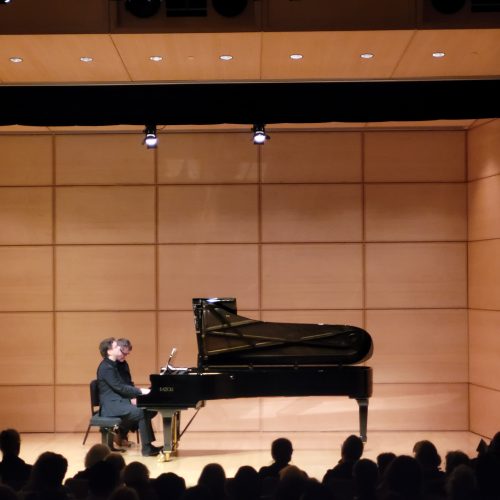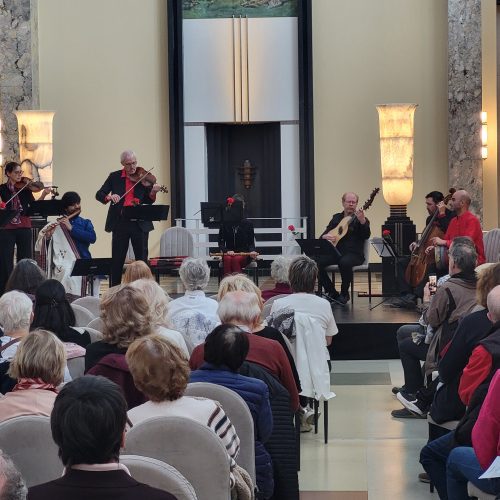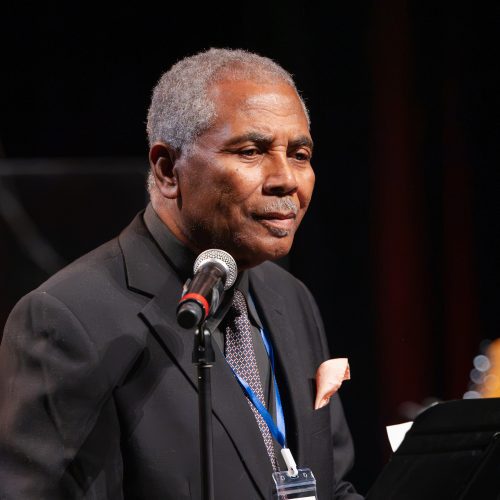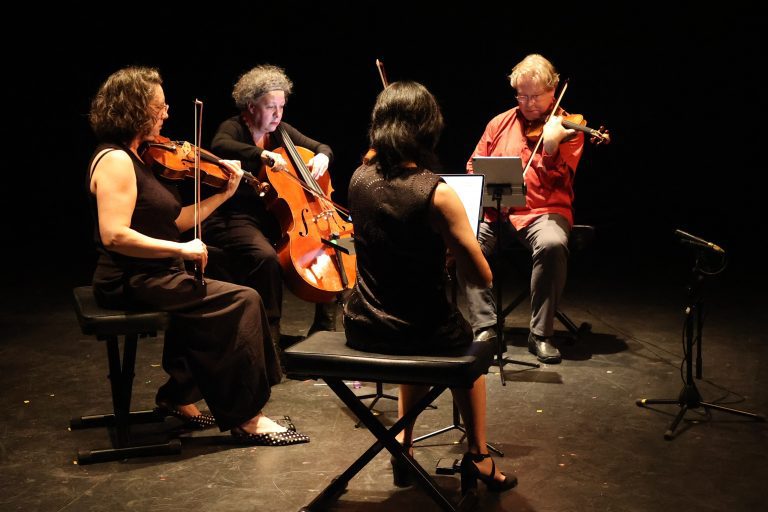
There was quite a crowd in the small hall of La Chapelle Scène contemporaine last night to hear two string quartets by George Lewis, performed by the Bozzini Quartet. Moreover, the 74-year-old composer was present to show his appreciation for the lively performance of the Montreal musicians.
INTERVIEW WITH ALISSA CHEUNG OF THE BOZZINI QUARTET
It was the Quartet 4.5 “Partial Truth” that was the first to be played (to understand the unusual numbering offered by Lewis, see the interview). We are quickly captivated: Lewis’s music is hyperactive, constantly teeming with striking textures (squeaks, glissandos, sustained notes, the bowing of bouncing strings, etc.). In this quartet, no moment remains uninhabited, even though the fabric of the score never gives the impression of being too dense. The energetic activity, a delicate and nervous pointillism, is incessant. But the most remarkable thing is the feeling of pulsation that emerges from it, a pulsation that is never really suggested in an obvious way. This one ends up inhabiting us, despite its ostentatious… absence. Lewis is a fan of philosophy, he says. I would therefore say that the beat, the groove, so invisible in the essence of his music, fully exists as an intersubjective being, in each of us, listeners, a sort of musical dasein.
The next quartet was no. 2.5 “Playing with Seeds,” more disparate in its construction, deploying a less sustained, more fractured energy, but also filled with exciting textures (including that rubber ball rubbed on the body of the cello and viola, creating a frankly amusing organic purring sound, which I would have liked even more!).
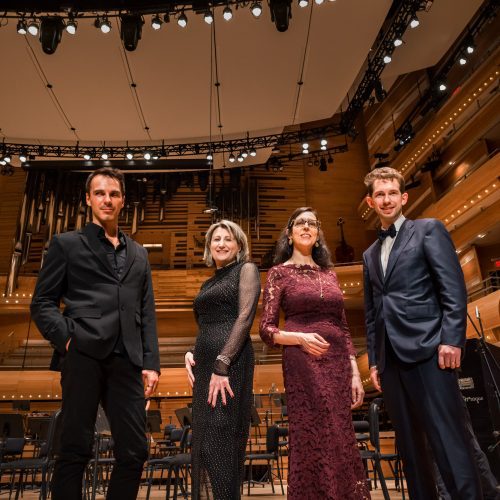
Rarely, it seems to me, has rigorously abstract and atonal music been so exciting to listen to. A well-deserved ovation concluded the exceptional performance of precision and technical mastery by the four members of the Bozzini Quartet (let’s name them: Isabelle and Stéphanie Bozzini, Alissa Cheung, and Clemens Merkel).
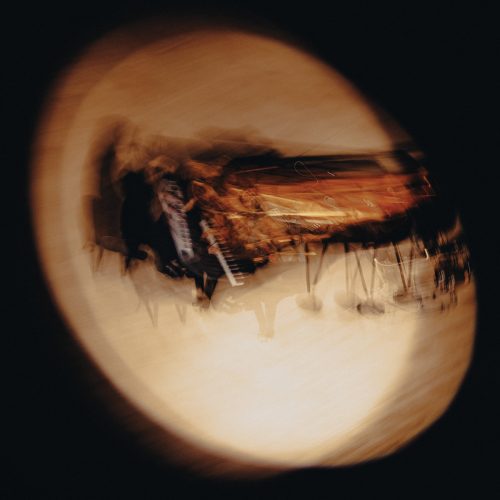
In the first part of the concert, and in total contrast to Lewis’s music (that’s a bit of the recipe for Quebec Musiques Parallèles concerts, and we like it), there was a long composition by Patrick Giguère, Ce qui frémit (that which shivers), for viola da gamba and synthesiser. The composition works with the just intonation system, a kind of well-tempered microtonality with 22 notes per scale.
We heard music unfolding like the movements of tides, with ascending episodes, very slowly on long sustained notes, towards more active and powerful moments (but very reasonably. Nothing thunderous here), then descending. A mix of drone and ambient. It was in the first third of the piece that I had the most pleasure, particularly at the first “tidal” peak, where Daniel Áñez’s synthesiser seems to emerge from the aquatic depths to gently ripple while accompanying the gamba, which also becomes more effervescent. The last third of the piece, on the other hand, seemed too long to me, despite a final crescendo that had a beautiful effect.
Marie-Loup Cottinet on the viola da gamba particularly stood out in a piece with precise intonation, which must be very difficult to execute well, and especially to tune!