Additional Information
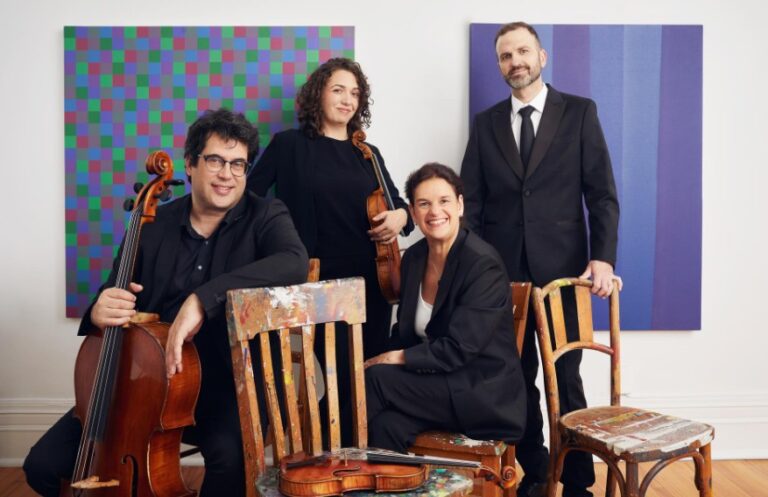
If you watched the state funeral of the great sociologist Guy Rocher on TV, you also saw and listened to the Molinari Quartet, whose musical activities PAN M 360 has been covering since the platform’s inception. Music lovers will still be eager to hear this excellent ensemble, which begins its 2025-26 season on Tuesday, October 7. With Olga Ranzenhofer, we explore this first program under the Passages banner, consisting of works by Bartók, Shostakovich, and Boucourechliev. We also talk about the quartet’s new member, violist Cynthia Blanchon, and we look ahead to the new season that is just beginning.
PAN M 360: Let’s start with the renewal. You’ve reached parity with the arrival of violist Cynthia Blanchon. Bravo! Why did you choose her specifically? What are her strengths?
Olga Ranzenhofer: We chose Cynthia after auditioning several violists. Her rich sound, her keen sense of phrasing, her great musicality, and of course her great technical mastery of the viola convinced us that she was the violist we were looking for. She also has extensive experience in chamber music.
It’s a great pleasure for me to have another woman in the quartet. The work atmosphere is cheerful and we all really enjoy working together. Cynthia’s arrival gives new impetus to the Quartet.
PAN M 360: Why play on a Tuesday as the season opener?
Olga Ranzenhofer: Usually, our concerts are on Friday evenings, but with the arrival of our new violist, we had to change because Cynthia was unable to perform on the date we had planned. It’s as simple as that! The other concerts will be on Friday evenings again.
PAN M 360: We will be returning to your 2025-26 programs several times this season, but can we talk about a general perspective for this 29th season?
Olgan Ranzenhofer: We have maintained our mandate to perform the great works of the 20th and 21st centuries and to premiere new works since our beginnings, and this season is no exception! Our first concert features works by two of the most important quartet composers of the 20th century, Béla Bartók and Dmitri Shostakovich, who wrote no fewer than 21 quartets between them! It is essential for a quartet to play these works, as they are the foundation of the string quartet repertoire.
We were supposed to perform the complete Shostakovich quartets last May, but unfortunately the concerts had to be canceled at the last minute. We are very happy to announce that we will be performing this complete set with Cynthia next May. We also have two beautiful premieres this fall; Denis Dion wrote Coin Darling for us, a work in tribute to Guido Molinari, and we will premiere Blair Thomson’s first quartet, Internesses, in December. We will also finish our complete Philip Glass quartets in February and record them for ATMA. So, continuity and new releases are on the menu for our 29th season.
PAN M 360: The first concert of the season of your series Vingtième et plus is entitled Passages. Why?
Olga Ranzenhofer: There are several reasons for this title. First, there is the passing of the torch to our new violist. Second, Bartók’s First Quartet represents the transition from post-Romanticism to the path of modernity, and the three movements of this quartet form an astonishing journey, from despair to hope, from funeral dirge to Hungarian dance. Finally, the premiere in 1953 of Shostakovich’s Fourth Quartet opened the way to greater artistic freedom with the death of Stalin.
PAN M 360: Tell us about the challenge of Shostakovich’s 4th Quartet, written during the Stalinist regime and premiered after Stalin’s death in 1953. What are its special features? How did you prepare for it this time?
Olga Ranzenhofer: This 4th quartet was performed at the very first Molinari concert in November 1997. I’ve been playing this quartet for almost 30 years now, and I always discover something new in it. That’s the sign of a true masterpiece! Of course, we change our interpretation over the years, and that’s what’s extraordinary about live music. It’s always renewed. The structure of this quartet is very classical, both in its four movements and in the internal form of its movements. The second movement is a small masterpiece in itself, with its very touching, intimate theme that contrasts with the very orchestral first movement. The last movement is particularly incredible, with its long, intense buildup. It’s always a great pleasure to play this work.
PAN M 360: Same question for Béla Bartók’s 1st quartet, opus 7, “whose three movements form an astonishing journey, from despair to hope, from funeral song to Hungarian dance.”
Olga Ranzenhofer: This quartet takes us through a whole range of emotions. The sighs of despair at the beginning transform over the course of the work into a return to life and then a joy of living with dance rhythms. Bartók’s quartets always represent a great challenge because everything is intertwined and depends on what came before. The work is in constant accelerando; you have to carefully balance the tempos and intensities to be able to reach the end of the work!
PAN M 360: To complete the program, the Quartet III by the Bulgarian composer (naturalized French) André Boucourechliev (1925-1997), a work written for the 1995 Evian International String Quartet Competition. Why this choice? What are its particularities? How do you approach it?
Olga Ranzenhofer: This quartet is very interesting. Boucourechliev, who was also a musicologist and writer, composed about thirty works. These three quartets offer great challenges to the musicians because we must be more than performers… we participate at several moments in the composition of the work. Boucourechliev created “open” sections in which the musicians must make decisions about the material to play, the order in which to play it, and the choice of intensities and speeds. All this must be done not by chance, but by attentively listening to the other voices and following a common thread. We create a new work every time we play this quartet.
I invite music lovers to listen to the episode entitled “Passages” of our podcast “Le studio du Quatuor Molinari.” Host Jean Portugais welcomes Cynthia Blanchon for an interview and presents the works on the program for the concert on Tuesday, October 7.
PAN M 360: How did the Molinari Quartet (and your daughter Odile Portugais, soprano) experience the state funeral of sociologist Guy Rocher? Remind us of your interpretation choices!
Olga Ranzenhofer: Guy Rocher was a great builder of modern Quebec. He was also a great music lover and a loyal supporter of the Molinari Quartet. At 98, he still came to our concerts! My husband, Jean Portugais, knew him well at the University of Montreal, and we were very touched to be invited to see him in palliative care in August.
I brought my violin and played Bach, Handel, and Massenet for him. After his death, his daughter Anne-Marie called me to ask the Molinari Quartet to play at the National Tribute in his honor.
We chose to play the first movement of the magnificent Quartet No. 2 by Quebec composer Jacques Hétu and the first movement of Shostakovich’s 1st Quartet, two works conducive to contemplation. One of the pieces I had played for Mr. Rocher was Handël’s Lascia ch’io pianga, which is an aria for soprano. The family wanted this work, so we asked Odile to do it with us. We were also asked to play the well-known song Adieu Monsieur le professeur, so my colleague Antoine Bareil made an arrangement for voice and quartet. It was a very touching moment at the very end of the ceremony when the Katimavik Vocal Ensemble, conducted by Frédéric Vogel, sang the chorus and invited the crowd to join us.