Additional Information
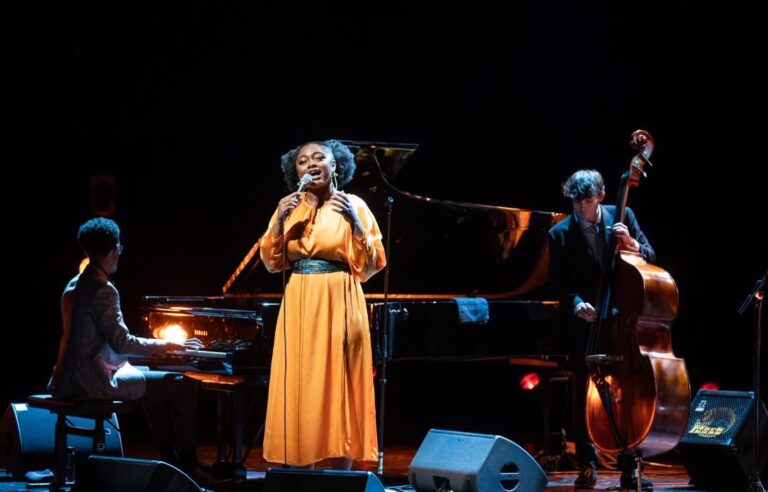
With just two albums to her name, a self-released homonym 2021 and Linger Awhile on the Verve label 2022, Samara Joy has won two Grammy statuettes: Best New Artist and Best Jazz Vocal Album. Her career was thus launched, and she triumphed on Sunday at Monument-National, before which PAN M 360 obtained a pleasant and instructive interview with the African-American revelation. The 23-year-old Bronx woman is loquacious, nuanced and highly intelligent. Read our conversation!
PAN M 360: At this young age, your approach is so classy ! The way you sing, the sound, the backing band (piano trio), all is so rooted in old jazz forms. How come ? Why do you love this so much ?
Samara Joy: Well, I think because of its acoustic nature, I find that it leaves a lot of room to make music together. I love big bands. I also love electronic music, and you know, the different effects that people can get and different instruments and love. I love all of that. But I think from my musical discovery, at least at the moment, I’m just having four musicians on stage and seeing what we can come up with together? On the spot. I love that.
PAN M 360: And you grew up learning that, as a classical singer, in a way, because the way you sing the repertoire you’re exploiting. And I suppose what you’re going to do in the next few years, is classical in some way. You could have been an opera singer, couldn’t you ?
Samara Joy: No… I don’t know if I could have been. It takes years and years and years of training, I think.
PAN M 360: But don’t you have a big training ?
Samara Joy: That’s true. But I don’t know if it was as rigorous as what opera singers go through. And on my side, I didn’t grow up listening to jazz, so I had around four years, four years to straighten up and, you know, learn everything I could learn. But it’s a lifetime thing. So… I don’t know ! (laughs)
PAN M 360: Before this happened, were you already singing in choirs or whatever ?
Samara Joy: I was singing a bit of everything in school. I was singing lead roles in musicals. And then I kind of took the lead in church to the way my church was kind of set up: we had a choir, but we also had maybe four or five singers up front, handling the main harmony parts. And I took over the lead after a while when I was like 15 or 16 years old. So I was singing in different opportunities offered to a teenager.
PAN M 360: Also as a child ?
Samara Joy: Not really as a child. I started when I was like 10 years old or something like that. And yeah, eventually I went to Purchase College, a state university, for jazz studies. It was my first real exposure to Sarah Vaughan and Duke Ellington.
PAN M 360: Obviously you have many affinities with Sarah Vaughan.
Samara Joy: Yeah, I mean, she was someone that I heavily listened to. I didn’t try to be like her but…
PAN M 360: But it’s your natural voice that fits with this style of singing!
Samara Joy: Yeah. So I don’t know, I just I spent a lot of time listening and absorbing the music so that I could sing it in the style.
PAN M 360: And don’t you fear to be perceived as a conservative mind ?
Samara Joy: Well, I just started ! I don’t, I don’t really fear being perceived as anything. I get that question a lot you know. But I love young musicians with a lot of background like Julius Rodriguez. I consider him a very open minded musician with a lot of background and a lot of different things. And he puts it together, in his own way.
PAN M 360: That’s the way classical musicians approach music too.
Samara Joy: I think that there’s only so much you can do to keep the tradition before you lose sight of. You know, what the musicians that we look up to did to contribute to the music? I don’t believe that their mindset was that we have to play music to keep tradition. I think they wanted to play music because they liked it ! And then as a result of liking it, they came up with stuff to play that was fun to them. compositions and playing styles and then out this, you know, outburst, this creativity and improvisational, and you know, techniques and stuff like that different, different generation different different. I don’t want to say phases, but just different levels of so vast in the short time that it’s even been created and made and played.
So yeah, I think it’s, I mean, if we try to force or put labels on people to like, you know, keep tradition keep tradition, and it’s not going to be fun to play anymore. And there’s no way that we can ever grow past a certain point without knowing what has already been created. It’s just, I mean, think of musicians like Duke Ellington or Benny Golson, or Max Roach, you know, they were so creative, so innovative.
PAN M 360: I must also ask you the Grammy question. Is it a big deal for you? How do you see it?
Samara Joy: I’m very grateful. And I still don’t really know how to feel about it. I think it’s amazing and kind of surreal. I don’t try to put pressure on myself to appeal to a mass audience for the sake of just you know, saving jazz or anything like that. Jazz doesn’t need saving, you know, I just want to contribute what I can and have fun with it.
Crédit photo : Benoît Rousseau