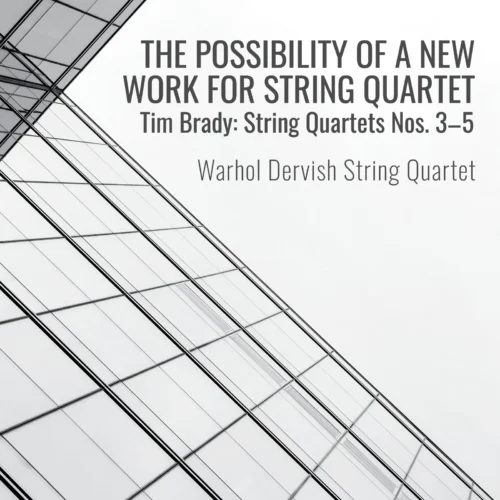
Quebecer Tim Brady is at the very top of the Canadian pantheon of great and important composers of contemporary music. He may be intimidated by this statement, given his immense modesty. But that’s how it is, I know it’s true. So three new quartets by this prolific and original creator is something to celebrate. All the more so because Brady (he says so himself) has long thought he had nothing to say in this historically charged format.
The one that sounded the charge was No. 3, aptly named The (Im)Possiblility of a New Work for String Quartet. Appropriately, because somewhere in 2019, Brady said to himself: “I can’t write any more quartets, there’s nothing left to say!’’ Yet that’s where he got the work’s narrative structure, in which the performers’ role is to co-compose the piece.
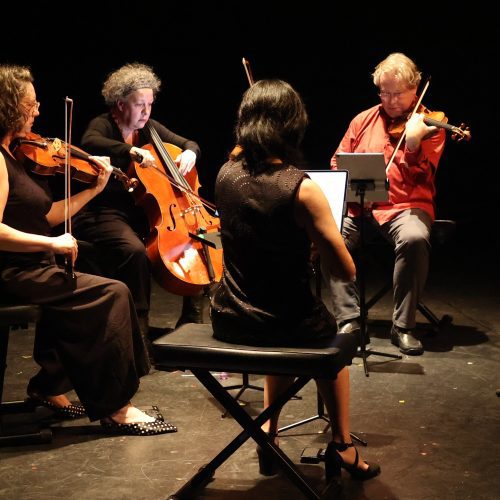
You might say that this is nothing new: jazz does it, aleatoric music does it, many contemporary graphic scores do it too. It’s basically improvisation. But what’s interesting about the Brady way is that it’s all that and more. Maybe it’s the composer’s spirit hovering over Warhol Dervish’s excellent string players, but the result is quite playful and a world away from the clichés of the usual contemporary aleatoric or graphic music, often grating and obtuse, the cerebral testimony of an academic approach rather than the result of shared, sharable pleasure. Brady’s instructions are directive enough to allow for a solid narrative framework, but impressionistic enough to let the instrumentalists have fun together and appeal to a not too small audience. Instructions such as ‘compose an imaginary folk tune’, ‘play sustained notes in F minor’, ‘make a loud noise’ are provided by the composer. Without knowing these details, music lovers will still have the feeling of following a post-modern musical framework that seems to evoke the past in a resolutely contemporary structural shift.
In other words, Tim Brady’s quartet has a bright future ahead of it, because it can be appreciated by everyone without the need to read a technical and off-putting explanatory document. You understand the process instinctively. At the end, the musicians have to tear up their scores, as if to symbolically assert that the moment has definitely passed and that next time it will be very different. A theatricality reminiscent of R. Murray Schafer.
Tim Brady’s intelligence lies in the fact that he has avoided reworking the recipe, and generating a ‘system’ out of it. In fact, he probably needed to free himself from the psychological weight of history and regain confidence in his fundamental ability to write something worthwhile and even original for the string quartet medium. Quartet No. 3 served as a kind of exorcism. The following quartet returns to the established method, and is therefore entirely written out.
Quartet No. 4 so begins with a very simple melody. It is very gentle and melancholy. The 17 minutes or so that follow develop the initial material without ever abandoning its contemplative and very pacifist nature. A few microtonal passages occasionally blur the harmonic tranquillity, but rarely the dynamics. We are bathed in a mysterious zenitude, sometimes disquieting, but permanent. Around two-thirds of the way through the piece, minimalist arpeggio swirls gently stir up this Olympian calm, but that’s about it. Once again, Brady’s postmodernism is both personal and stimulating.
Quartet No. 5 is intended to be a “substantial” work. Brady envisioned it like that somewhere in 2022 (his initial inhibition is now definitely a thing of the past!). Five movements, three fast and two slow, abrupt contrasts, varied textures, appreciable rhythmic demands… In short, everything that constitutes a great quartet by a great composer. And so it is. One is reminded at times of Gorecki in his dynamic motricity, but also of Nico Muhly in his complex post-minimalism. A few obsessive pulsations evoke the intro to “Reich’s Music for 18 Musicians,” while the slow movements are sometimes tinged with Bartokian colours. But in the end, it’s all pure Brady, and absolutely brilliant.
While we wait to hear the sixth quartet (completed in the meantime), which takes up again the principle of “instructions” used in the third, let’s savour this music to the full, masterfully rendered by the Warhol Dervish, an amazing Montreal ensemble that is all too rare both on record and on stage!
This is great music, powerfully performed and superbly recorded.