Additional Information
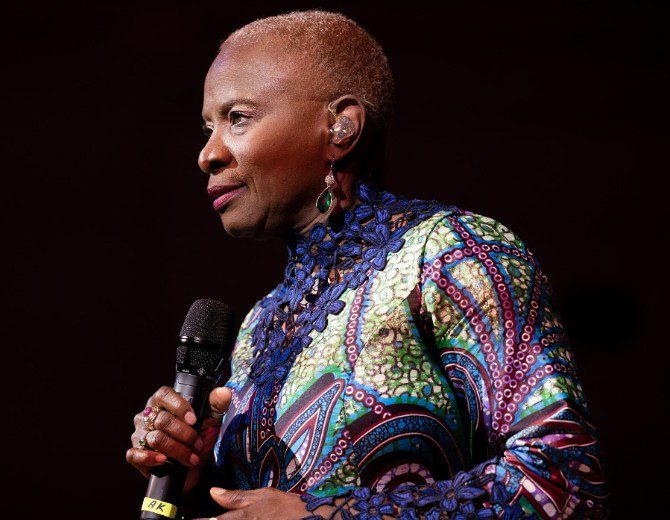
Benin’s Angélique Kidjo is undoubtedly one of Africa’s megastars, and probably the one of her generation to have acquired the greatest notoriety in North America, where she has lived for many years. This reputation reached the eyes and ears of composer Philip Glass, pioneer and pillar of American minimalism alongside the likes of Steve Reich and Terry Riley. A decade earlier, Glass had composed a three-movement work, Ifé, trois chants Yorùbá, dedicated to the African singer, with libretto in the Yoruba language. The work has since been performed, and here the Orchestre symphonique de Montréal takes over under the direction of Swiss-Australian conductor Elena Schwarz. Beforehand, the voluble Angélique lends herself to this interview with Alain Brunet, who has been talking to her sporadically since the 90s.
PAN M 360: What motivated you to perform such a work?
Angélique Kidjo: The artistic director of the London Philharmonic, Timothy Walker, had suggested that I sing with a symphony orchestra. What had he been smoking? He met my singing teacher and said he’d think about it. A year later, the London Philharmonic came to play at Lincoln Center and contacted me again, saying that a composer should write for me. He gave me Philip Glass, whom I knew personally, as an example. We make an appointment with Philip, who invites us to his home and accepts. “No problem,” says Philip, looking at me: “Angelique, you choose the subject, write me three texts and I’ll write you a work.” So I wrote three texts about the creation of the universe according to the Yorubas. I write it down and translate it into French and English, telling Phillip that this language is very tonal. He said nothing and came back to me a year later with a piano-vocal score. So I say to myself, “How did he do it?
PAN M 360 : And how did he do it?
Angélique Kidjo: When we met at the first rehearsals, I asked him, and he looked at me with an impish smile and said, “You don’t know everything about me, Angélique … I’ve studied phonetics!” And then he provided me with the manuscript of the work in phonetic script. And that’s when it all really began. The Luxembourg Philharmonic Orchestra first commissioned the work. Philip was on site. He explained to journalists that he and I had built a bridge over which we had not yet begun to walk.
PAN M 360: And why choose Yoruba rather than Fon, your mother tongue?
Angélique Kidjo: I speak both. We speak four languages in Benin. The mythology of the creation of the world among the Yorubas is the same as that of the Fons. It was also told to me in Yoruba, because people in my family were of Yoruba descent – on my maternal grandfather’s side, whose forebears were Yoruba slaves in Bahia, Brazil, before returning to Africa. Before colonization, the Yoruba and Fon kingdoms were at war with each other, and prisoners lived with us as they did with them. That’s why you have to speak several languages in Africa, otherwise you can’t move! So I’m a product of this crossbreeding, and since I have a certain facility with languages, I chose Yoruba. In fact, I didn’t choose this language rationally. When a language inspires me, I write in that language.
PAN M 360: And how was this opera conceived by Philip Glass for an African artist?
Angélique Kidjo: Philip is still Philip. What’s incredible about him is his flexibility and adaptability. To say that his music is repetitive is reductive. He goes where the music takes him, adapting to the number of bars suggested by a tune or text. The work opens with the supreme god Olodumare sending the artists’ tutelary god Obatala and Oduduwa, the god of logic, to build the world. He gives them a sack, a rooster and some palm wine, telling them not to drink until the job is done. Obatala doesn’t heed this instruction and gets drunk, so Oduduwa has to drag him wherever he goes. Oduduwa finds himself in front of an endless expanse of water. Olodumare then tells him to empty the sack and put the rooster on top of the contents of the sack, black dust, so that the rooster scatters it all and creates dry land. Thus the continents were born, and Yemanja, the goddess of the sea, who had not been warned to cede her territory, became angry and called upon other divinities to create a world around this new land. This is the second movement. The third movement features the god Osumare, two snakes that intertwine to hold the Earth so that it doesn’t fall, and so this male-female god holds the Earth and guarantees its fertility. This story gradually becomes part of Philip’s music.
PAN M 360: From a formal point of view, was Philip Glass inspired by melodies?
Angélique Kidjo: He was inspired phonetically by the music of the language to compose this work, while remaining himself.
PAN M 360: This work was made a decade ago. Have you performed it many times?
Angélique Kidjo: Yes, we did it in Manchester at the beginning of February with conductor Robert Ames. Until now, I’ve only been conducted by men, and now, for the first time, a woman will be conducting in Montreal: Elena Schwarz. It’s a dream come true!
PAN M 360: Coming from a feminist artist who built her career in Africa, then in Europe and North America, it makes perfect sense!
Angélique Kidjo: Yes, absolutely. I’m a pragmatic feminist, I work with men, I grew up with seven brothers and my father also built the woman I am. There are many men who want equals by their side, my father saw my mother as his equal and she had as much power as my father. My daughter was also brought up like that, she’s independent and responsible. And this time I’ll be working with a female boss.
PAN M 360: Did Philip Glass do anything else for you?
Angélique Kidjo: His 12th symphony, Logia, was composed for the 100th anniversary of the Los Angeles Philharmonic, and he wanted me to be the soloist in the 3rd movement for voice and organ. He called me up and said he’d pushed me under the bus, laughing. I told him it was okay with me (laughs).
PAN M 360: So you’re all set for Montreal?
Angélique Kidjo: I never take anything for granted. As long as it’s not over, lots of things can happen…
PAN M 360: Projects?
Angélique Kidjo: I hope to be back very soon for the release of my new album in August.
PAN M 360: See you soon then!
Angélique Kidjo: Yes!
Angélique Kidjo and the OSM on Wednesday March 19, 19h30, Maison symphonique. Tickets & infos
Artistes
Orchestre symphonique de Montréal
Elena Schwarz, cheffe d’orchestre
Angélique Kidjo, chant
Œuvres
Leoš Janáček, La petite renarde rusée, Suite (arr. C. Mackerras, 22)
Philip Glass, Ifé, trois chants Yorùbá (20 minutes)
Entracte (20 min)
Ludwig van Beethoven, Symphonie no 6 en fa majeur, op. 68, « Pastorale » (39 minutes)
Artistes
Orchestre symphonique de Montréal
Elena Schwarz, cheffe d’orchestre
Angélique Kidjo, chant
Philippe-Audrey Larrue-St-Jacques, présentateur
Œuvres
Ludwig van Beethoven, Symphonie no 6 en fa majeur, op. 68, « Pastorale » (39 min)
Philip Glass, Ifé, trois chants Yorùbá (20 min)
Concert sans entracte