Additional Information
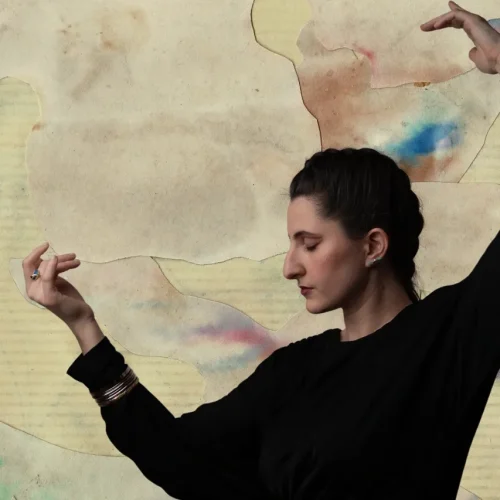
Photo credit: Chantal Anderson
Editor’s note: That was May 22, 2020. It was our first interview with Kaitlyn Aurelia Smith on www.panm360.com and you know the rest… so far: the pandemic brings back the same topic, just as relevant a year and a half later, and 21 months after the postponement of the Caribou / Kaitlyn Aurelia Smith program originally scheduled for March 2020 and… held this Monday, November 22, 2021. That’s why we’re bringing you back for the next 48 hours this text… that you may never have read.
In her most recent creative cycle, Kaitlyn Aurelia Smith has linked daily exercises for physical flexibility with the practice of composition. Every day, her movements became different, and so did the music.
The multiplicity of her poses and movements, somewhere between contemporary dance, contortionism and yoga, thus constitutes a constantly renewed language, a “mosaic of transformation” intrinsically linked to her sound explorations.
It was an opportunity for her to reflect on the circulation of energy flows, both in her body and in her works. Here is the holistic expression of body movement and sound through the flow of energy: electricity.

“Electricity,” Smith points out, “allows my analog synthesizers to produce sounds, and also what makes the sound reach the ear, strikes the imagination. I was inspired by the simple fact of thinking about the capacity of electricity and how it brings my instruments to life. For me it is the most fundamental source of energy.”
As a result, The Mozaic of Transformation is a sonic testament to that admiration for electrical energy.
“You know, when you see something beautiful, whatever you can think of to replicate translates into sounds. It’s like when you’re watching a beautiful sunset – wow, it’s so beautiful. I wish others could see it – I felt like I was overwhelmed by the beauty. The inspiration for this album was electricity, and the only thing I could do was to give it sound. The intention was also to show how amazing electricity is.”

The notion of sharing is also important for Smith, who rejects the idea of shutting herself up in an ivory tower.
“I always think of music as a language, that is, I always try to refine my ability to translate inspiration and what I feel inside into a sound form that I can pass to others so that they can feel inspired in turn. This inspiration of electricity is like when I see a sunset, so beautiful that I wish others could see it. The intention is to share this inspiration.”
The dramatic arc of The Mozaic of Transformation is thus constructed:
“The short tracks follow one another and build up this framework until the last track, much longer than the others. This dramatic ascent takes you on a kind of transformation, the journey is made through constant back and forth between the combinations of sounds and music. I try to mix a lot of things. The last piece on the program was the first one I composed. The intention was to record it with a full orchestra but I didn’t find a taker. I always wish I had the resources of a chamber orchestra or a symphony orchestra. In this case, therefore, it is I alone who creates my orchestral sounds – especially from instrument samples.”

Smith, a native of Orcas Island adjacent to British Columbia, lives in Los Angeles. Trained as a musician, the 33-year-old artist followed a typical path before branching off into the atypical. “I started playing classical guitar and learning to compose for the orchestra,” she explains, “and then I switched to analogue synthesizers, and then mixed it all together. I really like the mixing of these sources.”
The composer thrives on music whose references are not immediately identifiable.
“When I studied music,” she says, “my brain was trained to identify music theory, instrumentation and production elements. Today, I’m inspired by music excluding the analysis of its construction. I like music when my brain gives in to it, period. The Japanese composer Joe Hisaishi, for example, is a great source of inspiration for me. I didn’t try to find out how he made his music, but I know now that it’s a mixture of orchestral and electronic music.”
After the release of her excellent album The Kid in 2017, Smith has directed her creative energy in several directions. She founded Touchtheplants, a multi-disciplinary ecosystem for projects hosting the first installments of her instrumental electronic series and texts on the practice of inner listening. In the same vein, she has continued to explore the textural possibilities of electronic instruments as well as the forms, movements, and expressions found in the relationship of the human body to sound and colour.

One of the most accomplished American composers of her generation, Kaitlyn Aurelia Smith also acknowledges the feminine electricity that nourishes her work, although..
“I’m glad that this feminine energy is received as such, but I try not to compare my work with that of other women. And… if the feminine energy is always there in the music, I don’t think it comes exclusively from female bodies. I hear a lot of female energy coming from male bodies as well. I’m not exactly sure… it’s a complex thing…”
Let the mysteries do their work.