Additional Information
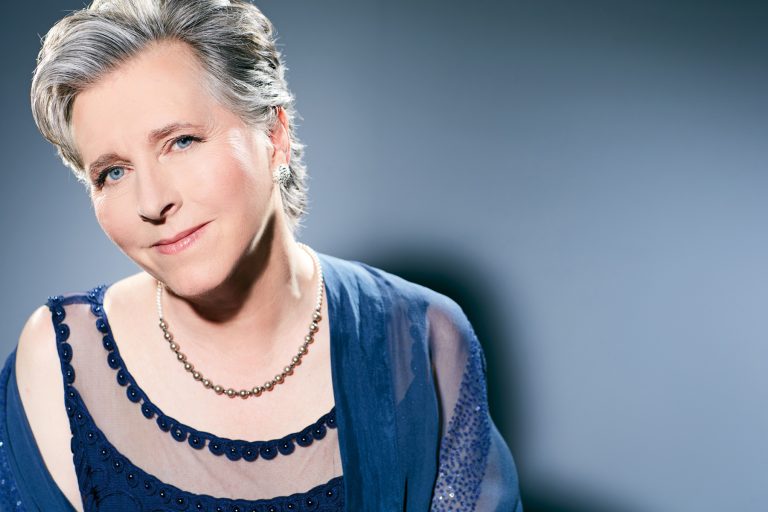
A career spanning five decades, studies with Yvonne Lefébure and the mentorship of a certain Arthur Rubinstein, the honour of being the first pianist, in 1990, to publicly perform Liszt’s Piano Concerto No. 3, rediscovered the previous year, an exceptional mastery of the romantic and classical repertoire (Liszt, Chopin, Beethoven, Mozart…), this only begins to touch on what the artistic life of Montrealer Janina Fialkowska represents. The pianist, at 75, will retire from international concerts (she will probably still play in Germany, where she lives, and around) in 2027, just after a farewell tour that will take her everywhere in Canada. Including the Maison symphonique de Montréal, on Friday, October 2, 2026. What is really crazy about this story is that this visit to the hall will be the first that Fialkowska will make as a performer! No, she had never played there before. What an irony that it is for a concert… of farewells.
For both music lovers and novices, the experience will be worth it. The natural elegance, sense of style, and fine and generous musicality of the great lady of the piano will offer a high-quality artistic experience. On this occasion, she will play Beethoven’s Fourth Concerto with the Orchestre classique de Montréal (OCM), under the direction of Andrei Feher. A substantial meeting, supported by history because, if Janina Fialkowska is a piano icon, one might forget that the OCM is the oldest chamber orchestra in Canada (this includes its first incarnation as the McGill Chamber Orchestra).
I took the opportunity to discuss with Ms. Fialkowska about her life, music, and other things, a first for me. Which makes me regret not having had the opportunity before, as the artist is so generous and intellectually stimulating.
PanM360 : Last time in Montreal on stage, but not at all, isn’t it?
Janina Fialkowska : No, of course not. I still have family and friends here, and everywhere in Canada. Besides, I will be back in Montreal next year for the International piano competition. I will be part of the Jury.
PanM360 : How difficult was it to take this decision?
Janina Fialkowska : That’s a very good question. First of all, I’ve had the example of quite a few of my older colleagues who I admired beyond anything, who played on beyond their best playing. And it just broke my heart. But what breaks my heart most is when I hear the young people who come to play for me and they say, oh, well, so-and-so wasn’t very good, was he? And they’re talking about one of the greatest pianists of all time.
I always had that at the back of my mind, that it’s best to leave when you’re still playing well, which I hope I am. But you know, after a while, also, the travel is no longer fun. The expenses of travel have gone up enormously. Flying across the Atlantic has become really unpleasant.
Also, little things like renting cars in Canada. Of course, you have to rent cars if you’re playing in the smaller towns in this country. Have you seen how much it costs to rent a car? It’s just crazy. So there are those things. And then, you know, I’m 75 years old.
Finally, there are the muscles. A lot of playing the piano is gymnastics. It’s about moving flexibility and muscles. My flexibility is not quite the same. I have managed, I think, well, in the past two or three years, in that I have vastly diminished my repertoire. I’ve been playing only pieces that I feel very, very comfortable in. I finally realized that it’s so much stress before concerts, thinking I’ve got to play as well as I used to. I don’t want to not give my best to my audience. And I have a duty to the composer as well.
So there’s no regrets. I’ve made my decision, and I’m happy. I don’t know how I’m going to feel in a year from now. But right now, I’m looking forward to a little bit of retirement and peace and quiet.
PanM360 : Among those masterpieces you have had to ‘’let go’’, which ones do you regret the most not playing anymore?
Janina Fialkowska : It breaks my heart to no longer play the Chopin concertos, for example, but I know that I would not play them as well as I did. So…
PanM360 : Chopin… You that Arthur Rubinstein called ‘’a natural born Chopin player’’.
Janina Fialkowska : Yes, I know.. But, you know, there’s a time for everything. I have very good memories. I can still play the Beethoven Fourth Piano Concerto, which is, after all, my favorite concerto. I feel very, very lucky that it doesn’t pose any technical problems at all, yet, for me. It just feels very good. I can also play a great many of the Mozart concertos. But, for example, I had to give up Brahms quite a few years ago.
Brahms concertos, Liszt concertos, I loved playing them. But I can’t anymore. I had to reduce from 50 concertos to about six.
PanM360 : So, that’s the reason why you’ll be playing Beethoven’s Fourth with Andrei Feher and the OCM?
Janina Fialkowska : There is that, and also the fact that they asked me to play it!
PanM360 : Is it the first time at Maison symphonique? I don’t recall you playing there before.
Janina Fialkowska : Yes it is. I’m very much looking forward to it.
PanM360 : What do you expect?
Janina Fialkowska : I expect excellent acoustics. I have heard performances in this hall. I’m excited to finally play there. I think it’s going to be very good for the Beethoven.
PanM360 : Over the course of a career that spans decades, I would be interested to know if you had one or two musical moments that you would love to relive again, if you could…
Janina Fialkowska : There are some, yes. The one that always comes to mind when people ask me something like this is… It was quite a long time ago. It was in the 70s. And I was making my debut with the London Philharmonic in London. Bernard Haitink was conducting.
And I was playing the Chopin E Minor Concerto, which is not a concerto that conductors particularly like, because it’s extremely difficult to accompany. They don’t really have a chance to shine in it. I mean, it’s very much an accompanying concerto. Well, he turned that completely around and he made it into such a magical piece. I could not believe that the Chopin E Minor Concerto could sound this way. He basically transported me into another world and showed me what was possible.
What I learned from that performance was enormous. But I will always, always remember that. That was very, very, very big in my mind.
Another performance that I remember… Well, actually, it was the Beethoven 4. The first time I played it, it was a wonderful experience, with the Cleveland Orchestra and Lorin Maazel. I was so impressed with his technique. I just couldn’t believe it. I’d never seen anything like it.
But the one Beethoven 4 that really rather stands out for me was in Jerusalem, of all places. And it was Sir Roger Norrington conducting. It was the first time that he had ever conducted this piece. He was so full of ideas. Some of them were a bit crazy and some of them weren’t. But it was so much fun. I don’t know when this was. 1985, somewhere around there. But a lot of things that he told me or that we figured out together then, I’m still doing now.
PanM360 : You studied with Yvonne Lefébure, and had a close association with Arthir Rubinstein. What would be some of the most enduring learnings that you still carry on with you from both those magisterial figures?
Janina Fialkowska : Well, with Madame Lefebvre, I learned the Beethoven Fourth. I was 15 or 16 when I actually learned it. I had never realized before how theatrical a performance could be. I had always sort of played, tried to play as well as I could. But mainly it was for myself, you know, or it was for the people close around me. But I wasn’t really aware of the bigger world out there. And she was, I won’t say a showman because that sounds a bit negative. But she knew how to dazzle the crowd. she could do that with her teaching as well. It was a very, very intense teaching. But it was lots of fun also. I learned mostly French music from her. My love for French music started with her. She was also wonderful for Bach, for voice differentiations.
With Arthur, with Rubinstein, it was something completely different. He was a great pianist. Perhaps one of the one or two greatest of the 20th century. The personality was so strong. And he had such an aura about him. Basically, he would walk on stage and people would start cheering. Even before he played a note. From him, I learned very, very specific things. He was not a teacher at all. He didn’t know how to teach. And he said so. But he used to say, ‘’oh, these are just a few little advices from an older colleague.’’
Oh yeah, some advices. The best was when he would sit down and just play and I would listen. But what was so important to him was, first of all, the structure of the works that he was playing. He made me think of that very well. He made me absolutely plan what I was going to do from the first note until the last note of the piece.
This frees you up to be spontaneous. That sounds paradoxical, but it works. He also made me very, very aware of never, ever using a dead sound at the piano. It always had to speak. Even if you’re playing triple pianissimo, the sound had to reach the people in the back row of the 3,000 seat hall. And this you couldn’t learn academically. You couldn’t be taught, but you could learn just by being aware of this and experience playing in halls. So projection was very important to him. And, of course, he had a beautiful sound.
And, oh yes, rhythm. Rhythm was so important to Arthur. He said that once Picasso had said to him ‘’when I paint, I paint from my stomach.’’
And Rubinstein said, ‘’that’s exactly how I feel. The rhythm is in your stomach.’’ It’s not a metronomic rhythm. You have to find the pulse of the piece. And that’s why he played mazurkas so wonderfully and waltzes so wonderfully and Spanish music somewhat, because he just felt this music.
I learned also a lot about food because he was a big gourmet. And well, just how to enjoy life. I never quite succeeded to enjoy it as much as he did, but I at least was shown the way.
PanM360 : One last thought about the upcoming concert on October 2?
Janina Fialkowska : The public in Quebec, they know what they’re hearing. For 100 years, there has been a tradition of piano in Quebec. We don’t find that so much elsewhere. There is Charles Richard-Hamelin, Marc-André Hamelin, Louis Lortie, and is all this world that comes from Quebec. And that’s what makes our province something special in the world of music and especially in the world of piano. But I really like this public, it has supported me all these years. And yes, I regret that it will end now, but I have really beautiful memories.
PanM360 : Bravo for such a wonderful international career and good luck. Because it’s not over, life goes on.
Janina Fialkowska : No, only a new chapter.