Additional Information
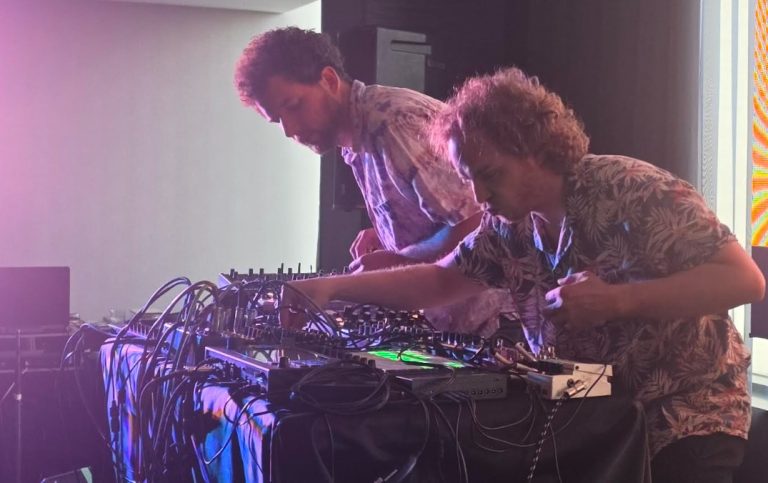
From Bogotá, the electronic duo RIZOMAGIC is wrapping up a short tour in Quebec—their first appearance in North America. The duo has made a few appearances in the Montreal area, including at the Souk du Sud festival, and is currently at the FME in Rouyn-Noranda, where they’re performing this weekend.The duo’s tour showcases their third album, Cumbión Planetario, released on Soundway Records.
RIZOMAGIC consists of Diego Manrique and Edgar Marún; these highly trained musicians draw on Colombian and Mexican musical traditions, such as the “cumbia rebajada” (slowed-down cumbia) from Monterrey, which is central to their latest album.
These traditional styles are thus electronically adapted for their new album using a tuning system based on the frequency of an Earth day, as indicated by the research of Swiss astrophysicist Hans Cousto. The inspiration came during a residency in Switzerland at the SMEM (Swiss Museum and Center for Electronic Music Instruments).
This “cosmic” vision is thus integrated into their electronic instrument-making, an approach they describe as “Colombian psychotropic futurism.”
Perfect for PAN M 360! An interview was in order, shortly before the Colombian musicians boarded the bus for Abitibi.
PAN M 360: So you’ve been together for a long time?
Edgar: We met while studying music at the Pontificia Universidad La Javeriana. I studied classical and jazz double bass,
Diego: And I studied composition.
PAN M 360: So you come from a classical background?
Diego: Yes. All forms, from Bach to contemporary music. Then I started doing something else. Electronic music came later, but the curiosity was always there. And then we started exploring that electronic side. We finished our studies before the pandemic, and in 2020, we launched this project, just before the pandemic.
PAN M 360: What did you set up at the beginning? How have you evolved? And where are you today? Just tell us about your evolution as a duo.
Edgar: The first album is titled Voltaje Raizal. And back then, we used a lot of sampling, all based on music from Colombia’s Atlantic and Caribbean coasts. The rhythmic approach involved, for example, adding unusual accents to traditional Colombian rhythms like fandango, porro, or chandé. At first, we started by exploring these samples. Voltaje Raizal did very well. It was released on the Italian label DisastersByChoice.
Diego: We started before the pandemic, around late 2019 or early 2020. And the lockdown in Bogotá began in March. At first, I’d go over to Edgar’s place and we’d start making music. That’s when we came up with the Rizomagic concept. But during lockdown, we couldn’t go out, so we had to exchange files remotely—it became a very seamless way of working. Even after the pandemic, since we lived far apart in Bogotá.
Edgar: This way of working still works today; we still work like that—it’s a bit like an “exquisite corpse,” the Surrealists’ technique. It created a working dynamic for the project that we’re still carrying out.
PAN M 360: Okay. And musically, how has it changed? What we heard today at the Souk du Sud was pretty ambient, with slow or medium tempos, dub atmospheres juxtaposed with Colombian music.
Diego: There are, in a way, two aspects to Rizomagic: the album and the live set. They’re different things. For every album we produce and compose, we always have a clear idea in mind—a concept to bring to life.
Edgar: And also a creative constraint—that’s really important to us. For example, for our latest album, Cumbión Planetario, we’ve made slower tracks, no faster than about 100 BPM. These kinds of constraints help us develop a more precise sound.
Diego: For our second album, Marimbitiaios, we’re focusing on music from the Pacific Coast—music for the marimba, for example. And the third album is more oriented toward *cumbia rebajada* from Monterrey, which is a slow-tempo cumbia.
Edgar: Cumbia rebajada originated in Mexican sound systems, where they’d play old Colombian 33-rpm records, slowing down the tempo. It’s a tradition that continues today. It just so happens that we really loved that sound. We also liked that tempo. Yeah, but we started composing at that tempo. But when we started playing this music live at 60 or 70 BPM, we realized it was too slow for dancing. So we did the opposite—we started speeding up our tracks.
PAN M 360: The album is more ambient in a way, and the music picks up speed in your live sets.
Diego: Exactly.
Edgar: We really love seeing people dance. It’s important that the audience coming to our shows has a physical connection to the music.
PAN M 360: I’ve also been told to ask you about that special tuning for the new album, Cumbión Planetario.
Diego: Yes, the album was recorded in Switzerland, at a place called La Becque, near Montreux; we’d been invited for an artist residency.
Edgar: While we were composing the album, and as part of our research, we looked into the concept of planetary frequencies developed by the Swiss physicist Hans Cousto. We then developed a tuning system based on the planetary frequencies calculated according to his theory. Internationally, the note A is set at 440 Hz—the standard for tuning instruments—which is 440 wave cycles per second. However, Hans Cousto calculated several astronomical phenomena, including the Earth’s cycle. So if this cycle lasts 24 hours or 23.9
hours or something like that, what fraction of this cycle does the Earth complete in one second? By rotating on its axis in 24 hours, the Earth completes one cycle every 86,400 seconds; this rhythm corresponds to a frequency of:
f = 1 / 86,400 = 0.000011574 Hz. Another characteristic is that if we multiply this number, we obtain a similar frequency. So we multiplied it up to 20 Hz because the human ear can only perceive sounds starting at that range.
PAN M 360: So you tuned the music to 20 Hz.
Diego: Yes, we have a micro-tuning system, so we can choose frequencies that correspond to various astronomical phenomena. This is the case for several tracks on the album. But in our experience—for example, with “KIR,” a track from the new album—we’re starting to hear it. We never get tired of listening to it because it’s a natural tuning, based on “pure” intervals—that is, ones that reflect nature.
PAN M 360: More specifically, what tools do you use to compose and produce your music?
Diego: One important thing to note is that we compose on a computer but perform live without one.
PAN M 360: What’s your gear?
Diego: We have two “brains”—Edgar has an Ableton Push 3, and I have an Akai FORCE. The two “brains” are synchronized: the Akai handles percussion and sampling, while the other manages the MIDI synthesizers. So we have the bass, the harmony, and the melody.
Edgar: The synthesizers are analog, but they aren’t modular. That means you can adjust and modify all the sounds however you want.
PAN M 360: And there’s no question of reproducing the albums.
Edgar: We don’t want to do that—though we could.
PAN M 360: Do you ever work with live musicians?
Diego: We did it in 2022 at the Bogotá Planetarium. We invited two saxophonists and a percussionist to join us. It’s really nice to have that extra dimension. We could definitely do it again. We also play instruments. I’ve been playing guitar since I was a kid. Edgar plays several instruments, so we have lots of projects and a bright future ahead of us to create all kinds of things.
PAN M 360: The gap between instrumental composition and digital composition isn’t as pronounced anymore.
Diego: Exactly.
PAN M 360: Here’s another example, this time from Colombia!
AT THE EMERGING MUSIC FESTIVAL, RIZOMAGIC WILL PERFORM:
Saturday, September 5, 2026, starting at 1 p.m.: Free concert on the Osisko Lake Peninsula as part of the Télé-Québec Afternoon.
Sunday, September 6, 2026, starting at 7 p.m.: They’ll be part of the free ÉrableRiemix closing night on the 7th Street Outdoor Stage, where they’ll provide the soundtrack alongside the DJ Passion collective.