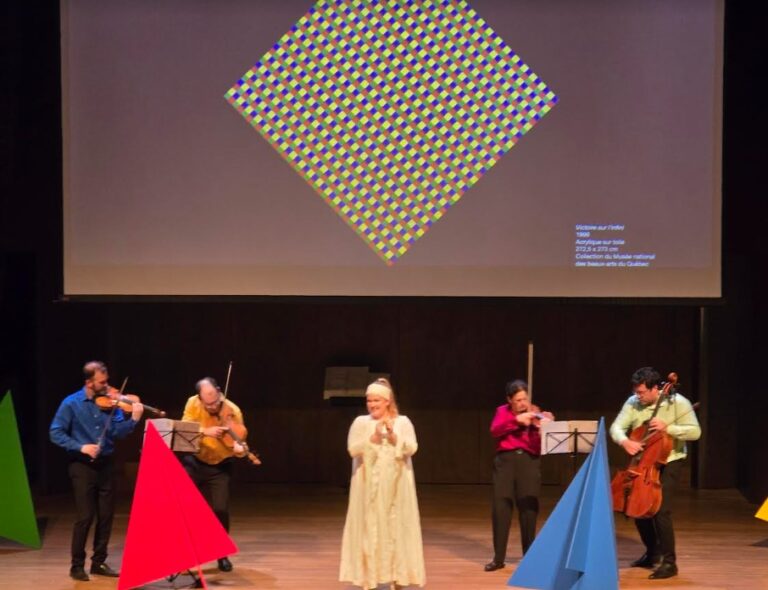
To commemorate the 20th anniversary of the death of the painter Guido Molinari, to whom the Molinari Quartet owes its name and the unfailing support of its foundation, an ambitious program was presented at Salle Bourgie on Tuesday, October 22. A fitting choice, given that the hall is welded to the Montreal Museum of Fine Arts. Thus, several of the painter’s works were synchronized with the performance of works that have been played by the ensemble over the years.
First, a work by Montreal composer Ana Sokolović , conceived early in her career. At the time, the Quartet’s commission was accompanied by a requirement: to be inspired by the visual universe of the famous Montreal painter. Already, the musician’s signature could be identified in this work divided into 8 movements imagined in the form of themes and variations: Mutation I – Tension- – Space / asymmetrical – Black diagonal – Mutation II / triangle – Dominant white – Coda / continuum. Each movement involves distinct writing techniques – use of spectacular glissandos, eloquent pizzicatos, crumpled motifs, harmonic spirals, string rubs and squeaks, rhythmic cross-hatching and more. In short, a singular and complete work, foreshadowing the great career and fully-deserved international reputation of Ana Sokolović, whose work will stand the test of time.
The second work on the program, Maxime McKinley’s Espaces fictifs is also inspired by works by Guido Molinari, and by high-profile exchanges with Fernande Saint-Martin (1927-2019), the eminent art theorist who was his wife. In an extract from the Vidéothèque québécoise Quatuor Molinari, the composer explains that he explored “reversibility, juxtapositions and superpositions of simple motifs that are constantly reconfigured, as well as the notion of rhythmic interval as the distance or gap, greater or lesser, that separates an element from its recurrence.
The piece also relies on the “dynamism of sharp contrasts or, on the contrary, extremely subtle transformations; horizontal, vertical or diagonal orientations; kaleidoscopic continuums playing on the mobility of back-, middle- and foregrounds; as well as the vibrations, mutations and energy of colors.”
Add to this eloquent explanation the Molinari Quartet’s coherent and diligent execution. The work is received as a dynamic spiral of short tableaux and motifs, culminating in intensity, increasing string volume and accelerating tempo, before losing altitude and settling down in a twirl.
The next performance was of the String Quartet Op.28 by Austrian composer Anton Webern, one of the pioneers of twelve-tone music, mistakenly executed by an American sniper at the end of the Second World War. A reminder of the foundations of the dodecaphonic revolution.
After the break, it’s time for the main course, R. Murray Schafer’s String Quartet no. 7 with “obligatory soprano”. The Molinari is known for its mastery of the late great Canadian composer’s quartets, but 7 stands out from the rest for its spatialization and theatricality. Giant paper airplanes in different colors are arranged on stage, and other paintings that inspired the work’s creator are projected onto a giant screen, while the performers wander around the stage and the aisles of the hall, playing their parts. Played solo, in duet, trio or quartet, accompanied by schizoid and no less flamboyant interventions from soprano Odile Portugais, the components of this innovative work at the time of its conception produce the desired effect: delight, amusement, elevation.