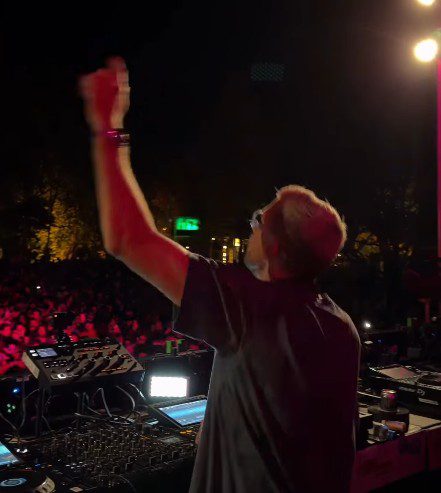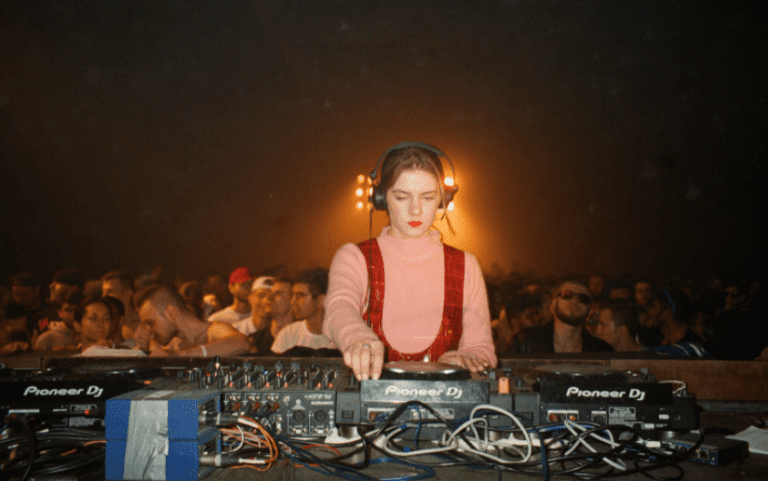
No matter what you say, dance floors – whether institutional or underground, legal or illegal – are eminently political, especially when it comes to electronic music. An aspect that Melvin Laur, artist and co-founder of the collective project Vertige Records, highlights in a thesis entitled “Ethnographic analysis of the Kyiv rave community: the post-revolutionary context”. His research work, carried out as part of a master’s degree in management sciences at HEC Montréal, presents the rave culture of the Ukrainian capital through the discourse of the actors who carry it out, mainly members of collectives organizing parties and artists, taking as a starting point the party as a political act.
Without going over the whole history of the rave movement throughout the world or even in Ukraine, it is important to know that after 2014, rave culture in Kyiv experienced, with a ten-year delay, a lightning development, to the point of becoming a popular destination for “techno-tourists. Why 2014? It was the year of the Euromaidan revolution, in response to the refusal of Viktor Yanukovych, the pro-Russian president at the time, to sign the agreement for Ukraine’s entry into the European Union. The movement was launched by the students who saw their future slipping away before their eyes. They protested peacefully by occupying the Maïdan square, in the heart of the capital. Then, the forces of order arrived. The repression was violent, with 125 deaths. The clashes lasted 93 days and ended on February 22, 2014 with the resumption of control of the country by the army, the exile of Yanukovych and new presidential elections. For those who are curious, the documentary Winter on Fire, produced by Netflix and available for free on YouTube[1], traces the history of this struggle of the Ukrainian people for freedom.
For Melvin Laur, this revolution catalyzed the Kyivian rave culture: “This culture was born from repression and political demands. It lasted and became professionalized until it became something really cultural, he explains. In fact, before the Maidan revolution, from the early 2000s until 2014, there was a huge drum and bass scene, really important. The genre predominated alongside commercial music and Ukrainian, Russian-speaking or international pop. Then there was this revolution and techno became very popular in Kyiv, taking precedence over the rest. Nevertheless, the early years of the techno scene in the post-revolutionary context are still marked by police raids and repression.
At the forefront of the movement were collectives such as the pioneering Rhythm Büro, Cxema, VESELKA and Laboratorium. Kyiv seemed to nurture a certain interest in raw and violent techno, “saturated to death boxes”, while offering a more conventional offer to please European tourists. There’s quite a heterogeneous scene there and that’s what was interesting to watch,” Melvin continues. Closer, a club located in a former Soviet factory, is very tech-house oriented, while places like O’tel – formerly Metaculture, but no longer existing – were really much more gabber and fast music, 160+bpm. In between, you had Kyrilliska with more industrial techno. And more to the west, on the Donbass side, it was the Shum collective that was the talk of the town, with a partnership with Boiler Room some time ago. The ephemeral parties organized by the collectives are also a way for young people to reappropriate their territory, by taking over disused buildings, former textile factories and vestiges left by the USSR.
Since the invasion of Ukraine by Russia, several Ukrainian techno artists, directly affected, have turned their social networks into platforms to relay information on the situation, like the DJ Daria Kolosova. Etapp Kyle participated in the “Support Ukraine Fundraiser Compilation[2]“. Stanislas Tolkachev has launched a label, Rudiment[3], whose profits – music and merchandise – will be donated to Ukrainian humanitarian organizations. Nastia, the most internationally known Ukrainian DJ, continues to tour (which has earned her criticism from some of her collaborators on the NECHTO label). She is taking on an ambassadorial role through the creation of a “Stand with Ukraine” fund and by organizing an auction, in collaboration with the brand Sennheiser[4]. Finally, an open letter[5] calling for the banning of Russian artists was signed by more than sixty actors of the Ukrainian electronic scene.
“It is really touching and impressive to see the different forms of resistance that are being put in place, there is the one on the ground but also this other part of the resistance, much more artistic and cultural, and that we perhaps often tend to forget and rightly so in these difficult times and which can be very dark. Creation is an escape and a way to resist”, concludes Melvin. To donate, check out this list of verified Ukrainian foundations.
[1] Available here: https://youtu.be/yzNxLzFfR5w, read on March 29th, 2022.
[2] Available on Bandcamp: https://united4equity.bandcamp.com/album/support-ukraine-fundraiser-va, read on March 30th, 2022.
[3] To follow the project’s progress: https://www.instagram.com/tolkachevstanislav/, read on March 30th, 2022.
[4] To read the original post on Instagram: https://www.instagram.com/p/Cbftj5zjnCa/?utm_source=ig_web_copy_link, read on March 30th, 2022.
[5] “An Open Letter from the Ukrainian Electronic Music Scene,” available on https://banrussianmusicscene.webflow.io/?fbclid=IwAR0Ix61z3CPDMfKpqtheyLLJDazwyIHAh5mXzrksWi1PSZOBdWXYjlhriRc, read on March 30th, 2022.
Photo credit: Yana Franz