Additional Information
The gesture is described as “living”, “non-linear”, “restorative”, “transformative” and “creative”.
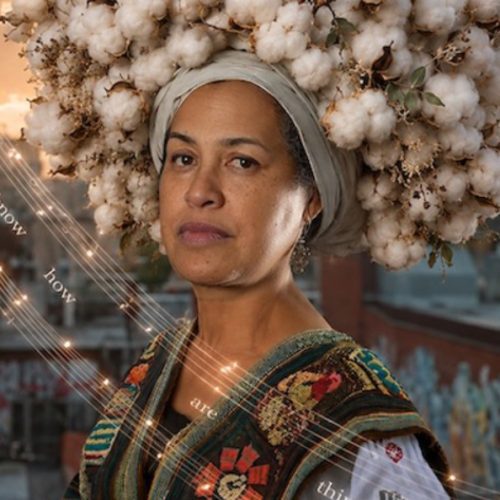
Julie Richard’s ambitious Black Ark project aims to reconstruct fragments of compositions by female musicians of African descent, most of whom lived in the United States a century ago. Not only does Black Ark endeavor to find and show, but it also undertakes initiatives to re-actualize and revalue.
Despite their double oppression – as women and as blacks at a time of heavy racial segregation and widespread sexism of all races – African-American women composers had nonetheless attempted to impose their own vision and sensibility. Julie Richard is one of those who is striving to inscribe them once and for all in the great history of music.
Given the poor and difficult conditions of creation at the time, the works unearthed may have been broken down over time, as well as being forgotten. Blak Ark’s work necessarily becomes a “conversation” with what remains of these works, the outcome of which is to restore them to their rightful place and coherence.
In this way, Blak Art becomes Orchestra and bears witness to this reconstitution. Recorded in different locations and with different sections of the ensemble conducted by Julie Richard, this performance, captured in audiovisual format, brings to light a score that will find its audience once again.
This is a work by Shirley Graham Du Bois (1896-1977), composer, writer, intellectual, theaterwoman, civil rights activist, true pioneer. The work in question is her 1932 three-act opera “Tom-Toms: An Epic of Music and the Negro”. Its reconstruction is the subject of a film, some excerpts of which will be “augmented” on stage by certain interventions directed by Julie Richard.
It makes perfect sense: this year, isn’t Suoni per il Popolo programmed by a team composed essentially of women, something absolutely unique in Montreal’s musical ecosystem? Julie Richard is one of the programmers of this festival, which is very much in line with PAN M 360’s values of extreme eclecticism, from hardcore punk to contemporary written music.
Musician, composer, multidisciplinary artist and cultural animator, Julie Richard has been active on the Montreal scene for some twenty years. Her interests include jazz, pop, experimental music and music of African, Gypsy, Jewish and Creole descent, to name but a few.
We really look forward to a conversation with Julie Richard!

PAN M 360 :What was the original motivation behind Blak Ark?
JULIE RICHARD: About eight years ago, I decided to undertake a search for archives on African and American women composers of classical music, because I thought it was suspicious that there weren’t any… when in fact there were. One thing led to another, and I found pieces that were never finished, and then I heard the rumor of this score by Shirley Graham Du Bois. When I came across this woman’s portrait, I said to myself “I absolutely must make this piece my own”.
PAN M 360: How did you come across her?
JULIE RICHARD: In New Orleans, I’d been talking to the manager of the university bookstore, and she said, “Listen, it would be interesting for you to contact the Harvard University bookstore, because they have a handwritten score of Shirley Graham’s opera Tom-Toms.” I finally contacted the bookseller there, and he sent me what he had.
PAN M 360: Did Shirley Graham compose a lot?
JULIE RICHARD: Very little, in fact. Her musical career came to an abrupt end. Basically, she wrote for the theater, and also wrote librettos for opera. But she was disillusioned by the impact of music on social phenomena. So she decided to devote herself more to literature than to theater and music.
PAN M 360: So let’s focus on Tom-Toms. How was this work reconstructed? What did you do with this handwritten score?
JULIE RICHARD: I studied the score, researched what we’d done and saw that there were people who’d already worked on it. I then eliminated all the sections that had already been presented and concentrated on what I felt needed to be rearranged and completed, because I probably didn’t have the latest version of this work. I then concentrated on the movements that nobody had redone, i.e. all those movements that were perhaps too technically demanding.
So I redid the orchestration from a basic score and handwritten notes, things like “there’s a clarinet here”. It was still pretty basic, but it’s a classical work. You could intuitively imagine what could be added.
PAN M 360: So you made your own extrapolation!
JULIE RICHARD: Absolutely. Olivier Saint Pierre contributed to the arrangements. I also made arrangements by hand, which were transcribed by copyists Brigitte Dajczer and Tim S. Savard.
PAN M 360: How many artists are involved in the execution?
JULIE RICHARD: We have a 48-piece orchestra, an 11-voice choir, 2 soloists and 5 dancers. In all, 75 people were mobilized for this production.
PAN M 360: It’s a big deal! How did you manage to finance it?
JULIE RICHARD: I got a grant from the Canada Council for the Arts during the pandemic, to make a recording. That’s why we’re first presenting this performance in a short film. For the moment, it’s absolutely impossible to present it on stage, given the amount of money required to do so. In fact, we had to record the work in different sections in different venues – Ausgang Plaza, Maison de la culture Saint-Laurent, Black Theatre Workshop. For Saturday’s event at the Sala, I chose to perform certain segments on stage to augment the film projection.
PAN M 360: How is the work presented?
JULIE RICHARD: It’s all about ritual music, with drums talking to each other, drawing people’s attention to a great tragedy in progress. Another part of the opera is based on spirituals. Questions are raised by the composer: “What are we doing? To what extent have we lost our references? Should we go back to Africa? There’s the concept of pan-Africanism, of which Shirley Graham was a subtle activist.
PAN M 360: Are you in charge of the location recordings?
JULIE RICHARD: Yes, I’m a conductor. I didn’t study conducting, but I’ve been conducting since I was 12, when I was in the bugle and drum corps. After that, I studied classical music and opera singing.
PAN M 360: Is the music performed by classical musicians?
JULIE RICHARD: They’re not artists we’re used to seeing in this type of production. Many of them have had a classical education, but are also associated with other musical forms such as soul and hip-hop. It’s great that they have the opportunity to express themselves in such a context.
PAN M 360: The Suoni context, of course!