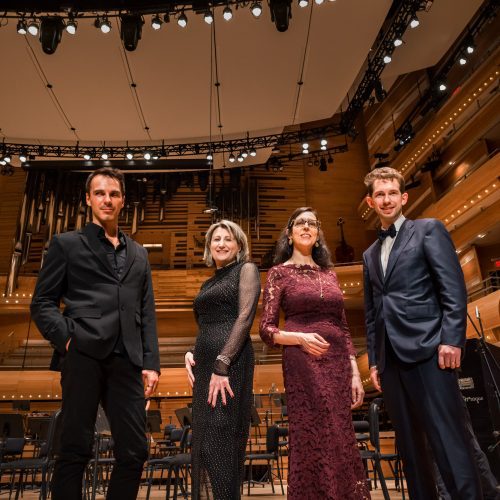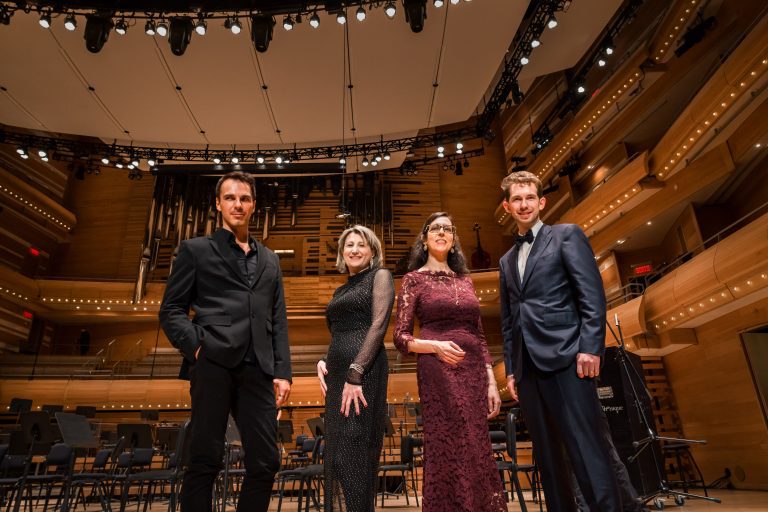
In the Montreal musical Temple that the Maison symphonique has become, the creative expression of four high-caliber compositions was honored with a smoothly conducted ceremony by the artists on stage. Four works bearing a rather similar sonic heritage, that of modernist avant-garde, tinged here and there with spectralism and atonal expressionism. Three of them are creations, and two are specifically focused on Jewish culture.
I will briefly summarize my impressions of each of them: De l’encra escafada (The Ink That Fades) by Adrian Mocanu is the most accomplished; Letter From Across the River by Dalit Hadass Warshaw, the most touching; Height of Land by Nicholas Denton Protsack, the most impressionistic; Riddle by Hana Ajiashvili, the most visceral.
Watch the recording of the Azrieli Prize Gala Concert 2026:
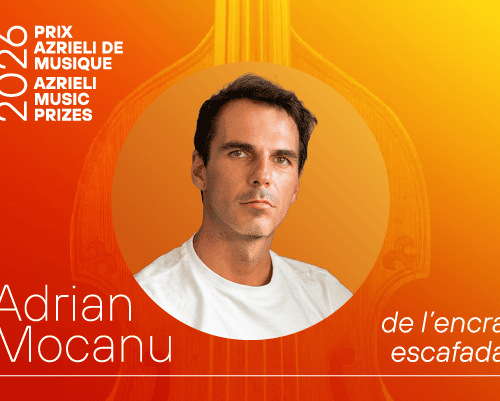
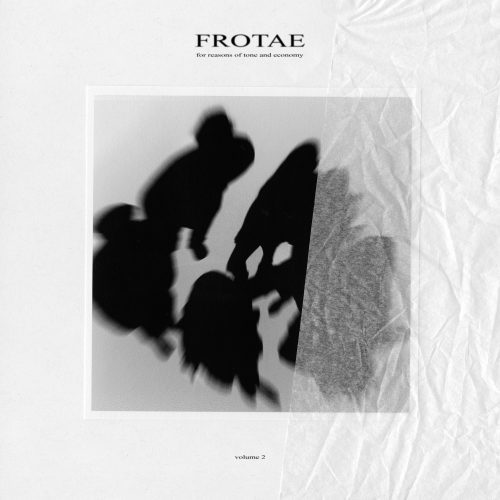
The Azrieli Commission for International Music 2026, De l’encra escafada by Adrian Mocanu, proved to be a judicious introduction. His universe of molecular noise, initially teeming with tiny particles randomly orbiting in a very delicate sound space, reveals a progressive and intellectually brilliant discourse leading to a musical fabric that gains in amplitude and depth, but with some dynamic back-and-forths. The whole concludes very satisfactorily in a radiant final fullness. The subject, the lost voice of the trobairitz (medieval female troubadours), manifests throughout the work, through the shimmering of ghostly motivic fragments, evoking, one can guess, the specters of these artists whose voices we have forgotten. The choir, more often than not, uses extended vocal techniques (whispers, glissandos), while the orchestra is constantly atomized into thousands of colors, timbres, and textures. In front, a consort of viols (Les Voix Humaines: Susie Napper, Elinor Frey, Felix Deak, and Thomas Baeté) sometimes struggled in vain to be heard. To note for a future performance: the balance between this quartet and the rest of the orchestra/choir will need to be reworked. This is all the more important because these viola da gambas represent the spirit of Beatriz de Dia, whose only song that has come down to us constituted one of the materials of the composition. Despite everything, this work appeared to my colleague Alain Brunet and me as the most skillfully accomplished of the evening.
CHECK OUT THE INTERVIEW I CONDUCTED WITH THE COMPOSER OF DE L’ENCRA ESCAFADA, ADRIAN MOCANU
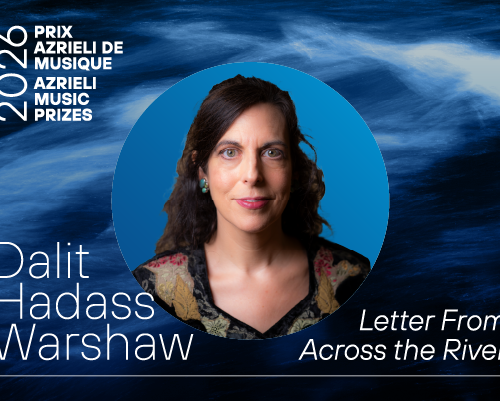
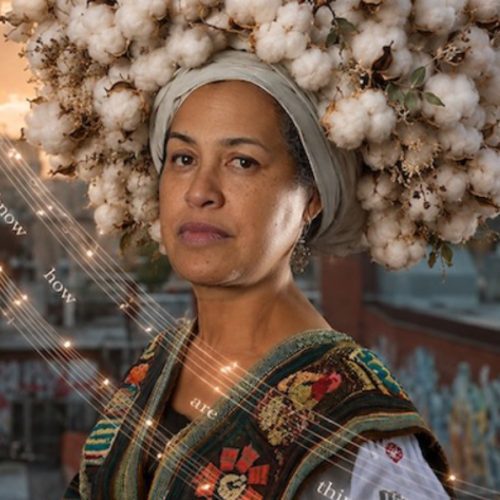
Letter From Across the River by the New Yorker Dalit Hadass Warshaw, the Azrieli Commission for Jewish Music 2026, followed with an eminently touching proposal. Warshaw tells the story of her great-grandfather, a Polish Jew who swam across a river to deliver a farewell letter to his sons, who had taken refuge in a safe territory, before returning to share the tragic fate of his wife and the rest of his family in the Death Camps. The construction of Letter is based on a linear discursive skeleton, easily understandable, largely due to the text powerfully sung by baritone Noam Heinz. Letter unfolds like a cinematic drama, or even a miniature oratorio. The action is underscored by evocative music, set against the narrated activities or suggested emotions. After an introduction slowly moving and then a torrential outpouring from the orchestra, which plunges the audience into the swirling river with the protagonist of the story, who also nearly drowns in it several times, a second and final part of the composition invites us into a moment of luminous and spiritual grace, carried by the lightened orchestra and especially the appearance of soprano Hila Baggio. While not absolutely flawless, Baggio’s performance, on a formidable score, demanding airy and luminous high notes, offered the angelic expression and sacred illumination required by the composer. Letter From Across the River is a piece that makes you very eager to hear it again.
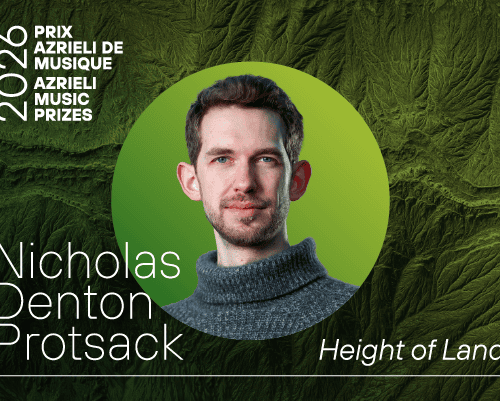
Third on the program (and first after the intermission), Height of Land by Nicholas Denton Protsack represented the Azrieli Commission for Canadian Music 2026. The Canadian Protsack, based in New Zealand, seeks to create a true reciprocity between Nature and today’s classical music. Protsack claims he wants to ensure that the sounds of nature become music, and vice versa. This has already been attempted several times, in the form of concrete music, ambient electro, or even instrumental imitation of animal sounds, the wind, etc. Protsack wants to offer something new, a innovative way of conceiving the relationship between musical sounds and the spirit of nature. He mainly claims not to offer a true answer, but rather to let people judge and continue their own research and inquiries. Does he succeed, then? Well, Height of Land appeared to me as a contemporary construction buzzing with textures that often evoke bird sounds, rustling leaves, etc. A few esthetically stimulating ideas: the presence of a secondary choir of eight singers and a cello among the audience, as well as an episode where the spectators are called to rub their hands. Nothing in all this, however, has not already been attempted (musicians among the audience, etc.), but Protsack’s performance is beautiful and the score shines with a thousand shades and effects. The general structure is a little difficult to grasp, and the ideas seem scattered, but at the same time, this is probably the principle behind the work that is being manifested: music that wishes to be in a symbiotic relationship with Nature cannot be constructed with too Cartesian a mind. In the end, Height of Land greatly pleased me, esthetically, but I feel that I will have to return to it to better grasp its ins and outs.
CHECK OUT THE INTERVIEW I CONDUCTED WITH THE COMPOSER OF HEIGHT OF LAND, NICHOLAS DENTON PROTSACK
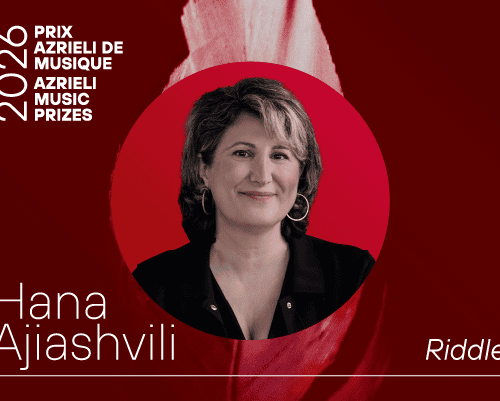
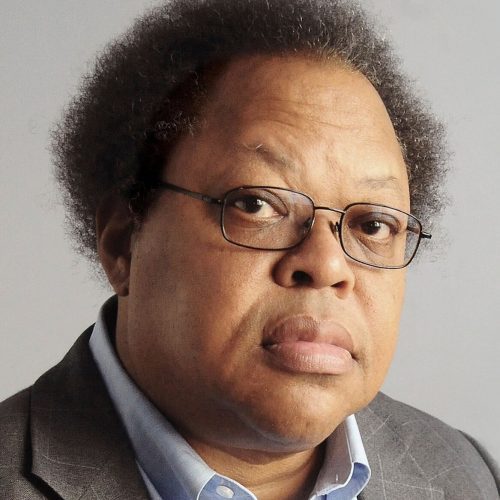
The last piece on the program, the Azrieli Prize for Jewish Music (so, an existing piece), was Riddle by Hana Ajiashvili. At the heart of the piece, a 12th-century text by Yehuda Halevi, in truth a riddle that leads to a political commentary: What is thin, empty, and smooth, but whose blood ‘flows from the mouth’? The answer is powerfully instructive: the pen that signs the execution orders. It is on this reflection, both dramatic and philosophical, that Ajiashvili composes a powerful, visceral framework, where the orchestra bursts into striking tuttis, in which the choir gradually unravels the text of the enigma in question, before ending in a fierce discharge. One comes out stunned. Positively so.
CHECK OUT THE INTERVIEW I CONDUCTED WITH THE COMPOSER OF RIDDLE, HANA AJIASHVILI
Hats off to the Orchestre symphonique de Montréal and the OSM Choir, resplendent, as well as the various soloists. At the helm, Asher Fisch seemed quite adequate, without particularly standing out. He did what he had to do correctly.
I mentioned earlier that the four pieces stem from a rather similar contemporary musical esthetic. Even if each one proves to be a significant addition to the repertoire of classical music, and they do, I would like to express the wish that, in future editions, particular care be taken to choose compositions that more broadly represent the world of new concert music. Because, indeed (and without being exhaustive, by far), what about expressionist neotonalism (in the style of Anna Thorvaldsdottir), or post-minimalism (in the style of Nico Muhly), or ecumenical post-modernism merging pop and scholarly cultures (in the style of Nicole Lizée)? In fact, schools of thought born and developed mainly in the last 25 years, that is, the 21st century.
An idea just like that, which absolutely does not detract from the achievement represented by the 2026 edition of the Azrieli Prizes.