Additional Information
The 2026 edition of the Domaine Forget International Festival is entering its final stretch with three concerts on August 16, 20, and 22. Each concert will showcase the trainee musicians of the Domaine Chamber Orchestra, the Pentaèdre ensemble, and Les Violons du Roy. This musical overview spans a wide range, from the birth of the symphony through the emergence of the classical style to the great works of French Baroque opera. It is an ambitious and stylistically diverse marathon that provides a fertile learning ground for the young trainees.
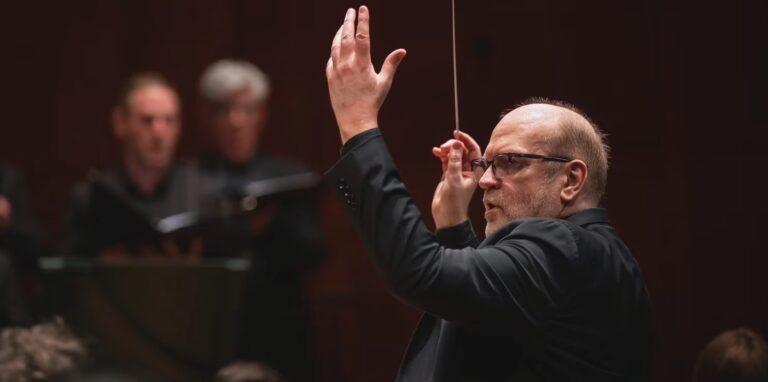
Conductor Bernard Labadie will be responsible for guiding and leading the musicians in the program on Thursday, August 20, titled “Immortal Vienna,” which pays tribute to this exceptional legacy from the cradle of the great classical tradition through three of its most iconic figures: Haydn, Mozart, and Beethoven.
Alexandre Villemaire of PAN M 360 spoke with Bernard Labadie about this program, which bridges the grace of Mozart’s opera arias and the grandeur of the early symphonies, highlighting the forms used, the legacy, and the influence these composers had on one another.
PAN M 360: This concert could practically have been called “The Lyrical Generation” or “The Classical Style”—a reference to Charles Rosen’s book—precisely because Mozart, Haydn, and Beethoven were featured in the program. What do these three composers have in common, or what is the connection between them?
Bernard Labadie : The connection between Haydn and Beethoven is very clear, since we begin with one of Haydn’s last symphonies and conclude the concert with Beethoven’s First Symphony. So, chronologically, they aren’t particularly close, nor are they in terms of compositional style. It’s clear that Beethoven learned his craft from Haydn—not only by studying with him but also by studying his works. There are many similarities in the structure of both.
Then, in Beethoven’s symphony, the opening comes as a huge surprise, since it begins in a different key. His symphony is in C major, but he begins on the dominant of F major. And that was the first time anyone had ever done that. It was like a way of heralding a new era.
For audiences of the time—and those who were somewhat familiar with the musical language—it was a real mystery. Once that initial surprise had passed, Beethoven’s First Symphony could almost be mistaken for a Haydn symphony, in the sense that the compositional techniques and orchestration are very similar. Toward the end of his life, Haydn finally began using clarinets, giving them a bit more to play, whereas Beethoven did so from the very beginning of his symphonic writing, although he used them less than the other woodwinds. This is typical of Haydn’s late works and Beethoven’s early ones.
They are clearly two branches of the same tree. The pairing of the two in this program is something else entirely, featuring two Mozart opera arias, including a magnificent scene: Fiordiligi’s aria from the second act of Così fan tutte. Certainly, in terms of form, we’re in a different world. But the foundations of the language are the same.
This dramatic aspect is one that we also find in orchestral music. Even without a story, even without words, the surprises and plot twists found in an opera are also present in orchestral music.
PAN M 360: Haydn lived a very long life and influenced many composers, such as Beethoven. What was his influence on Mozart?
Bernard Labadie : She was truly remarkable. They were even friends. Mozart paid her the greatest compliment by dedicating works to her, notably the six string quartets, which are immense masterpieces and carry on the legacy of the latter—who is truly one of the founding fathers of the string quartet and who elevated the genre to prominence. Mozart took that legacy and elevated it even further.
Haydn, for his part, was fully aware of the truly exceptional quality of Mozart’s music. There is that famous quote in which he told Leopold, Mozart’s father, that his son was the greatest living composer.
I wouldn’t call it a symbiotic relationship, but it’s clear that Mozart absorbed all aspects of Haydn’s compositional style, and, conversely, in his later symphonies, Haydn borrowed musical phrases from Mozart. In the case of Haydn and Beethoven, the relationship is more akin to that of a teacher and student. But in that relationship, Beethoven drew even more from Haydn than Mozart did. There are compositional techniques and foundational principles—not only of form but also of a very detailed musical language and approach to structure—that Beethoven learned from Haydn and that helped him grow, even blossoming in his late symphonies. His compositional style resembles Haydn’s much more closely than Mozart’s. Beethoven, like Haydn, is a master of working with short motifs, exploiting their full potential. Mozart, on the other hand, had such a highly developed sense of lyricism that the lyrical material in his orchestral works is absolutely exceptional. In both Beethoven and Haydn, an entire movement is often built around a single motif, with entire movements based on it. Of course, there are the famous four repeated notes in the Fifth Symphony, but all of Beethoven’s music is like that.
With this program, we’re really in a very tight-knit circle—a world of composers who know each other and socialize with one another, in which Haydn is the guiding figure. At the time he composed Symphony No. 99, which we’re going to perform, he was on his second trip to London, and he was a megastar.
PAN M 360: This was truly a time of stylistic change in music as we moved away from the Baroque period. A sense of drama and the element of surprise began to develop. Is this one of the characteristics we could attribute to the Classical style?
Bernard Labadie : Surprising the listener—I think every era does it in its own way. No, really, for me, what characterizes the Classical period is the establishment of major forms—in particular, the sonata form—which would become the structural model applied to almost all music, including vocal music. Because when you analyze Mozart’s great opera scenes, for example, even if they aren’t in sonata form, you can find elements of it throughout the entire repertoire.
And this dates back to Carl-Philipp Emanuel, Bach’s son, to whom we owe the first sonata form, which began in his time. When Haydn adopted it at the start of his career, it was a monothematic sonata form—that is, one based more on the contrast of keys than on the contrast of different themes. But as it developed, the number of themes increased, and even in concertos, we see the principle of the double exposition, which, in Mozart’s concertos, features a profusion of themes—to the point where it can sometimes be a bit difficult to follow the form.
This gives rise to extremely sophisticated compositions, yet they are underpinned by this form, which is very simple and based on a contrast of tones that clash and ultimately come together.
PAN M 360: In your opinion, what is the most memorable work from that era in this “immortal Vienna”?
Bernard Labadie : Oh, that’s almost impossible to say! It’s a bit like asking me which of my 250 children is my favorite! I think what we need to focus on is what each composer contributed. In Mozart’s case, it’s clear that he was the one who advanced the opera genre. After Handel, he was the one who took the genre to the next level.
And the significant leap forward he brought to opera is far greater than the one Handel made in his time. With Haydn, it was his mastery of instrumental forms that would become standards throughout the Classical period—and indeed the Romantic period as well. The string quartet, the string trio, the piano trio, and the symphony, of course. He is often called the father of the symphony, but he is the father of many things. And the fact that he lived a very long life allowed him to cultivate these genres consistently. The result is a very rich body of work that reflects the evolution of his style and becomes extremely varied and whimsical toward the end of his life.
Haydn’s musical forms toward the end of his career—they’re all, in one way or another, turned upside down. There’s always a surprise—things that aren’t where they’re supposed to be, that aren’t done the way you’d expect. He plays with the patterns he himself created. In the end, he takes his own models and turns them upside down—literally. And for me, when I work on this music, that’s always a great source of joy. It’s like a child playing with a giant set of Legos!
PAN M 360: Haydn had a great sense of humor, too, didn’t he?
Bernard Labadie : Yes, that’s clear! And he really emphasizes that in his music. However, he isn’t a great melodist, like Mozart, for example. His appeal and strength lie elsewhere. As for Beethoven, he’s the one who will break away from these forms and lead them toward the Romantic style. Each of these three composers makes an exceptional contribution to this repertoire.
To that we could also add the young Schubert. Because he, too, was influenced by—and drew inspiration from—the same sources and learned from the same masters. For example, his last symphony, the “Great” Symphony, is a monumental work. He truly follows the model of the Haydn symphony, but stretches it out over a much longer duration. It is one of the longest works in the repertoire of that era.
He really felt drawn to those forms as well. Obviously, as far as I’m concerned, he’s more romantic than classical. But in his instrumental music, he’s still heavily influenced by classical composers.
PAN M 360: You’ll have a rather limited amount of rehearsal time with the Academy orchestra. What will you focus on during these rehearsals, and what do you hope the trainees will learn from this repertoire—in terms of interpretation, style, and how to play it?
Bernard Labadie : It’s a little hard for me to make any grand statements, since this is the first time I’ve been there myself since 1986! I can’t wait!
The program is very ambitious, and we’ll certainly be pressed for rehearsal time. But the approach is different from that of a professional orchestra. Even though we expect the trainees to meet the same standards and requirements, the journey is more important here than the destination. For young musicians like these, our goal is above all to help them journey with us for a while, to see how we work, how we approach these works, and how to create—especially on modern instruments—a style that’s closer to what can be achieved on period instruments. There aren’t many modern orchestras that do this. It has truly been the hallmark of Les Violons du Roy from the very beginning. We hope to inspire these young musicians to delve deeper into this repertoire, to explore it in new ways, and to seek out and discover its incredible riches.
Haydn’s Symphony No. 99—I’m sure many of these young musicians will be playing it for the first time. Even for Les Violons du Roy, I think it will be a first. It’s not a piece we perform often in our repertoire. So, to discover pieces like this at that age—I envy them, and I’m even a little jealous. I really like these young musicians we’ll be working with. You have to look at the workshop as a whole. This is just one of three components. Over the course of two weeks, these musicians will be completely immersed—if I may say so—in new musical experiences.
We’re going to work hard, but it has to be fun. It’s still a short camp, and we can’t cover everything in that time. The idea is to give them as many tools as possible to add to their toolkit and take home with them afterward. We’ll put on a performance that showcases the work we’ve done. And ultimately, it’s not that concert that matters. What matters is what these young musicians will take home with them. They might not absorb everything, but it’ll be up to them to make sense of it all. I think they’ll leave here with a suitcase full of ideas—and, I hope, projects.
Academy Chamber Orchestra
Les Violons du Roy
Pentaèdre
Bernard Labadie, conductor
PROGRAM
HAYDN
Symphony No. 99 in E-flat major, Hob.I:99
MOZART
The Marriage of Figaro: “Porgi amor”
Così fan tutte : « Ei parte… Per pietà »
BEETHOVEN
Symphony No. 1 in C major, Op. 21